
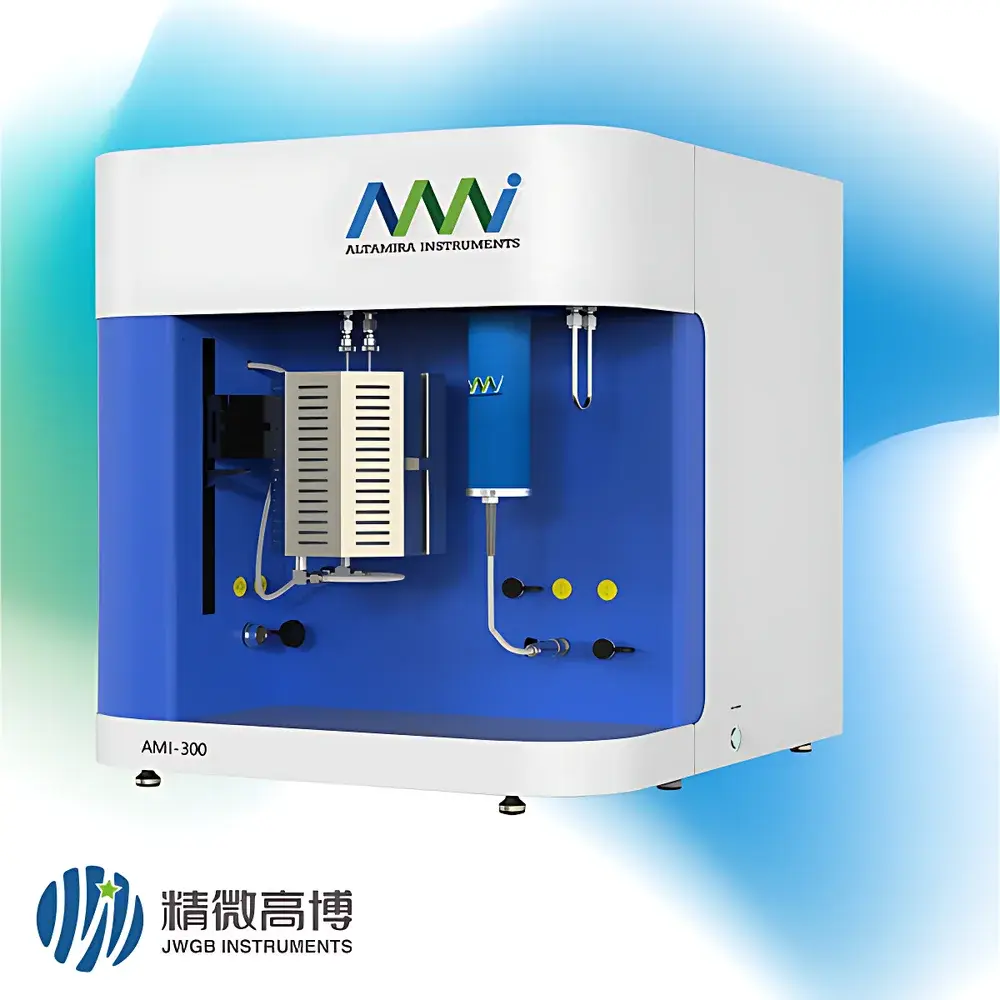
Altamira AMI-300HP High-Pressure Chemisorption Analyzer (100 bar)
| Brand | Altamira Instruments (USA) |
|---|---|
| Origin | USA |
| Manufacturer Type | Authorized Distributor |
| Product Category | Imported Instrument |
| Model | AMI-300HP High-Pressure Chemisorption Analyzer (100 bar) |
| Instrument Type | Chemisorption Analyzer |
| Measurement Principle | Continuous Flow Method |
| Gas Inlet Ports | Expandable up to 12 |
| Heating Temperature Range | Ambient to 1200 °C |
| Isothermal Stability | ±0.01 °C |
| Ramp Rate | 1–50 °C/min |
| Pressure Range | Atmospheric to 30 bar / 100 bar (dual-range configuration) |
| Analytical Modes | TPR, TPO, TPD, TPS, Pulse Chemisorption, Pulse Calibration |
Overview
The Altamira AMI-300HP High-Pressure Chemisorption Analyzer is an engineered platform for quantitative surface chemical characterization of heterogeneous catalysts and functional materials under rigorously controlled thermal and pressure conditions. Based on the continuous flow measurement principle, it enables dynamic monitoring of gas–solid interactions—including adsorption, desorption, reduction, oxidation, and surface reaction kinetics—across programmable temperature ramps and elevated pressures up to 100 bar. This capability bridges a critical gap between conventional ambient-pressure chemisorption systems and high-pressure catalytic evaluation environments representative of industrial reactors. The instrument integrates a precision furnace with ultra-stable temperature control (±0.01 °C isothermal stability), a modular gas delivery manifold supporting up to 12 independently regulated inlet streams, and a high-sensitivity thermal conductivity detector (TCD) optimized for low-concentration transient signal resolution. Designed for reproducible, traceable surface science investigations, the AMI-300HP serves as a core analytical tool in catalyst development workflows where quantification of active site density, binding energy distribution, redox behavior, and surface stability under process-relevant conditions is essential.
Key Features
- High-pressure operation up to 100 bar, enabling realistic simulation of industrial catalytic environments such as hydroprocessing, Fischer–Tropsch synthesis, and high-pressure hydrogenation.
- Wide thermal operating range from ambient to 1200 °C, with programmable ramp rates from 1 to 50 °C/min and exceptional isothermal stability (±0.01 °C), ensuring high-fidelity temperature-resolved analysis.
- Modular gas manifold architecture supporting up to 12 configurable inlet ports—facilitating complex multi-gas sequences, inert purging, reactive pulse injection, and carrier gas blending without hardware modification.
- Integrated TPR/TPO/TPD/TPS functionality with automated sequence scripting, allowing standardized execution of temperature-programmed reduction, oxidation, desorption, and sulfidation profiles per ASTM D7214, ISO 18316, and IUPAC-recommended protocols.
- Dual-range pressure system: calibrated low-range (0–30 bar) for high-resolution kinetic studies and high-range (up to 100 bar) for equilibrium and thermodynamic assessments—both traceable to NIST-certified pressure transducers.
- Robust mechanical design compliant with ASME B31.3 process piping standards for high-pressure gas handling; includes redundant safety interlocks, burst disc protection, and real-time pressure/temperature fault monitoring.
Sample Compatibility & Compliance
The AMI-300HP accommodates powdered, pelletized, or monolithic catalyst samples (typically 0.1–1.0 g) within standard quartz or ceramic microreactors. It supports corrosive gases (e.g., H₂S, NH₃, Cl₂), reducing atmospheres (H₂, CO), oxidizing mixtures (O₂/He, NO/O₂), and inert carriers (Ar, He, N₂). All wetted components are constructed from electropolished 316 stainless steel or high-purity quartz to minimize catalytic memory effects and surface contamination. The system meets key regulatory expectations for analytical instrumentation used in GMP-compliant R&D environments: full audit trail logging (per FDA 21 CFR Part 11 requirements), electronic signature support, and calibration traceability to national metrology institutes. It is routinely deployed in laboratories adhering to ISO/IEC 17025 quality management systems and supports documentation packages required for GLP audits in catalyst qualification studies.
Software & Data Management
Control and data acquisition are managed via Altamira’s proprietary ChemiSoft™ v5.2 software suite—designed for technical users in catalysis research. The interface provides real-time visualization of TCD signals, pressure transients, and thermocouple feedback across all analytical modes. Users define multi-step methods—including pre-treatment, conditioning, pulse injection, ramp segments, and hold periods—with parameter constraints enforced by built-in safety logic. Raw data are stored in HDF5 format with embedded metadata (instrument ID, operator, timestamp, calibration IDs, gas lot numbers). Batch processing tools enable automated peak integration, baseline correction, and stoichiometric quantification of consumed/reacted gas volumes. Export options include CSV, ASCII, and direct import into MATLAB, Python (via Pandas), or OriginLab for advanced kinetic modeling (e.g., Langmuir–Hinshelwood fitting, Arrhenius analysis). Software validation documentation (IQ/OQ/PQ protocols) is available upon request.
Applications
- Quantification of metal dispersion, active surface area, and turnover frequency (TOF) in supported transition metal catalysts (e.g., Pt/Al₂O₃, Ni/MgAl₂O₄, Co/Fe-based FT catalysts).
- Evaluation of sulfur tolerance and regeneration behavior of automotive three-way catalysts (TWCs) and diesel oxidation catalysts (DOCs) via sequential TPO–TPR cycles under simulated exhaust gas compositions.
- Thermodynamic and kinetic profiling of CO₂ hydrogenation catalysts (e.g., Cu/ZnO/Al₂O₃) under industrially relevant pressures (30–100 bar), correlating surface hydride formation with methanol selectivity.
- Acid site strength distribution mapping in zeolites and mixed oxides using NH₃-TPD, with deconvolution of weak/medium/strong Brønsted and Lewis sites.
- Stability assessment of single-atom catalysts (SACs) under cyclic redox conditions, tracking sintering onset via irreversible TPR peak broadening and signal attenuation.
- Supporting DOE, EU Horizon, and industry-funded projects targeting low-carbon fuel synthesis, carbon capture utilization (CCU), and green ammonia production catalysts.
FAQ
What pressure ranges does the AMI-300HP support, and how are they implemented?
The system features dual calibrated pressure modules: a high-sensitivity 0–30 bar sensor for kinetic measurements and a robust 0–100 bar transducer for equilibrium studies. Switching between ranges is software-controlled and automatically adjusts valve sequencing and flow compensation algorithms.
Can the instrument perform simultaneous multi-gas pulses during TPD or TPR?
Yes—the 12-port gas manifold allows independent timing and concentration control of up to four reactive gases per analytical step, enabling co-pulse experiments (e.g., H₂ + CO during syngas TPR) with sub-second temporal resolution.
Is the furnace compatible with corrosive gas environments at high temperature?
The reactor zone uses high-purity alumina insulation and quartz-lined stainless-steel tubing; optional Hastelloy C-276 reactor tubes are available for extended service life with halogenated or sulfur-rich feeds above 800 °C.
How is calibration traceability maintained across pressure, temperature, and flow domains?
Each unit ships with NIST-traceable calibration certificates for pressure transducers, Pt100 RTD sensors, and mass flow controllers (MFCs); annual recalibration services include on-site verification against certified reference standards.
Does the system support remote operation and cybersecurity protocols for networked lab environments?
ChemiSoft™ supports secure TLS 1.2 encrypted remote desktop access, role-based user permissions, and integration with enterprise Active Directory; all network interfaces comply with IEC 62443-3-3 security level SL2 requirements.
Related Products



