
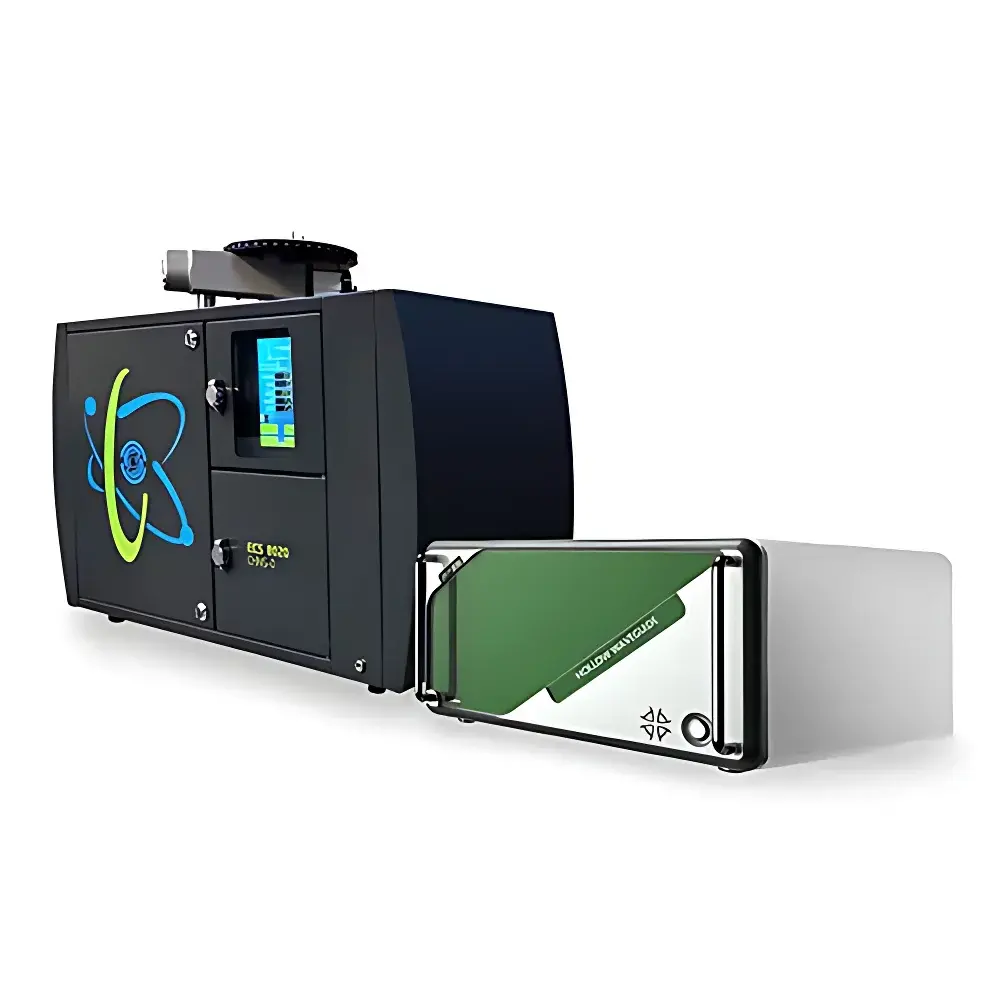
AMBA EA-I3211 Carbon Isotope Ratio Analyzer
| Origin | Netherlands |
|---|---|
| Manufacturer Type | Authorized Distributor |
| Origin Category | Imported |
| Model | EA-I3211 |
| Pricing | Upon Request |
Overview
The AMBA EA-I3211 Carbon Isotope Ratio Analyzer is a fully integrated, dual-module stable isotope analysis system engineered for high-precision δ13C measurement in solid and gaseous carbon-bearing samples. It combines Dumas combustion — a standardized, high-efficiency flash combustion technique for quantitative elemental conversion — with mid-infrared (MIR) hollow-waveguide absorption spectroscopy for CO2 isotopic ratio detection. Unlike traditional isotope ratio mass spectrometry (IRMS), which requires ultra-high vacuum, cryogenic cooling, and complex ion optics, the EA-I3211 leverages robust optical path design and temperature-stabilized waveguide cells to deliver laboratory-grade isotopic accuracy without vacuum pumps or specialized power conditioning. Its sub-0.1 mL optical measurement cell enables exceptional sensitivity for trace carbon samples (as low as 0.2 mg C), while maintaining linear response across three orders of magnitude — from microgram-scale paleosol organics to gram-level biomass or polymer standards.
Key Features
- Dual-mode operational architecture: Element analyzer front-end (EA) and CO2 isotope analyzer (IR) can operate independently or be coupled via gas-tight interface for end-to-end solid-sample δ13C analysis.
- Mid-infrared hollow-waveguide spectroscopy: Enables rapid, drift-resistant δ13C quantification at 4 Hz acquisition rate with <0.3‰ (1σ) long-term precision over 60 s integration.
- Modular Dumas combustion unit: Delivers complete oxidation of C, N, H, S, and O in organic and inorganic matrices; certified per ASTM D5373, ISO 16968, and EN 15407.
- No high-vacuum infrastructure required: Eliminates dependency on diffusion pumps, liquid nitrogen, or RF ion sources — reducing footprint, maintenance overhead, and total cost of ownership by 2–3× vs. IRMS systems.
- 50-position autosampler (expandable to 147 positions): Supports unattended batch processing of up to 288 samples per 24-hour cycle under GLP-compliant sequence control.
- Low-power operation: Full-system peak draw <1450 W (100–240 VAC); steady-state consumption ~1300 W — compatible with standard laboratory circuits without dedicated phase balancing.
Sample Compatibility & Compliance
The EA-I3211 accommodates diverse sample types including soils, sediments, plant tissues, microbial biomass, food matrices, petroleum fractions, synthetic polymers, and single-compound isolates (e.g., amino acid derivatives). Its wide dynamic range (0.2–1 mg C per analysis) and low detection limit support applications in paleoclimatology, biogeochemical cycling studies, authenticity verification (e.g., honey, wine, olive oil), and metabolic flux analysis. The system complies with ISO/IEC 17025 requirements for testing laboratories and supports audit-ready data integrity through configurable electronic signatures, user access levels, and full audit trail logging — meeting FDA 21 CFR Part 11 and EU Annex 11 expectations for regulated environments.
Software & Data Management
Control and data reduction are performed via AMBA’s proprietary IsoSoft™ v4.x platform, featuring real-time spectral visualization, automated baseline correction, multi-point calibration routines (including reference gas bracketing), and customizable report generation. All raw spectra, intermediate calculations (e.g., peak area integration, line shape fitting), and final δ13C values are stored in vendor-neutral HDF5 format with embedded metadata (sample ID, operator, timestamp, instrument configuration). Export options include CSV, Excel, and LIMS-compatible XML schemas. Software validation documentation (IQ/OQ/PQ protocols) and 21 CFR Part 11 compliance packages are available upon request.
Applications
- Soil science & paleoecology: δ13C profiling of soil organic matter decomposition pathways and C3/C4 vegetation reconstruction.
- Marine biogeochemistry: Isotopic tracing of dissolved organic carbon (DOC) sources and diagenetic alteration in sediment cores.
- Food authenticity & traceability: Detection of sugar adulteration, origin verification of dairy and meat products, and botanical origin assignment in botanical extracts.
- Proteomics & metabolomics: Position-specific 13C labeling studies using isotopically enriched precursors.
- Petroleum geochemistry: Source rock characterization and thermal maturity assessment via kerogen δ13C trends.
- Materials science: Carbon isotopic fingerprinting of synthetic polymers, carbon nanomaterials, and battery anode materials.
FAQ
What sample types are compatible with the EA-I3211?
Solid organic and inorganic samples (powders, pellets, filters, tissues) and pre-purified CO2 gas streams. Liquid samples require prior conversion to solid residue or trapping as CO2.
Does the system require external calibration gases?
Yes — primary calibration uses certified CO2 reference gases (e.g., NBS-19, IAEA-603) traceable to VPDB; secondary standards may be prepared in-house following ISO 14284 guidelines.
Can the EA and IR modules be used separately?
Yes — the EA module functions as a standalone CHNS/O elemental analyzer; the IR module accepts external CO2 injections for gas-phase δ13C analysis.
Is method validation support available?
AMBA provides application notes, SOP templates, and method transfer assistance aligned with ISO 17025 and USP <1225> validation parameters (specificity, linearity, accuracy, precision, LOD/LOQ).
What maintenance intervals are recommended?
Combustion tube replacement every 1,500–2,000 analyses; waveguide cell inspection annually; carrier gas filters replaced quarterly; full system performance verification semiannually.






