
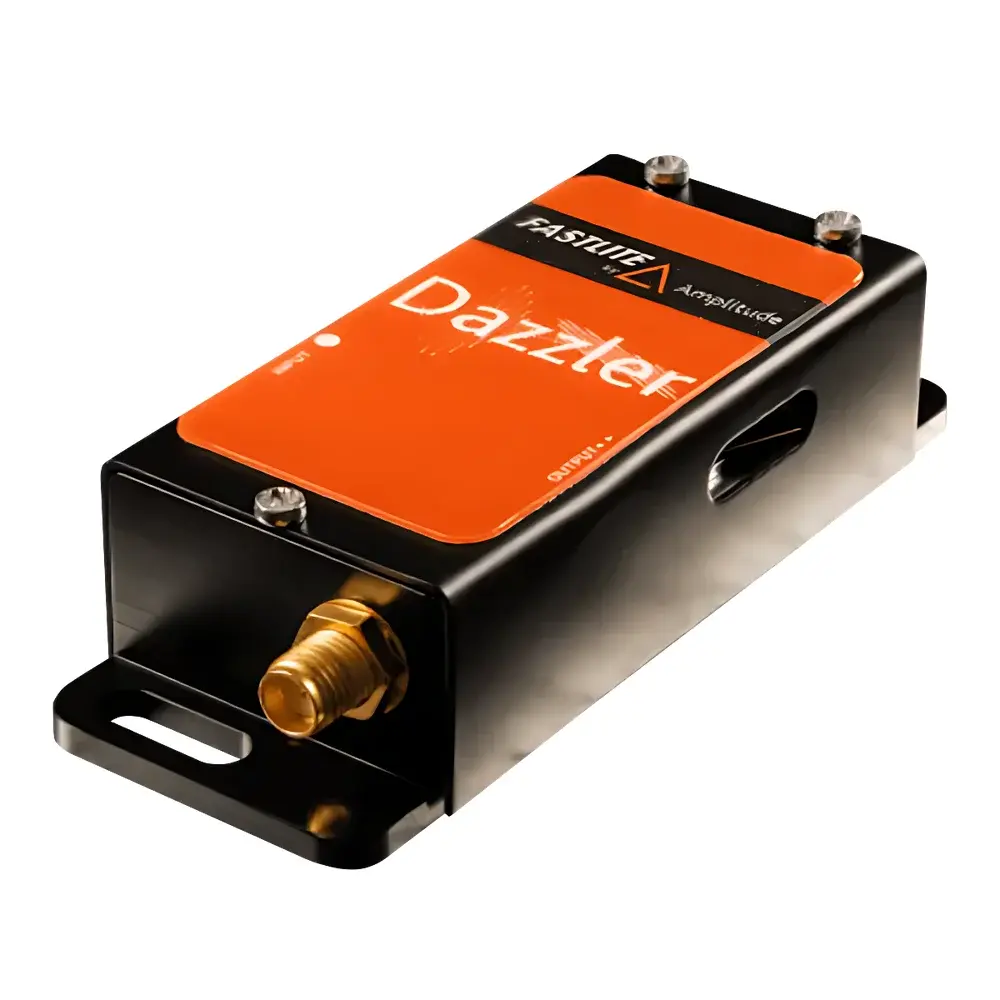
Amplitude Dazzler Ultrafast Laser Pulse Shaper
| Brand | Amplitude |
|---|---|
| Origin | France |
| Model | Dazzler Ultrafast Laser Pulse Shaper |
| Spectral Range | UV to SWIR |
| Core Technology | Acousto-Optic Programmable Dispersive Filter (AOPDF) |
| Integration | Fully Integrated, Turnkey System |
| Repetition Rate Compatibility | Up to 30 kHz |
| Control | Independent, Simultaneous Spectral Phase & Amplitude Modulation |
| Form Factor | Ultra-Compact Benchtop Unit |
| Compliance | Designed for GLP/GMP-adjacent research environments |
Overview
The Amplitude Dazzler Ultrafast Laser Pulse Shaper is a turnkey, fully integrated pulse shaping platform engineered for precision temporal and spectral control of ultrashort laser pulses. Based on the acousto-optic programmable dispersive filter (AOPDF) principle, the Dazzler manipulates broadband femtosecond pulses by exploiting the interaction between polychromatic acoustic waves and orthogonally polarized optical fields within a birefringent crystal. This enables real-time, computer-controlled modulation of both spectral phase and amplitude—without moving parts or mechanical delay lines—across bandwidths spanning hundreds of terahertz (THz). Unlike grating-based or liquid-crystal spatial light modulator (SLM) approaches, the AOPDF architecture delivers intrinsic dispersion compensation, zero group-delay dispersion (GDD) drift, and sub-femtosecond timing stability. The system operates across a continuous spectral range from ultraviolet (UV) to short-wave infrared (SWIR), with model-specific optimization ensuring optimal diffraction efficiency, throughput, and phase fidelity in each band. Its ultra-compact footprint and pre-aligned optical path make it suitable for integration into CPA, OPCPA, NOPA, and CEP-stabilized amplifier chains—particularly where space-constrained, high-repetition-rate (≤30 kHz), and low-jitter performance are critical.
Key Features
- Fully integrated turnkey design: Includes collimated input/output ports, internal alignment optics, RF driver electronics, and thermal management—no external alignment or calibration required.
- Simultaneous and independent control of spectral phase and amplitude: Enables arbitrary pulse synthesis, including transform-limited, chirped, multi-pulse, and phase-locked pulse trains.
- Acousto-optic programmable dispersive filter (AOPDF) core: Utilizes longitudinal acoustic wave propagation in a birefringent crystal to achieve sub-10 fs temporal resolution and <100 as phase step resolution.
- UV–SWIR spectral coverage: Multiple model variants optimized for 250–450 nm (UV), 450–900 nm (VIS–NIR), 900–1700 nm (NIR–SWIR), and extended configurations up to 2500 nm.
- High repetition rate compatibility: Stable operation at pulse repetition frequencies up to 30 kHz, supporting both oscillator-level and amplifier-level integration points.
- No-moving-parts architecture: Eliminates mechanical hysteresis, vibration sensitivity, and long-term drift associated with motorized gratings or SLMs.
- Burnout-protection logic: Embedded firmware monitors instantaneous spectral power density and enforces safe RF drive limits to prevent crystal damage during high-peak-power operation.
Sample Compatibility & Compliance
The Dazzler accepts free-space, collimated Gaussian beams with typical input diameters of 4–8 mm and M² < 1.3. It is compatible with Ti:sapphire oscillators, Yb-based amplifiers, optical parametric amplifiers (OPAs), and non-collinear OPAs (NOPAs). Input polarization must be linear and aligned to the crystal’s extraordinary axis; optional half-wave plates enable polarization conditioning. The system complies with IEC 61000-6-3 (EMC emission) and IEC 61000-6-2 (immunity) standards. While not a medical device or GMP-certified instrument per se, its deterministic, repeatable pulse shaping behavior—combined with audit-trail-capable software interfaces—supports traceable experimental protocols under GLP frameworks. When deployed with validated third-party acquisition software (e.g., LabVIEW-based controllers with 21 CFR Part 11 add-ons), full electronic record integrity—including parameter history, user login logs, and waveform versioning—is achievable.
Software & Data Management
Control is executed via Amplitude’s proprietary Dazzler Control Software (DCS), a Windows-based application providing intuitive graphical interfaces for spectral mask definition, phase function scripting (via polynomial, spline, or custom Python API), and real-time feedback loops. DCS supports hardware-triggered sequencing at up to 500 Hz for rapid scanning of >100,000 preloaded pulse shapes—essential for 2D spectroscopy and closed-loop coherent control experiments. The software exports ASCII-based pulse characterization files (.dat, .csv) containing full spectral amplitude/phase vectors and metadata (timestamp, user ID, RF settings). Remote operation is implemented via TCP/IP client-server architecture, enabling integration into centralized lab automation systems. All parameter changes are logged with ISO 8601 timestamps and user identifiers, satisfying basic ALCOA+ (Attributable, Legible, Contemporaneous, Original, Accurate, Complete, Consistent, Enduring, Available) data integrity requirements for academic and industrial R&D documentation.
Applications
- Chirped Pulse Amplification (CPA) optimization: Pre-compensation of gain narrowing and high-order dispersion in Ti:sapphire or Yb-doped amplifier chains, enabling sub-25 fs pulses at multi-mJ energy levels.
- Two-dimensional electronic spectroscopy (2DES): Generation of phase-stable, variable-delay pulse pairs with constant throughput and <100 as relative timing jitter—critical for isolating quantum coherences in photosynthetic complexes and semiconductor nanostructures.
- Carrier-envelope phase (CEP) stabilization: Integration with Fringeezz interferometers to close high-bandwidth CEP feedback loops at ≤30 kHz repetition rates; supports single-shot, dispersion-free CEP actuation.
- Optical parametric chirped-pulse amplification (OPCPA) compression: Dynamic correction of pump–seed timing drift and spectral phase errors across octave-spanning idler bands, improving compression fidelity and shot-to-shot stability.
- Coherent quantum control: Closed-loop optimization of photochemical reaction yields, selective bond cleavage, or enhanced two-photon fluorescence using evolutionary algorithms interfaced via DCS Python API.
- Multiphoton microscopy: Adaptive pulse shaping for depth-resolved contrast enhancement, reduced photodamage, and improved signal-to-background ratio in live-tissue imaging.
FAQ
What laser sources are compatible with the Dazzler?
The Dazzler supports mode-locked oscillators (e.g., Ti:sapphire, Yb-fiber) and amplified systems (regenerative, multipass, or cryo-cooled) delivering pulses from 10 fs to 500 fs, with average powers up to 5 W and peak powers ≤10 GW. Custom configurations accommodate higher energies upon request.
Does the Dazzler require periodic recalibration?
No. The AOPDF architecture is inherently stable—no optical realignment or wavelength-dependent calibration is needed. Factory characterization data is embedded in firmware and remains valid over the product lifetime under normal operating conditions.
Can the Dazzler be used in vacuum or UHV environments?
Standard units are benchtop air-cooled systems. Vacuum-compatible versions with conductively cooled crystals and feedthrough-integrated RF connectors are available as OEM options.
Is third-party software integration supported?
Yes. DCS provides a documented COM interface and Python SDK, enabling bidirectional communication with MATLAB, Python (NumPy/SciPy), LabVIEW, and EPICS-based control systems.
How is dispersion measured and verified post-installation?
Amplitude supplies a reference interferometric autocorrelator (e.g., Wizzler) and spectral phase retrieval software (e.g., DazScope) as optional accessories. These tools allow users to directly measure residual GDD, TOD, and pulse duration after Dazzler insertion.
Related Products





