
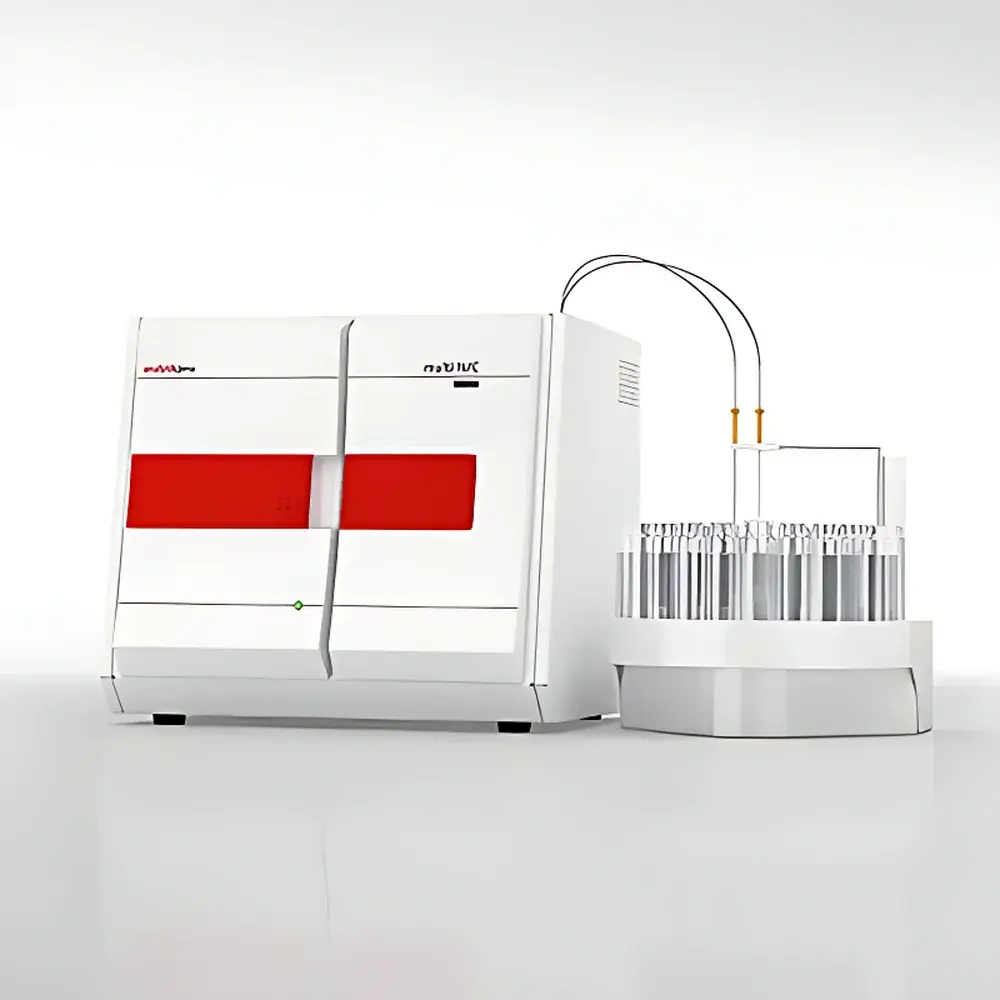
analytik jena multi N/C Pharma HT Pharmaceutical-Grade Dry-Method Total Organic Carbon and Total Nitrogen Analyzer
| Brand | analytik jena |
|---|---|
| Origin | Germany |
| Manufacturer | analytik jena GmbH |
| Country of Origin | Imported |
| Model | multi N/C Pharma HT |
| Instrument Type | Laboratory TOC/TN Analyzer |
| Detection Principle | Non-Dispersive Infrared Absorption (NDIR) for TOC |
| Oxidation Method | High-Temperature Catalytic Combustion at up to 1000 °C |
| Measurement Range | 0–10,000 ppm C or N |
| Accuracy | <3% RSD |
| Detection Limit | 4 ppb C |
| Resolution | 0.001 ppb C |
| Repeatability | ±3% RSD |
| Compliance | Designed for GLP/GMP environments |
Overview
The analytik jena multi N/C Pharma HT is a high-performance, dry-method laboratory analyzer engineered specifically for pharmaceutical water quality control and regulatory compliance testing. It simultaneously quantifies Total Organic Carbon (TOC), Total Nitrogen (TNb), Total Carbon (TC), Inorganic Carbon (TIC), Purgeable Organic Carbon (POC), and Non-Purgeable Organic Carbon (NPOC) in purified water, Water for Injection (WFI), Pure Steam condensate, and other ultra-pure aqueous matrices. Its core measurement architecture relies on high-temperature catalytic combustion oxidation (up to 1000 °C) followed by dual-path detection: Non-Dispersive Infrared (NDIR) for CO2 quantification (TOC/TC/TIC) and Chemiluminescence Detection (CLD) or Conductometric Detection (ChD) for NOx (TNb). This orthogonal detection strategy ensures trace-level sensitivity, matrix robustness, and metrological traceability—critical for meeting pharmacopoeial requirements including USP <643>, EP 2.2.44, JP 2.59, and FDA guidance on water system validation.
Key Features
- Patented VITA (Variable Integration Time Algorithm) flow control and signal processing technology, enabling dynamic response optimization across the full 0–10,000 ppm measurement range without manual dilution or range switching
- Easy Cal calibration protocol: single-point calibration using certified potassium hydrogen phthalate (KHP) or ammonium sulfate standard yields stable, long-term calibration validity—reducing operator dependency and method variability
- Integrated SCS (Safety Control System): real-time monitoring of furnace temperature, gas pressure, catalyst status, and combustion efficiency; automatic shutdown upon anomaly detection to protect personnel and hardware
- Self-cleaning combustion tube and catalyst bed: automated post-run thermal regeneration minimizes carryover and extends service intervals beyond 10,000 analyses under routine GMP operation
- Modular architecture with configurable autosampler integration (e.g., AS-3700), acidification module for TIC removal, and optional halogen scrubber for chlorine-rich samples
- Robust high-temperature furnace with platinum-coated ceramic catalyst: delivers complete oxidation of recalcitrant compounds (e.g., pyrogens, humic acids, amino acids) while maintaining catalytic activity over >2 years of continuous use
Sample Compatibility & Compliance
The multi N/C Pharma HT is validated for direct analysis of low-conductivity, low-particulate aqueous samples—including USP WFI, EP Purified Water, and clean steam condensate—without filtration or pretreatment. Its dry combustion design eliminates reagent consumption, cross-contamination risk from wet chemistry, and baseline drift associated with persulfate-based oxidation. The system meets ISO/IEC 17025:2017 method validation requirements and supports full audit trails, electronic signatures, and user-access controls aligned with FDA 21 CFR Part 11 and EU Annex 11. All firmware and software updates are version-controlled and documented per ICH Q5A and Q5C stability guidelines.
Software & Data Management
Controlled via the proprietary multiWin 5.0 software platform, the instrument provides integrated method development, sequence scheduling, real-time chromatogram visualization, and automated report generation compliant with ALCOA+ principles (Attributable, Legible, Contemporaneous, Original, Accurate + Complete, Consistent, Enduring, Available). Raw data files are stored in encrypted .mwd format with immutable metadata (operator ID, timestamp, instrument state, calibration history). Export options include CSV, PDF, and XML for LIMS integration (e.g., LabWare, STARLIMS, Thermo SampleManager). Audit trail review functions allow chronological reconstruction of all critical events—including parameter changes, calibration actions, and result overrides—with time-stamped user attribution.
Applications
- Pharmaceutical water system qualification (IQ/OQ/PQ) and routine release testing per USP <1231>
- Biopharmaceutical process water monitoring during cell culture media preparation and buffer formulation
- Validation of depyrogenation tunnels and autoclave steam quality via condensate TOC/TN analysis
- Investigation of organic leachables from single-use systems (SUS) and tubing materials
- Environmental monitoring of cleanroom HVAC condensate and humidification water
- Supporting root cause analysis for out-of-specification (OOS) water test results in GMP investigations
FAQ
Does the multi N/C Pharma HT require daily calibration?
No—its Easy Cal protocol enables calibration verification every 24 hours using a single 500 ppb KHP standard; full recalibration is recommended only after maintenance or if system suitability fails.
Can it measure TOC and TN simultaneously in one injection?
Yes—the dual-detector configuration (NDIR + CLD/ChD) and synchronized combustion event allow concurrent quantification of carbon and nitrogen species from a single 100 µL sample aliquot.
Is the instrument compatible with USP <643> system suitability criteria?
Yes—it routinely achieves <2% RSD for replicate injections of 500 ppb sucrose and meets the 30% recovery requirement for 500 ppb 1,4-benzoquinone challenge tests.
What maintenance is required for GMP operation?
Monthly catalyst activity check, quarterly furnace thermocouple verification, and annual full optical path alignment—documented via built-in maintenance scheduler and printable service logs.
How does it handle high-salinity samples like seawater or brine?
Not recommended for direct analysis; saline matrices require pre-dilution or offline desalting due to potential chloride-induced detector saturation and catalyst deactivation.
Related Products







