
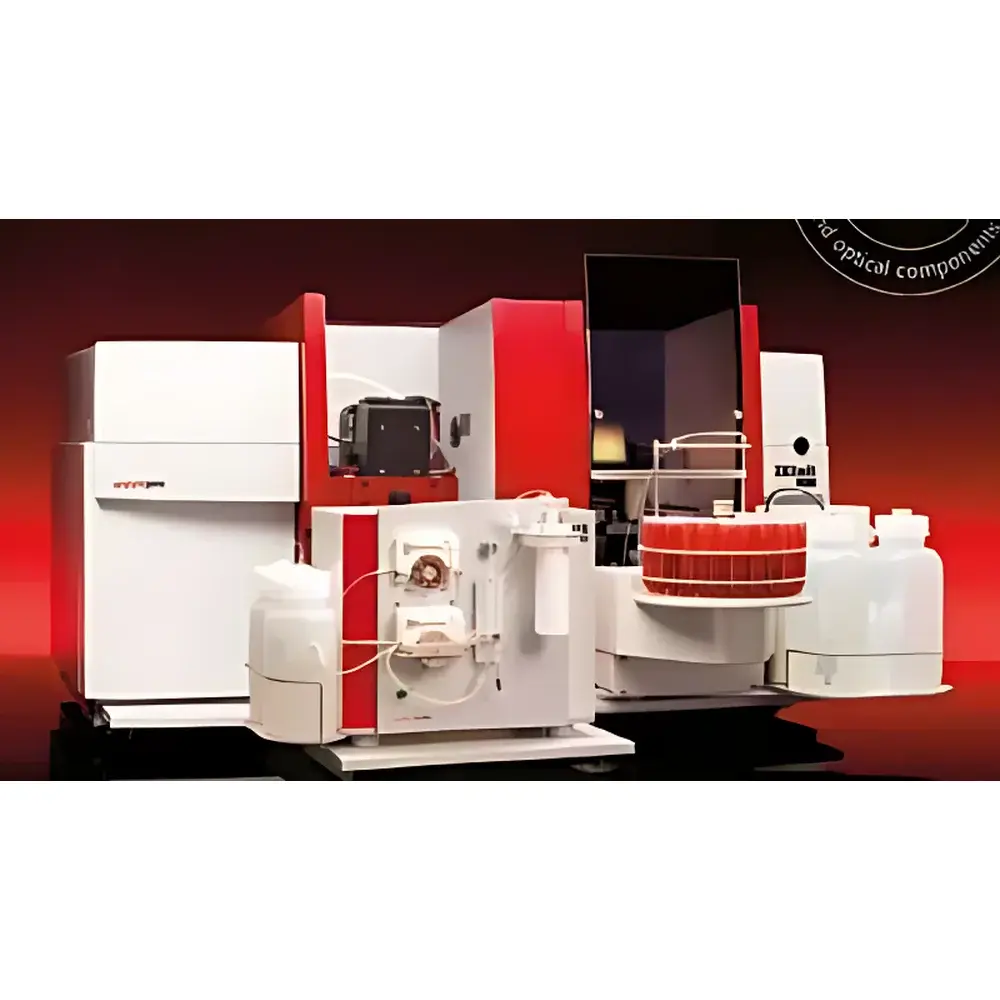
Analytik Jena ZEEnit 700P Flame and Graphite Furnace Atomic Absorption Spectrometer
| Brand | Analytik Jena |
|---|---|
| Origin | Germany |
| Manufacturer | Analytik Jena GmbH & Co. KG |
| Instrument Type | Flame–Graphite Furnace AAS |
| Monochromator | Concave Grating |
| Optical System | Dual-Beam |
| Detector | Photomultiplier Tube (PMT) |
| Background Correction | Deuterium Lamp + Triple-Field Zeeman |
| Grating Density | 1800 lines/mm |
| Lamp Holder | Automated 8-Lamp Turret with Auto-Alignment |
| Magnetic Field Range | 0.1–1.0 T (Switchable Between 2-Field and 3-Field Zeeman Modes) |
| Graphite Furnace | Transversely Heated, Temperature Range: Room Temp to 3000 °C, Max. Ramp Rate: 3000 °C/s |
| Autosampler Capacity | Up to 108 Positions |
| Dimensions | 1200 × 480 × 600 mm |
Overview
The Analytik Jena ZEEnit 700P is a high-performance, integrated flame and graphite furnace atomic absorption spectrometer engineered for trace elemental analysis across diverse sample matrices. Based on the fundamental principle of atomic absorption spectroscopy—where ground-state atoms in the gaseous phase absorb characteristic radiation emitted by element-specific hollow cathode lamps—the ZEEnit 700P delivers exceptional sensitivity, selectivity, and analytical robustness. Its dual-atomization architecture eliminates mechanical switching between flame and graphite furnace modes, enabling seamless transition between rapid liquid-phase flame analysis (ppm–ppb range) and ultra-trace solid/liquid analysis via electrothermal atomization (sub-pg absolute detection). Designed and manufactured in Jena, Germany—the historic center of precision optics—the instrument incorporates legacy Zeiss optical engineering, including a high-throughput Czerny–Turner monochromator with 1800-line/mm concave grating and automated wavelength selection.
Key Features
- Integrated Flame–Graphite Furnace Platform: Single-instrument architecture with no manual or motorized atomizer repositioning; optimized gas flow paths and thermal isolation ensure reproducible atomization conditions in both modes.
- Transverse Heating Graphite Furnace (THGA): Uniform temperature distribution across the entire graphite tube surface minimizes analyte loss, matrix interference, and memory effects—critical for accurate quantification of volatile and refractory elements (e.g., As, Se, Pb, Cd, Cr).
- Dual-Mode Background Correction: Simultaneous or selectable use of deuterium lamp (D₂) and triple-field Zeeman background correction. The Zeeman system operates with programmable magnetic field strength (0.1–1.0 T) and switchable 2-field/3-field configurations, suppressing structured background up to 2.5 A without signal attenuation and extending linear dynamic range by one order of magnitude.
- Automated 8-Lamp Turret: Fully motorized, self-aligning lamp carousel with real-time intensity monitoring and automatic spectral line selection; supports HCLs, EDLs, and multi-element lamps.
- Intelligent Sample Handling: 108-position autosampler with programmable dilution, standard addition, and carryover reduction protocols; integrated solid sampling capability enables direct analysis of powders, filters, and biological tissues using platform-assisted ashing and atomization.
- Advanced Thermal Control: Real-time furnace temperature monitoring with closed-loop feedback; maximum heating rate of 3000 °C/s ensures precise control over pyrolysis and atomization steps per ASTM D482, ISO 11170, and USP .
Sample Compatibility & Compliance
The ZEEnit 700P accommodates aqueous solutions, organic solvents (with appropriate safety interlocks), digested environmental and biological samples, suspended particulates (via filtration or direct slurry introduction), and solid micro-samples (e.g., hair, soil, plant tissue) using its optional solid sampling accessory. Its dual-background correction strategy meets stringent regulatory requirements for background complexity, particularly in high-salt matrices (seawater, brines) and biological digests. The system complies with ISO/IEC 17025 analytical validation criteria and supports full audit trails required under FDA 21 CFR Part 11 and GLP/GMP environments when paired with Analytik Jena’s ASpect software suite. All calibration, measurement, and maintenance logs are time-stamped, user-identified, and exportable in CSV/PDF formats.
Software & Data Management
Controlled by ASpect M software (v5.x or later), the ZEEnit 700P provides method-driven operation with embedded SOP templates for EPA Method 200.7, 200.9, ISO 11170, and EN 14802. The software features multi-level user access control, electronic signature support, and automated QC checks—including bracketing standards, continuing calibration verification (CCV), and drift monitoring. Data integrity is ensured via write-once archival mode, encrypted local storage, and optional networked backup to LIMS-compatible servers. All raw absorbance/time profiles, peak integration parameters, and furnace temperature ramps are retained for full reprocessing and forensic review.
Applications
- Environmental testing: Quantification of heavy metals (Pb, Cd, Ni, As) in drinking water, wastewater, soils, and sediments per EPA and EU WFD directives.
- Clinical and toxicological analysis: Trace element profiling (Zn, Cu, Fe, Mn) in serum, whole blood, and urine; lead monitoring in pediatric samples.
- Food and agricultural safety: Detection of contaminants (Hg, Sn, Al) in infant formula, seafood, and fortified cereals under EU Regulation (EC) No 1881/2006.
- Geochemical and metallurgical QA/QC: Multi-element analysis of ores, alloys, and catalysts following ASTM E1085 and ISO 11885.
- Pharmaceutical elemental impurities: Compliant screening per ICH Q3D guidelines using validated graphite furnace methods for Class 1 and 2A elements.
FAQ
Does the ZEEnit 700P require separate instruments for flame and graphite furnace analysis?
No—the ZEEnit 700P integrates both atomization systems into a single optical and mechanical platform with fully automated mode switching and shared optical path alignment.
Can the instrument perform direct solid sampling without acid digestion?
Yes—when equipped with the optional solid sampling accessory, it supports direct analysis of microgram quantities of solids using temperature-programmed ashing and atomization protocols.
What background correction methods are available, and how do they differ?
The system offers concurrent or independent use of deuterium lamp correction (for broadband background) and triple-field Zeeman correction (for structured, transient, or high-magnitude background); the latter provides superior specificity for complex matrices.
Is the software compliant with 21 CFR Part 11 for regulated laboratories?
Yes—ASpect M supports electronic signatures, audit trail generation, role-based access, and data immutability features required for FDA-regulated workflows.
What maintenance routines are recommended for long-term stability?
Daily quartz window cleaning, weekly graphite tube inspection and replacement per usage log, biannual monochromator alignment verification, and annual PM service including lamp intensity calibration and furnace current calibration.





