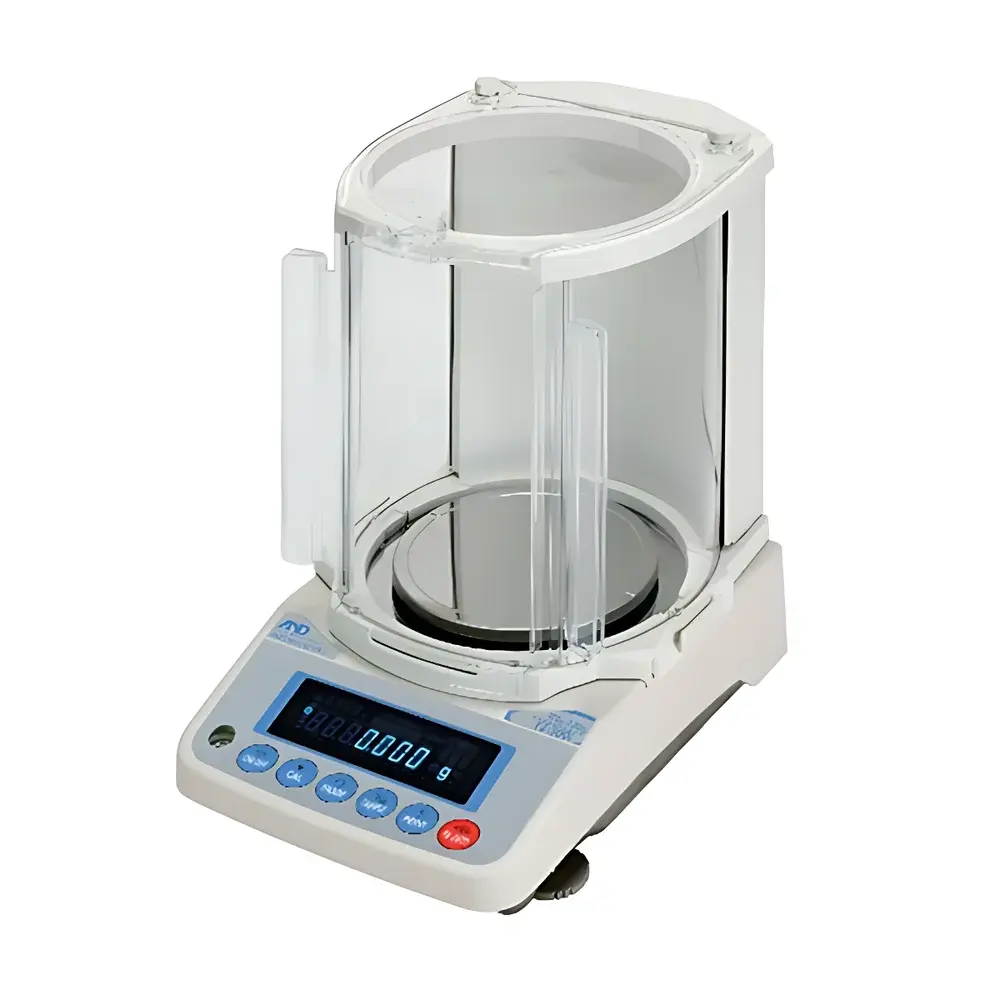
Anden HR250A Analytical Balance
| Origin | Japan |
|---|---|
| Manufacturer Type | Authorized Distributor |
| Origin Category | Imported |
| Model | HR250A |
| Instrument Type | Analytical Balance |
| Capacity Range | 200–500 g |
| Readability | 0.1 mg |
| Calibration Method | Internal Automatic Calibration |
| Maximum Capacity | 252 g |
| Accuracy | ±0.3 mg |
| Repeatability | 0.2 mg |
| Stabilization Time | 2 s |
| Sensitivity Drift | ±2 ppm/°C (10–30 °C) |
| Operating Environment | 5–40 °C, RH <85% non-condensing |
| Display Update Rate | 5 or 10 Hz |
| Counting Mode Minimum Unit | 0.1 mg |
| Sample Count Options | 10 / 25 / 50 / 100 pcs |
| % Weighing Minimum Reference Weight | 10.0 mg |
| % Display Resolution | 0.01% / 0.1% / 1% |
| Interface | RS-232C |
| Software Compatibility | WinCT Data Acquisition Suite |
| External Calibration Weights | 250 g / 200 g / 100 g / 50 g |
| Pan Diameter | Ø90 mm |
| Draft Shield Dimensions | 193(W) × 262.5(D) × 84.5(H) mm |
| Power Supply | AC adapter (~11 VA), region-specific voltage compliance |
| Net Weight | ~3 kg |
Overview
The Anden HR250A Analytical Balance is a high-precision mass measurement instrument engineered for laboratory environments requiring traceable accuracy, regulatory compliance, and operational robustness. Based on electromagnetic force compensation (EMFC) transduction technology, the HR250A delivers stable, drift-compensated readings with 0.1 mg readability across its 252 g maximum capacity. Its internal automatic calibration system integrates a built-in reference mass and motor-driven actuation mechanism, enabling scheduled or event-triggered recalibration without manual intervention—critical for maintaining measurement integrity in GLP- and GMP-regulated workflows. The balance incorporates real-time environmental monitoring (temperature and air density fluctuations) to dynamically adjust sensitivity and offset parameters, minimizing thermal and buoyancy-induced errors common in analytical weighing. Designed and manufactured in Japan, the HR250A adheres to stringent quality control protocols throughout assembly and final verification, ensuring long-term metrological stability and inter-unit consistency.
Key Features
- Internal automatic calibration with integrated reference weight and self-diagnostic validation sequence
- Real-time environmental compensation: automatic adjustment for temperature-induced sensitivity drift (±2 ppm/°C) and ambient air density variations
- Dual display update rates (5 Hz standard / 10 Hz counting mode) optimized for dynamic or static weighing tasks
- GLP/GMP-compliant data handling: timestamped results with operator ID entry, audit-ready print/export via RS-232C
- Multi-function weighing modes: standard mass, piece counting (10/25/50/100 sample sets), percentage weighing (0.01% resolution), density determination (with optional kit), and checkweighing
- Ergonomic draft shield with precision-machined acrylic panels (193 × 262.5 × 84.5 mm) and low-profile access design for minimal airflow disruption
- Intelligent power management: auto-on activation upon pan loading, programmable sleep mode, and low-power standby
- Stainless steel weighing pan (Ø90 mm) and corrosion-resistant housing suitable for routine solvent exposure and cleanroom-compatible operation
Sample Compatibility & Compliance
The HR250A supports a broad range of sample types—from dry powders and granular pharmaceuticals to small metallic components and lyophilized biologicals—within its 252 g capacity and 0.1 mg resolution envelope. Its electromagnetic force sensor architecture ensures immunity to mechanical hysteresis and load-point dependency, delivering consistent repeatability (≤0.2 mg SD) regardless of sample placement within the central 70% of the pan surface. The balance conforms to international metrological standards including OIML R76-1 (2021), ISO 9001:2015 (measuring equipment control clause), and ISO/IEC 17025:2017 (calibration uncertainty requirements). It supports full traceability per ISO/IEC 17025 and FDA 21 CFR Part 11 when used with WinCT software configured for electronic signature, audit trail logging, and user-access controls. Routine verification aligns with USP and EP 2.1.6 guidelines for analytical balance performance testing.
Software & Data Management
WinCT—a Windows-based data acquisition and reporting suite—is supplied as standard for seamless bidirectional communication via RS-232C. The software enables automated data capture with customizable templates, real-time graphing of sequential weighings, statistical analysis (mean, SD, CV%, tolerance pass/fail), and export to CSV, Excel, or PDF formats compliant with laboratory information management systems (LIMS). All exported records include embedded metadata: date/time stamp, operator ID, balance serial number, calibration status, environmental conditions at time of measurement, and raw digital output prior to rounding. Audit trails are immutable and time-stamped, satisfying ALCOA+ principles (Attributable, Legible, Contemporaneous, Original, Accurate, Complete, Consistent, Enduring, Available) required under GxP frameworks.
Applications
The HR250A is routinely deployed in quality control laboratories for active pharmaceutical ingredient (API) assay, excipient blending verification, and finished-dose uniformity testing per USP . It serves research labs conducting gravimetric preparation of standard solutions (e.g., ICP-MS calibration standards), catalyst loading quantification, and nanomaterial dispersion mass verification. In academic settings, it supports teaching protocols on measurement uncertainty, error propagation, and statistical process control. Industrial applications include micro-component assembly verification in electronics manufacturing and precious metal plating bath replenishment calculations. Its compact footprint and low power draw make it suitable for mobile QC carts and ISO Class 5–7 cleanroom installations.
FAQ
Does the HR250A support external calibration with user-provided weights?
Yes—the balance accepts external calibration using certified Class M1 or better weights (250 g, 200 g, 100 g, and 50 g), with full traceability documentation stored in internal memory.
Is the RS-232C interface compatible with modern Windows OS versions?
Yes—WinCT supports Windows 10 and 11 (64-bit); legacy RS-232 ports may require USB-to-serial adapters with signed FTDI drivers.
How frequently should internal calibration be performed?
Per ISO/IEC 17025 and pharmacopeial guidance, internal calibration is recommended before first use, after relocation, following significant ambient temperature shifts (>5 °C), and at defined intervals (e.g., every 2 hours during continuous operation).
Can the HR250A be integrated into a networked LIMS environment?
Direct Ethernet or Wi-Fi is not supported; however, RS-232C output can be routed through a serial server or middleware application (e.g., LabWare, Thermo Fisher SampleManager) for secure LIMS ingestion.
What is the uncertainty contribution of environmental compensation?
The built-in thermal and air density compensation reduces typical environmental uncertainty components by ≥60% compared to uncompensated balances operating under identical lab conditions (validated per EURAMET cg-18).