
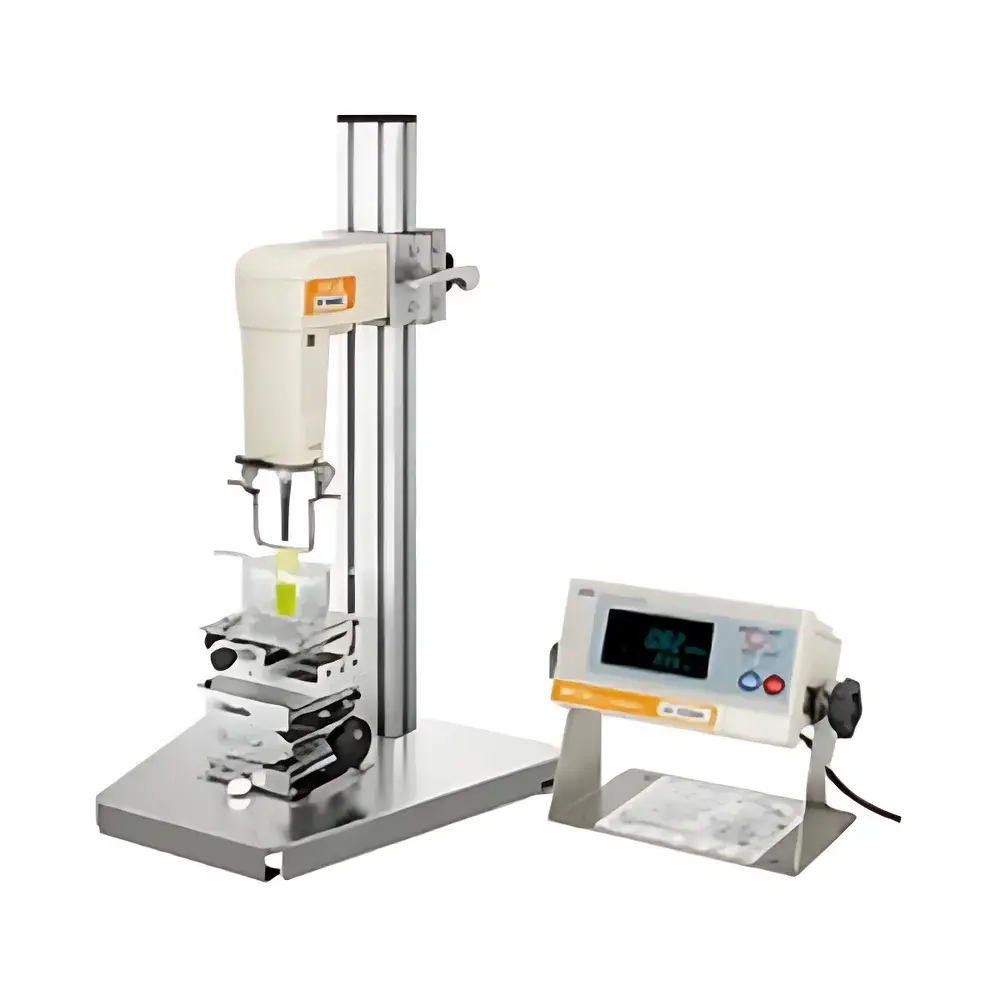
Anders SV-A Series Oscillating Viscometer
| Origin | Japan |
|---|---|
| Manufacturer Type | Authorized Distributor |
| Origin Category | Imported |
| Model | SV-A |
| Quotation | Upon Request |
| Instrument Type | Oscillating Viscometer |
| Viscosity Range | 0.3–100,000 mPa·s |
Overview
The Anders SV-A Series Oscillating Viscometer is an engineered solution for precise, real-time viscosity measurement of low- to high-viscosity liquids—including Newtonian and non-Newtonian fluids—using the principle of resonant frequency damping in a dual-tine tuning fork sensor. Operating at a fixed sinusoidal excitation frequency of 30 Hz with sub-millimeter amplitude (<1 mm), the instrument measures the energy loss (damping) induced by fluid resistance on the oscillating stainless-steel sensor tines. This method eliminates mechanical shear stress artifacts common in rotational systems, enabling stable characterization of shear-sensitive, volatile, foaming, or thermally unstable samples without structural disruption. Designed and manufactured in Japan, the SV-A platform delivers metrological traceability suitable for R&D laboratories, QC environments, and process development workflows where sample conservation, thermal responsiveness, and operational robustness are critical.
Key Features
- Fixed-frequency (30 Hz) oscillating fork sensing architecture ensures consistent excitation conditions and minimizes sample disturbance—ideal for foams, gels, and emulsions.
- Three interchangeable models (SV-1A, SV-10A, SV-100A) cover a unified dynamic range from 0.3 to 100,000 mPa·s without sensor replacement or mechanical recalibration.
- High-resolution fluorescent display supports on-device unit selection: mPa·s, Pa·s, cP, and P—enabling seamless unit conversion without external software.
- Repeatability of ±1% of full-scale reading (at 20–30°C, no condensation) meets ISO 2555 and ASTM D2196 verification requirements for routine viscosity assessment.
- Minimal sample volume requirement: only 2 mL for SV-1A; 10 mL for SV-10A and SV-100A—reducing material consumption and waste in high-value or limited-availability formulations.
- Integrated temperature sensor with minimal thermal mass achieves thermal equilibrium with sample in <5 seconds, supporting accurate viscosity–temperature correlation per ISO 7885.
- Stainless-steel sensor assembly enables rapid cleaning, chemical compatibility with organic solvents and aqueous media, and long-term corrosion resistance.
- RS-232 serial interface supports bidirectional communication with PCs, LIMS, or thermal printers for GLP-compliant data logging and audit trail generation.
Sample Compatibility & Compliance
The SV-A series demonstrates broad compatibility across physically heterogeneous samples: volatile solvents (e.g., acetone, ethanol), low-surface-tension formulations, air-entrained foams, polymer melts during gelation, and phase-transitioning systems (e.g., wax crystallization, protein denaturation). Its non-invasive oscillatory mode avoids shear thinning or thixotropic breakdown, making it particularly suitable for yield-stress fluids and time-dependent rheological behavior monitoring. The instrument complies with general principles outlined in ISO/IEC 17025 for measurement uncertainty estimation and supports calibration traceability to NIST-traceable standard oils (e.g., Cannon–Fenske certified reference materials). While not intrinsically certified for FDA 21 CFR Part 11, its RS-232 output and deterministic real-time response enable integration into validated systems under GMP/GLP frameworks when paired with compliant data acquisition software.
Software & Data Management
The SV-A operates as a standalone viscometer with embedded firmware handling all signal processing, temperature compensation, and unit conversion. Raw analog-to-digital conversion of tine damping is performed onboard, ensuring immunity to electromagnetic interference during transmission. The RS-232 interface outputs ASCII-formatted data packets containing viscosity, temperature, timestamp, and status flags at user-configurable intervals (1–10 s). Third-party SCADA, LabVIEW, or custom Python-based acquisition tools can ingest this stream for trend analysis, statistical process control (SPC), or automated reporting. For regulated environments, optional data capture solutions provide electronic signatures, audit trails, and change control logs aligned with ALCOA+ (Attributable, Legible, Contemporaneous, Original, Accurate) principles.
Applications
- Real-time monitoring of solvent evaporation kinetics in coatings and inks
- Quality control of pharmaceutical suspensions and topical gels during batch release
- Characterization of edible oil oxidation stability via viscosity drift over time
- In-process viscosity tracking during polymerization, crosslinking, or enzymatic hydrolysis
- Thermal profiling of molten chocolate, margarine, or cosmetic waxes across cooling ramps
- Stability assessment of aerated food products (e.g., mousses, whipped toppings) without foam collapse
- Viscosity–temperature coefficient (VTC) determination for heat-transfer fluids and lubricants
FAQ
What measurement principle does the SV-A use, and how does it differ from rotational viscometry?
It employs resonant frequency damping of a 30 Hz oscillating stainless-steel fork—measuring energy dissipation rather than torque. Unlike rotational methods, it applies negligible shear, preserving sample microstructure.
Can the SV-A measure non-Newtonian fluids accurately?
Yes—the oscillatory method yields apparent viscosity at a defined frequency and amplitude, providing reproducible comparative data for pseudoplastic, dilatant, or viscoelastic systems without flow curve assumptions.
Is temperature control integrated, or is an external bath required?
The built-in Pt100 sensor provides fast-response temperature measurement; however, active temperature regulation requires an external Peltier or circulating bath for isothermal studies.
How is calibration performed, and what standards are recommended?
Single-point or two-point calibration using certified silicone oils (e.g., Cannon Viscosity Standards) is supported. Calibration constants are stored in non-volatile memory and survive power cycles.
Does the SV-A support compliance with FDA 21 CFR Part 11?
The base instrument does not include electronic signature or audit trail functionality—but its deterministic RS-232 output enables integration into Part 11–compliant data systems via validated middleware.



