
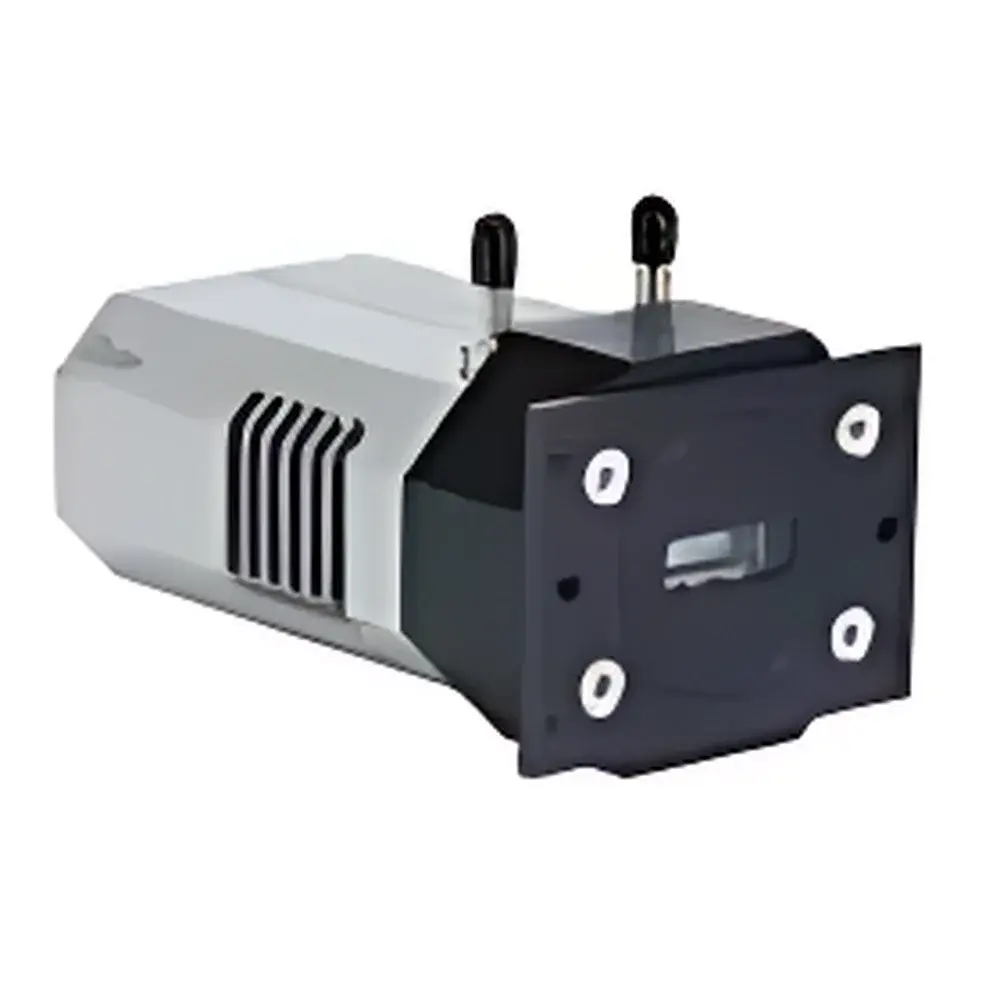
Andor iDus DV-420A-BV Back-Illuminated, Thermoelectrically Cooled CCD Detector
| Brand | Andor |
|---|---|
| Origin | United Kingdom |
| Model | DV-420A-BV |
| Spectral Range | 300–1000 nm |
| Pixel Array | 1024 × 256 |
| Pixel Size | 26 × 26 µm |
| Imaging Area | 26.6 × 6.7 mm |
| Peak Quantum Efficiency | 95% |
| Maximum Cooling Temperature | −75 °C |
| Full Well Capacity (typ.) | 510 k e⁻ |
| Register Capacity (typ.) | 1 M e⁻ |
| Maximum Spectral Acquisition Rate | 75 spectra/s |
| Read Noise (typ.) | 4 e⁻ |
| Readout Speeds | 0.1 / 0.05 / 0.033 MHz |
| ADC Resolution | 16-bit |
| Dark Current (@−70 °C) | 0.002 e⁻/pixel/s |
| Interface | USB 2.0 |
| Vacuum Packaging | Andor UltraVac™ |
| Cleanroom Assembly | ISO Class 4 (10,000) |
| Compliance | CE, RoHS |
Overview
The Andor iDus DV-420A-BV is a high-performance, back-illuminated, thermoelectrically cooled CCD detector engineered for demanding low-light spectroscopic applications. Designed around a scientific-grade, deep-depletion silicon sensor, it delivers exceptional quantum efficiency across the UV-Vis-NIR range (300–1000 nm), with peak QE exceeding 95% at ~650 nm. Its architecture leverages Andor’s proprietary UltraVac™ vacuum encapsulation technology—hermetically sealed and baked under ultra-high vacuum to eliminate condensation, outgassing, and long-term degradation of the photosensitive surface. Manufactured in an ISO Class 4 (10,000) cleanroom environment, the detector meets stringent reliability and stability criteria comparable to those required for defense and space-qualified instrumentation. The 1024 × 256 pixel array, with 26 × 26 µm pixels and a 26.6 × 6.7 mm active area, provides optimized spatial resolution and spectral dispersion compatibility with standard Czerny–Turner and crossed-beam spectrometers—including the Zolix Omni-λ500 and Omni-λ750 monochromators.
Key Features
- Back-illuminated CCD architecture enabling >95% peak quantum efficiency and enhanced UV response down to 300 nm
- Thermoelectric (TE) cooling to −75 °C, reducing dark current to 0.002 e⁻/pixel/s at −70 °C for extended integration times
- UltraVac™ vacuum sealing ensures permanent hermeticity and eliminates performance drift over time or thermal cycling
- Low-noise readout electronics with <4 e⁻ RMS read noise (at slowest 0.033 MHz speed) and selectable readout rates (0.033 / 0.05 / 0.1 MHz)
- 16-bit analog-to-digital conversion supporting dynamic range >80 dB and full-well capacity of 510 k e⁻ per pixel
- USB 2.0 interface enabling plug-and-play operation without external power supplies or frame grabbers
- Robust mechanical design with standardized C-mount and SMA fiber-optic coupling options for seamless integration into OEM and lab-based spectroscopy platforms
Sample Compatibility & Compliance
The DV-420A-BV is compatible with a wide range of spectroscopic sample configurations, including transmission, fluorescence, Raman, plasma emission, and absorption measurements. Its linear response and high pixel uniformity support quantitative intensity calibration traceable to NIST-traceable standards. The detector conforms to CE marking requirements for electromagnetic compatibility (EMC Directive 2014/30/EU) and safety (LVD Directive 2014/35/EU), and complies with RoHS 2011/65/EU restrictions on hazardous substances. While not certified as a medical device, its stable thermal management, audit-ready metadata logging (via Andor Solis software), and reproducible gain/dark reference acquisition support GLP-compliant workflows in regulated analytical laboratories.
Software & Data Management
The detector is fully supported by Andor’s Solis for Spectroscopy software—a modular, Windows-based platform offering real-time spectral acquisition, multi-channel averaging, dark/reference subtraction, wavelength calibration (polynomial and pixel-mapping), and export to ASCII, HDF5, and vendor-neutral .spe formats. Solis supports automated script-driven acquisition sequences compliant with ASTM E131 and ISO/IEC 17025 documentation requirements. Raw data includes embedded metadata (temperature, exposure time, gain, binning, calibration coefficients), enabling retrospective traceability. For integration into custom LabVIEW, MATLAB, or Python environments, Andor provides comprehensive SDKs with native DLL and .NET wrappers, supporting full control of cooling setpoint, trigger mode (free-run, external TTL, software), and region-of-interest (ROI) readout.
Applications
- High-sensitivity UV-Vis absorption and reflectance spectroscopy in materials science and thin-film characterization
- Time-resolved fluorescence lifetime measurements using gated acquisition modes
- Raman spectroscopy with low-frequency cutoff optimization and stray-light rejection
- Plasma diagnostics and atomic emission analysis in combustion and fusion research
- Environmental monitoring of trace gas species via differential optical absorption spectroscopy (DOAS)
- Quantitative elemental analysis in ICP-OES systems requiring high linearity and dynamic range
- OEM integration into portable or benchtop spectrometers where size, power efficiency, and vacuum integrity are critical
FAQ
What vacuum level is maintained inside the UltraVac™ enclosure?
The detector is sealed under <1×10⁻⁶ mbar vacuum during final bake-out, ensuring no internal moisture or residual gas affects QE stability over its operational lifetime.
Can the DV-420A-BV be operated in vertical orientation?
Yes—the mechanical housing and thermal path are orientation-insensitive; however, prolonged operation above −60 °C base temperature is recommended to minimize thermophoretic particle migration within the vacuum chamber.
Is firmware upgradable in the field?
Yes—firmware updates are delivered via Solis software and require no hardware modification or service intervention.
Does the detector support hardware binning?
No—binning is performed digitally in software post-readout; the physical pixel structure remains fixed at 1024 × 256.
What is the typical MTBF (mean time between failures)?
Based on accelerated life testing and field deployment data, MTBF exceeds 50,000 hours under continuous operation at −70 °C.





