
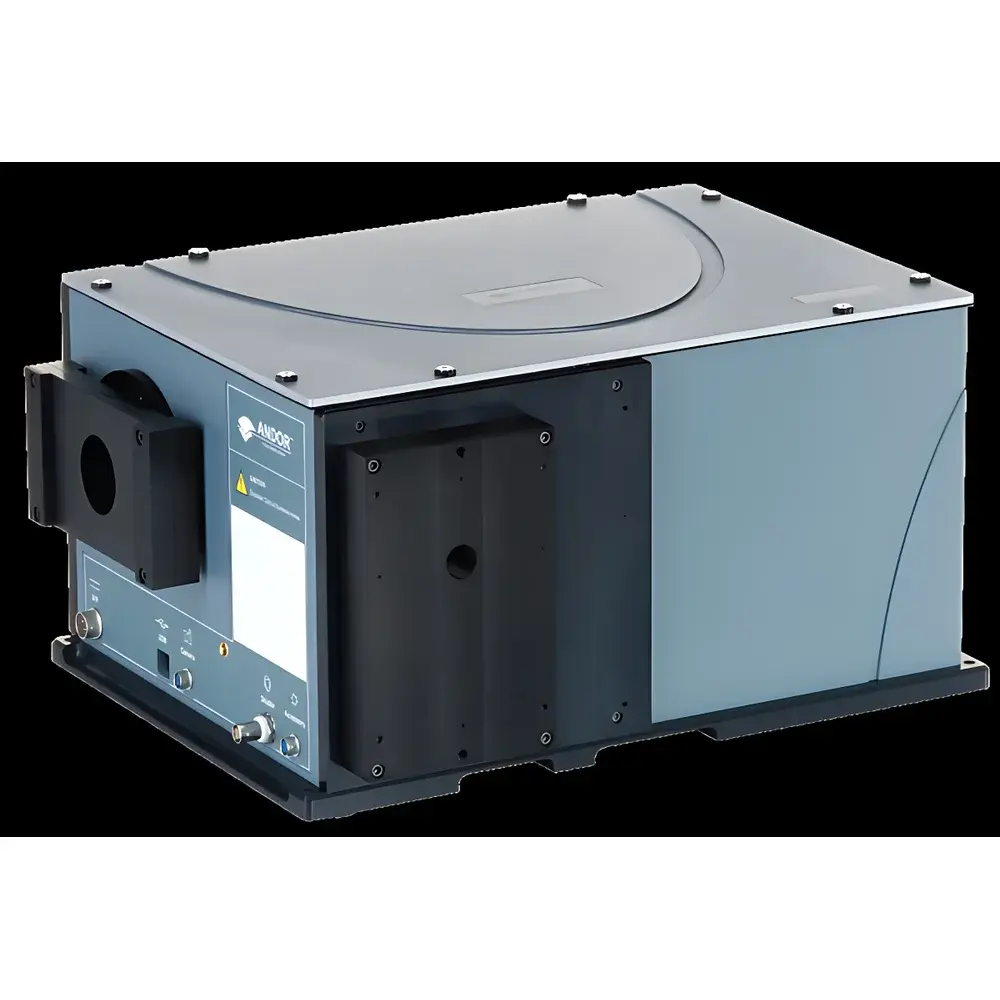
Andor SR-303i Research-Grade Imaging-Corrected Grating Spectrometer
| Brand | Andor |
|---|---|
| Origin | United Kingdom |
| Model | SR-303i |
| Application Systems | Transmission & Reflectance Spectroscopy |
| Grating Turret | Triple-grating (motorized) |
| Spectral Resolution | 0.08 nm @ 2400 g/mm, 300 nm |
| Dispersion | 2.2 nm/mm |
| Wavelength Range | 303–800 nm |
| F-number | F/4 |
| Wavelength Accuracy | ±0.04 nm |
| Stray Light Rejection | ≤0.3% T (typical), <2.2×10⁻⁵ (peak-to-valley) |
| Focal Length | 303 mm |
| Image Plane Dimensions | 28 mm × 14 mm |
| Slit Width Range | Motorized dynamic slit, up to 12 mm |
| Weight | 20 kg |
| Dimensions (L×W×H) | 394 × 238 × 208 mm |
Overview
The Andor SR-303i is a research-grade, imaging-corrected Czerny–Turner grating spectrometer engineered for high-fidelity spectral acquisition in low-light and multi-channel applications. Its optical architecture integrates optimized toroidal mirrors and precision-aligned diffraction gratings to eliminate astigmatism and minimize coma across the full focal plane—enabling diffraction-limited spatial resolution and wavelength fidelity simultaneously. Unlike conventional monochromators or non-imaging spectrometers, the SR-303i delivers true spectral image formation at the detector plane, making it uniquely suited for microspectroscopy, time-resolved spectroscopy, and spatially resolved spectral mapping where pixel-level registration between wavelength and position is critical. Designed for integration with scientific detectors—including back-illuminated CCDs, EMCCDs, ICCDs, and InGaAs arrays—the SR-303i serves as the core dispersive element in turnkey systems compliant with ISO/IEC 17025 traceability requirements for spectral calibration and quantitative analysis.
Key Features
- Imaging-corrected optical design with toroidal collimating and focusing mirrors, ensuring uniform spectral line shape and minimal spatial distortion across the 28 mm × 14 mm focal plane
- Motorized triple-grating turret with automatic wavelength calibration and zero-hysteresis positioning; no realignment required when switching gratings
- High-precision motorized dynamic slit (up to 12 mm width), fully programmable for optimal throughput–resolution trade-off and seamless coupling to microscope ports or fiber inputs
- Exceptional stray light suppression: <2.2×10⁻⁵ (peak-to-valley) achieved via baffling, blackened internal surfaces, and optimized grating blaze geometry
- F/4 aperture and 303 mm focal length balance light-gathering efficiency with compact mechanical footprint and thermal stability
- Wavelength accuracy of ±0.04 nm and repeatability of ±4 pm, verified against NIST-traceable Hg/Ne emission lines and suitable for USP and ASTM E275 spectral validation protocols
Sample Compatibility & Compliance
The SR-303i supports transmission, reflectance, fluorescence, and Raman configurations through standardized input/output interfaces (C-mount, SMA905, and kinematic flanges). Its 303–800 nm spectral range covers deep UV to near-IR transitions relevant to semiconductor defect analysis, photoluminescence quantum yield measurement, and catalytic surface characterization. When paired with Andor’s iStar ICCD or Newton EMCCD detectors, the system meets GLP/GMP data integrity requirements per FDA 21 CFR Part 11—including electronic signatures, audit trails, and secure parameter locking. All optical components are RoHS-compliant and manufactured under ISO 9001-certified processes; calibration certificates include uncertainty budgets aligned with EURACHEM/CITAC guidelines.
Software & Data Management
Control and acquisition are managed via Andor SOLIS software—a modular, Windows-based platform supporting full instrument orchestration: motorized slit control, grating selection, wavelength scanning, and real-time spectral preview. SOLIS implements IEEE 1789-compliant timestamping and embeds EXIF-style metadata (grating ID, slit width, exposure, calibration date) directly into FITS and HDF5 output files. For regulated environments, optional SOLIS Compliance Edition adds 21 CFR Part 11 modules: role-based access control, electronic signature workflows, and immutable audit logs for all configuration changes. Raw spectral data export supports ASCII, CSV, and vendor-neutral JCAMP-DX formats for third-party chemometric analysis (e.g., MATLAB, Python SciPy, Unscrambler).
Applications
- Microspectroscopy of semiconductor wafers and 2D materials using confocal or widefield microscope coupling
- Time-resolved photoluminescence decay profiling with sub-nanosecond ICCD gating
- Multi-point spectral mapping of biological tissue sections under hyperspectral illumination
- UV-Vis-NIR reflectance quantification for pigment stability studies per ISO 105-B02
- Plasmonic resonance tracking in colloidal nanoparticle suspensions
- Calibration reference source characterization for metrology labs accredited to ISO/IEC 17025
FAQ
Is the SR-303i compatible with third-party detectors?
Yes—standard C-mount and 60 mm lens-thread interfaces enable mechanical and electrical integration with most scientific CCD, sCMOS, and InGaAs array detectors. Pinout documentation and trigger timing specifications are provided upon request.
Can stray light performance be validated independently?
Yes. Andor supplies a certified stray light test report based on ASTM E275 Annex A3 methodology, including measured peak-to-valley ratios at 656.3 nm (Hα) with adjacent 650 nm and 660 nm blocking filters.
What calibration standards are included?
Each unit ships with a NIST-traceable Hg/Ne pen-ray lamp and a factory calibration certificate covering wavelength accuracy, resolution verification, and focal plane flatness mapping.
Is remote operation supported over Ethernet or USB?
Yes—SOLIS supports TCP/IP command protocol for headless operation and integration into LabVIEW, Python (PyAndor), or MATLAB automation frameworks.




