
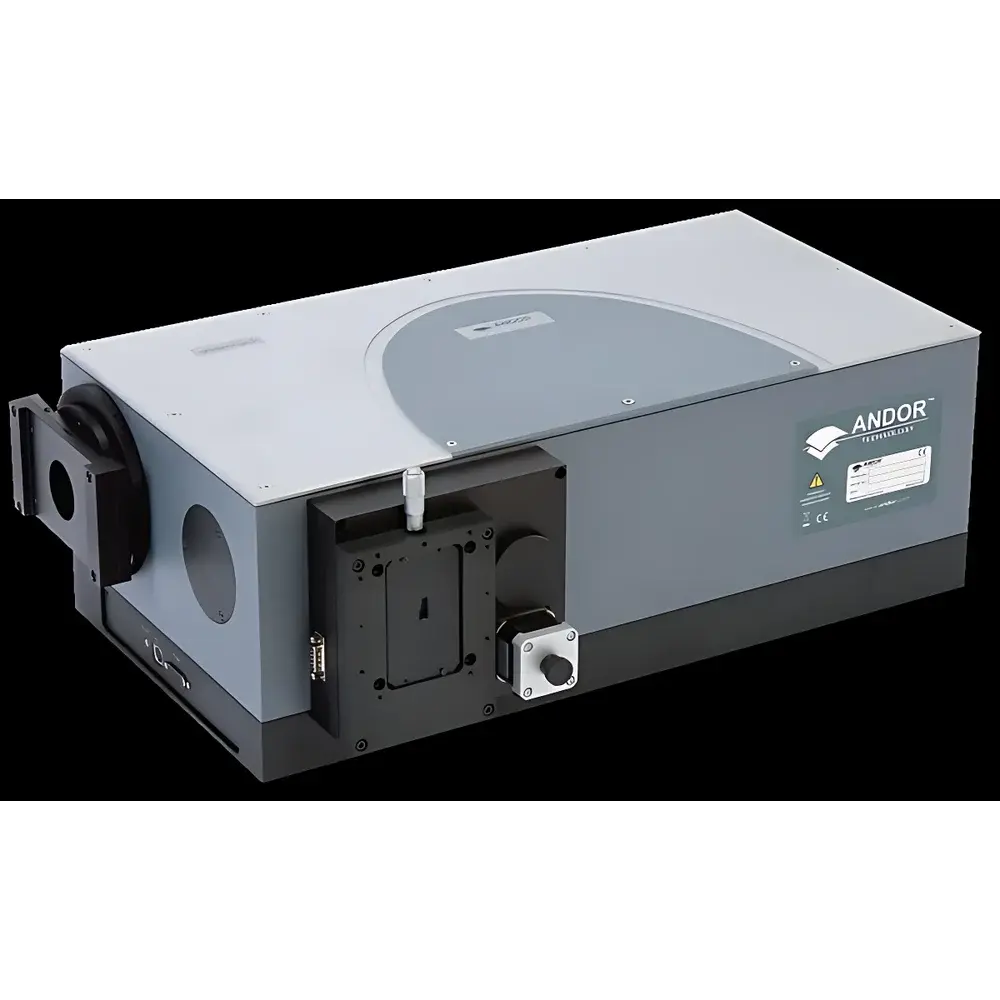
Andor SR-500i Imaging-Corrected Grating Spectrometer
| Brand | Andor |
|---|---|
| Origin | United Kingdom |
| Model | SR-500i |
| Spectral Resolution | 0.05 nm |
| Wavelength Range | 180 nm – IR |
| Dispersion | 1.44 nm/mm |
| F/# | f/6.5 |
| Wavelength Accuracy | ±0.04 nm |
| Stray Light | 2.6 × 10⁻⁵ |
| Grating Configuration | Triple-grating turret |
| Focal Length | 500 mm |
| Entrance/Exit Ports | Up to 2 input and 2 output ports |
| Image Plane Dimensions | 28 mm × 14 mm |
| Physical Dimensions | 550 mm × 343 mm × 206.5 mm |
Overview
The Andor SR-500i Imaging-Corrected Grating Spectrometer is a high-performance, research-grade monochromator-spectrometer engineered for demanding optical spectroscopy applications—particularly laser Raman spectroscopy, photoluminescence, time-resolved fluorescence, and UV-Vis-NIR spectral analysis. Based on the Shamrock platform, the SR-500i employs an optimized Czerny-Turner optical design with integrated imaging correction across the entire focal plane. This correction minimizes astigmatism and coma, ensuring uniform spectral line shape and spatial fidelity across the full 28 mm × 14 mm detector plane—critical for CCD and sCMOS array detectors used in quantitative spectral imaging. Its 500 mm focal length delivers high spectral dispersion (1.44 nm/mm) while maintaining excellent light throughput (f/6.5), enabling precise wavelength separation without sacrificing signal-to-noise ratio. The instrument operates over an extended spectral range from deep ultraviolet (180 nm) into the infrared region, supporting interchangeable gratings and optional vacuum or purged configurations for enhanced UV transmission.
Key Features
- Triple-grating turret system enabling rapid, software-controlled selection of diffraction gratings—optimized for resolution, throughput, or spectral coverage.
- Precisely aligned and factory-calibrated optical train; requires no user recalibration upon installation, reducing commissioning time and long-term maintenance overhead.
- Dual-input/dual-output port architecture: supports simultaneous coupling of two excitation sources (e.g., 532 nm and 785 nm lasers) and/or two detectors (e.g., back-illuminated CCD and InGaAs array), facilitating multi-modal or comparative measurements.
- Imaging-corrected optics delivering diffraction-limited performance across the full 28 mm × 14 mm focal plane—essential for pixel-registered spectral imaging and multichannel detection.
- Wavelength accuracy of ±0.04 nm and repeatability of ±0.05 nm—validated against NIST-traceable emission lines—ensuring metrological reliability in regulated environments.
- Stray light suppression of 4.6), achieved through optimized baffling, blackened internal surfaces, and precision grating mounting—critical for high-dynamic-range Raman measurements where Rayleigh rejection exceeds 10⁶.
Sample Compatibility & Compliance
The SR-500i is compatible with standard fiber-optic inputs (SMA905, FC/PC), free-space beam coupling, and direct integration into confocal or micro-Raman platforms. It interfaces seamlessly with Andor’s iDus, iStar, and Kymera detector families, as well as third-party scientific cameras via industry-standard USB 3.0 or PCIe connections. The spectrometer meets mechanical and electromagnetic compatibility requirements per EN 61326-1:2013 and is designed for operation in ISO Class 5–7 cleanroom environments. While not inherently GMP-certified, its stable calibration, audit-ready wavelength tracking logs, and deterministic optical behavior support compliance with GLP, ISO/IEC 17025, and FDA 21 CFR Part 11 when deployed within validated laboratory workflows.
Software & Data Management
Controlled via Andor’s SOLIS software suite (Windows-based), the SR-500i supports full remote automation—including grating selection, slit width adjustment, filter wheel synchronization, and wavelength scanning—with programmable scripting (VB.NET, C#, Python SDK). All wavelength positioning commands are timestamped and logged with encoder feedback, providing traceable audit trails for quality assurance documentation. Data export conforms to HDF5 and ASCII formats, ensuring interoperability with MATLAB, Python (NumPy, SciPy), Igor Pro, and LabVIEW. Optional Andor Instrument Manager enables centralized control of multi-instrument setups—including synchronized acquisition across spectrometers, lasers, and delay generators—ideal for pump-probe or hyperspectral mapping experiments.
Applications
- Laser Raman spectroscopy: High-resolution vibrational mode discrimination with minimal peak broadening due to imaging correction and low stray light.
- Photoluminescence quantum yield (PLQY) and lifetime mapping: Simultaneous spectral acquisition across wide bands using EMCCD or sCMOS detectors coupled to dual-output configuration.
- UV-Vis absorption and reflectance spectroscopy: Accurate bandgap determination in thin-film semiconductors and perovskite materials.
- Time-resolved emission spectroscopy (TRES): Integration with pulsed lasers and gated ICCDs for nanosecond-resolved decay analysis.
- Plasmonics and metamaterial characterization: High-fidelity spectral response measurement across visible and near-IR ranges with calibrated responsivity.
FAQ
Is the SR-500i compatible with vacuum UV operation below 190 nm?
Yes—when configured with a vacuum-compatible housing and MgF₂-coated optics, the SR-500i supports operation down to 180 nm; optional nitrogen purge or full vacuum integration is available.
Can I upgrade the grating turret to accommodate custom or third-party gratings?
Grating mounts conform to standard 68 mm × 68 mm format; custom gratings with known groove density and blaze angle can be installed by qualified service engineers—calibration coefficients must be re-established post-installation.
Does the SR-500i support motorized slits and filter wheels?
Yes—integrated motorized entrance/exit slits (10 µm–3 mm adjustable) and optional motorized filter wheels (6-position) are supported via SOLIS and fully programmable through the SDK.
What is the typical warm-up time required to achieve thermal stability?
Under ambient lab conditions (20–25 °C, ±0.5 °C/h drift), optical alignment stabilizes within 30 minutes; wavelength repeatability remains within specification after 15 minutes of power-on.
How is wavelength calibration maintained over extended use?
The SR-500i uses absolute encoder-based position feedback on all moving axes; periodic verification using Hg/Ar or Ne lamp lines (recommended every 6 months) ensures continued traceability to primary standards.






