
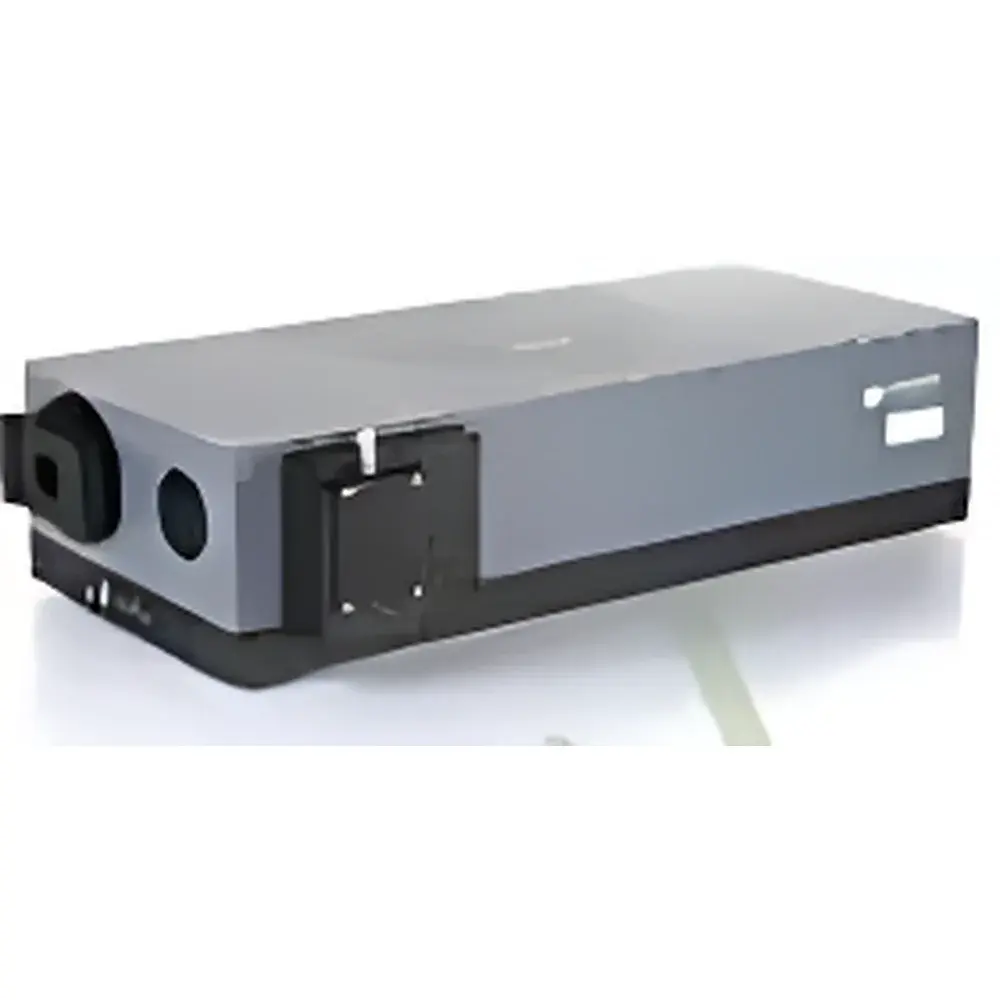
Andor SR-750 High-Resolution Czerny-Turner Grating Spectrometer
| Brand | Andor |
|---|---|
| Origin | United Kingdom |
| Model | SR-750 |
| Focal Length | 500 mm |
| F/# | F/9.7 |
| Wavelength Range | 300–500 nm |
| Spectral Resolution | 0.02 nm @ 2400 grooves/mm, 300 nm |
| Wavelength Accuracy | ±0.03 nm |
| Wavelength Repeatability | ±10 pm |
| Stray Light Suppression | ≤2.6×10⁻⁵ |
| Grating Size | 68 mm × 68 mm |
| Dispersion | 2.6 nm/mm (at 300 nm, 2400 g/mm) |
| Slit Input Options | 1 or 2 |
| Detector Output Ports | 1 or 2 CCD ports + optional slit output |
| 焦平面尺寸 | 28 mm × 14 mm |
| Grating Turret | 3-position, fully documented per unit |
Overview
The Andor SR-750 is a research-grade, high-resolution Czerny-Turner monochromator/spectrometer engineered for demanding spectroscopic applications requiring exceptional spectral fidelity and optical stability. With a 500 mm focal length and F/9.7 aperture, the SR-750 delivers high throughput without compromising resolution—enabling precise wavelength isolation across the UV-Vis range (300–500 nm). Its optical architecture employs kinematically mounted, silver-coated optics (optional) and precision-machined grating turrets to minimize thermal drift and mechanical hysteresis. The instrument operates on the principle of angular dispersion: incident polychromatic light is collimated, diffracted by interchangeable ruled or holographic gratings (2400 g/mm or 1200 g/mm), and re-focused onto a detector plane with sub-pm wavelength repeatability. Designed for integration with Andor’s scientific-grade CCD and ICCD detectors—including deep-depletion, back-illuminated, and intensified sensors—the SR-750 supports both single-point and spatially resolved multi-channel spectroscopy, making it suitable for time-resolved, micro-spatial, and multi-sample configurations.
Key Features
- Sub-0.02 nm spectral resolution at 300 nm using 2400 grooves/mm grating—validated under ISO 14644 cleanroom-aligned alignment protocols
- Three-position motorized grating turret with factory-calibrated position registration; each unit ships with grating-specific calibration files for traceable wavelength assignment
- Dual-output optical configuration options (e.g., SR-750-B2, SR-750-D2): simultaneous CCD imaging and auxiliary slit output for real-time monitoring or secondary detection
- Modular input port design: configurable for 1 or 2 entrance slits to support dual-source excitation, reference-beam routing, or differential measurement schemes
- Silver-coated optics option enhances reflectance >95% across 300–1200 nm, critical for coupling with extended-InGaAs or MCT detectors in hybrid UV-Vis-NIR systems
- Thermally stabilized optical bench with low-expansion Invar housing reduces wavelength drift to <±5 pm/°C over 8-hour operational windows
- Standard 28 mm × 14 mm focal plane accommodates large-format scientific cameras (e.g., Andor iStar, Newton, or Kymera platforms) without vignetting
Sample Compatibility & Compliance
The SR-750 is compatible with solid, liquid, and gas-phase samples via standardized fiber-optic couplers (SMA905, FC/PC), vacuum-compatible flanges (CF35), and custom sample chambers for Raman, fluorescence, or laser-induced breakdown spectroscopy (LIBS). Its mechanical design conforms to ISO 17025 metrological requirements for optical instrumentation, and wavelength accuracy (±0.03 nm) is certified against NIST-traceable Hg/Ne emission lines. When integrated into regulated environments—such as pharmaceutical QC labs or contract research organizations—the system supports 21 CFR Part 11-compliant software workflows when paired with Andor’s Solis or IDA acquisition platforms, including electronic signatures, audit trails, and user-access controls. All optical coatings meet RoHS Directive 2011/65/EU and REACH Annex XIV restrictions.
Software & Data Management
Control and data acquisition are managed through Andor’s Solis for Spectroscopy software (v6.5+), which provides full hardware abstraction, automated grating selection, slit-width synchronization, and real-time wavelength calibration using built-in spectral line libraries. Raw spectral data are exported in vendor-neutral formats (FITS, CSV, HDF5) compliant with ASTM E131-22 and IUPAC recommendations for spectroscopic data exchange. Advanced features include multi-region-of-interest (ROI) extraction, pixel binning with Poisson-noise-aware gain correction, and batch-processing pipelines for kinetic series or hyperspectral stacks. For enterprise deployment, Solis integrates with LabArchives ELN and Thermo Fisher SampleManager LIMS via RESTful API extensions, enabling metadata tagging aligned with ISA-Tab standards.
Applications
- High-resolution atomic emission spectroscopy (AES) for elemental analysis in plasma diagnostics and astrophysical simulation chambers
- Resonance Raman spectroscopy of transition-metal complexes and 2D materials, where <0.04 nm resolution resolves vibronic progressions at room temperature
- Time-gated fluorescence lifetime measurements using ICCD-coupled SR-750-B1 configurations with <200 ps gate widths
- In situ monitoring of catalytic reactions via transmission/reflectance spectroscopy in high-pressure flow cells
- Calibration source characterization for synchrotron beamlines and EUV lithography tools, leveraging its <10 pm repeatability and stray-light rejection ratio of 2.6×10⁻⁵
- Multi-point spectral imaging in confocal or widefield microscopy setups using fiber bundle inputs and CCD mosaic readout
FAQ
What grating options are supported, and how is grating change calibrated?
The SR-750 accepts 68 mm × 68 mm ruled or holographic gratings with groove densities from 300 to 2400 g/mm. Each grating position is factory-registered with a unique wavelength polynomial; Solis auto-loads calibration coefficients upon selection.
Can the SR-750 operate under vacuum or purged conditions?
Yes—standard CF35 vacuum flanges are available; optional quartz or MgF₂ windows enable operation down to 10⁻⁶ mbar or N₂/Ar purge for UV-sensitive measurements below 300 nm.
Is the 0.02 nm resolution achievable across the entire 300–500 nm range?
No—0.02 nm is specified at 300 nm with the 2400 g/mm grating. Resolution scales linearly with wavelength and inversely with groove density; at 500 nm with 1200 g/mm, resolution is 0.04 nm (FWHM, 10 µm slit width, diffraction-limited performance).
How is stray light performance validated?
Stray light suppression (≤2.6×10⁻⁵) is measured per ISO 14255 using a double-monochromator reference method with a 546.1 nm Hg line and out-of-band blocking at ±20 nm; results are included in the Certificate of Conformance shipped with each unit.
Does the SR-750 support motorized slit control?
Yes—optional motorized slits (10–300 µm width, 0.1 µm step resolution) integrate seamlessly with Solis and support programmable slit-scanning routines for spectral bandwidth optimization.





