
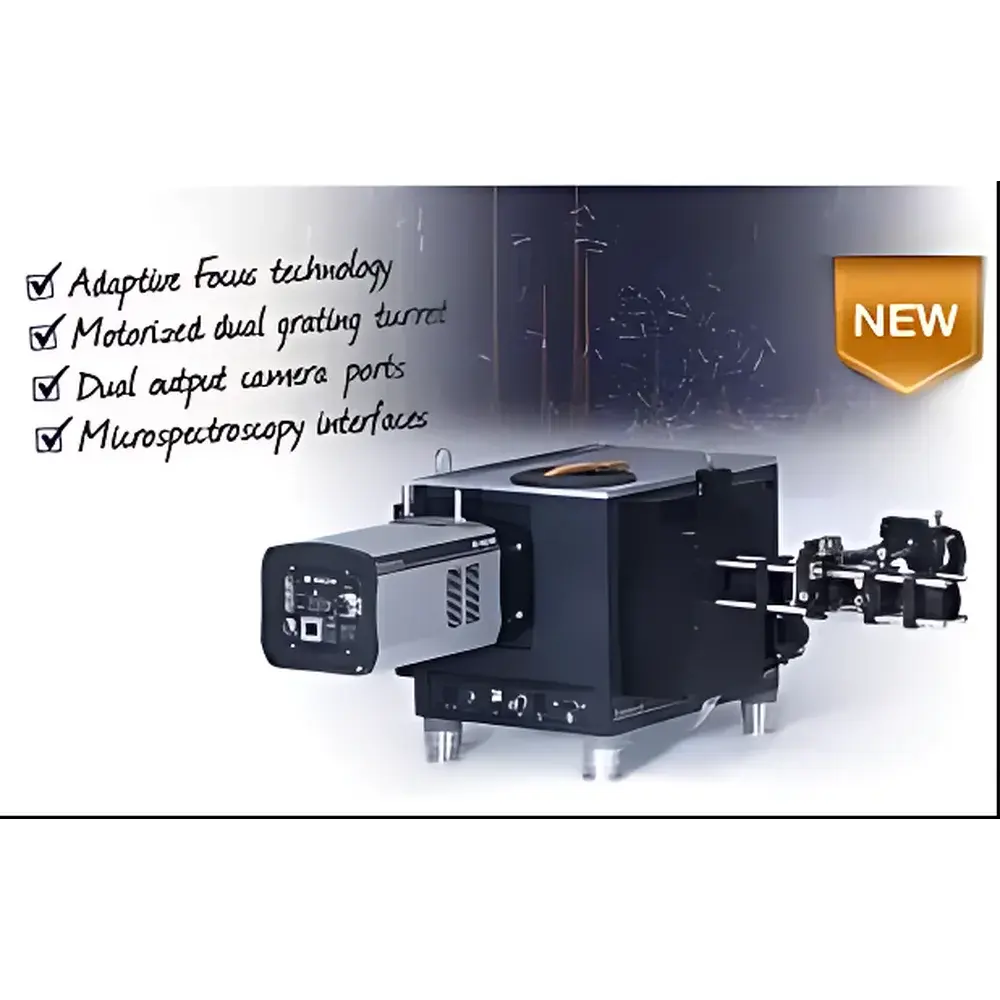
Andor SR193i Imaging-Corrected Grating Spectrometer with 193 mm Focal Length
| Brand | Andor |
|---|---|
| Origin | United Kingdom |
| Model | SR193i |
| Spectral Range | 200–1100 nm |
| F/# | 3.6 |
| Spectral Resolution | 0.21 nm @ 1200 g/mm, 500 nm |
| Dispersion | 2.6 nm/mm |
| Wavelength Accuracy | ±0.2 nm |
| Stray Light | 1.5 × 10⁻⁴ |
| Grating Configuration | Dual-grating turret with RFID-enabled auto-identification |
| Optical Design | Imaging-corrected with toroidal mirrors |
| Detector Interfaces | Dual-output ports for simultaneous UV–NIR CCD/EMCCD/ICCD and InGaAs array or single-point detectors |
| Optional Coating | Silver-coated optics for enhanced NIR/SWIR throughput |
| Interface | USB 2.0, plug-and-play |
| Software Integration | Micro-Manager SDK-compatible spectral acquisition and analysis suite |
Overview
The Andor SR193i is a high-throughput, imaging-corrected grating spectrometer engineered for precision spectroscopic applications requiring spatial fidelity, wavelength stability, and multi-detector flexibility. With a compact 193 mm focal length optical layout, it employs a Czerny–Turner configuration enhanced by toroidal mirror-based imaging correction—enabling diffraction-limited performance across the full 200–1100 nm spectral range. Unlike conventional monochromators, the SR193i maintains focused line images at the detector plane regardless of grating selection or wavelength setting, making it uniquely suited for fiber-coupled multi-channel detection, microscope-integrated spectral mapping, and time-resolved techniques such as pump–probe transient absorption or time-gated fluorescence. Its f/3.6 aperture ensures high étendue, maximizing signal collection from low-light sources including single-photon emitters, plasma plumes, or weak Raman scatterers.
Key Features
- Active autofocus system: Dynamically repositions the focusing mirror in real time to compensate for angular shift across grating orders and blaze angles—ensuring optimal spectral resolution without manual intervention.
- Dual-grating turret with integrated RFID: Enables automatic recognition of installed gratings, retrieval of calibrated groove density, blaze wavelength, and efficiency curves directly into acquisition software.
- Imaging-corrected optical path: Toroidal collimating and focusing mirrors eliminate coma and astigmatism, delivering uniform spectral line images across the full detector width—critical for multi-fiber bundle coupling and confocal spectral imaging.
- Dual-output port architecture: Supports simultaneous use of UV–NIR silicon-based detectors (CCD, EMCCD, ICCD) and extended-range InGaAs arrays or single-element MCT/PbS/InSb detectors—ideal for hybrid broadband spectroscopy.
- Pre-aligned and factory-calibrated: Each unit undergoes individual spectral calibration against NIST-traceable emission lines; delivered ready for immediate integration with no on-site optical alignment required.
- Modular mechanical interface: Includes adjustable-height feet, direct C-mount, lens-mount, and cage-system (30 mm) compatibility—facilitating seamless integration with inverted/upright microscopes, LIBS ablation chambers, or OEM instrumentation platforms.
- Dynamic 15 mm wide entrance slit: Provides extended field-of-view capability for spatially resolved spectroscopy while preserving spectral resolution through optimized optical conjugation.
Sample Compatibility & Compliance
The SR193i supports transmission, reflection, and emission measurements across solid, liquid, and gaseous samples. Its broad spectral coverage and high stray light rejection (<1.5 × 10⁻⁴) meet requirements for quantitative absorbance ratioing (e.g., UV-Vis protein quantification per ASTM E275), reflectance standards validation (ISO 13468), and laser-induced breakdown spectroscopy (LIBS) plasma diagnostics under ISO 21648. The silver-coated optics option enhances responsivity beyond 900 nm, enabling compliance with NIR pharmaceutical assay protocols (USP ) and SWIR material identification workflows. All firmware and control logic are designed to support audit-ready data integrity practices aligned with GLP and 21 CFR Part 11 when paired with compliant acquisition software environments.
Software & Data Management
The SR193i is natively supported within the open-source Micro-Manager platform, allowing synchronized hardware control of Andor cameras, motorized filter wheels, shutters, and XY stages alongside spectral acquisition. Its embedded firmware exposes full wavelength scanning, grating selection, slit width adjustment, and focus positioning via standardized device adapters—enabling reproducible method scripting and batch acquisition. Spectral data export conforms to HDF5 and FITS formats, ensuring compatibility with Python-based analysis pipelines (e.g., SciPy, Astropy) and MATLAB toolboxes. Real-time spectral fitting, background subtraction, and multivariate peak deconvolution are accessible through optional Andor SOLIS Spectroscopy Suite modules, which maintain full traceability of instrument parameters, calibration history, and environmental metadata per ISO/IEC 17025 reporting guidelines.
Applications
- Microspectroscopy: Absorbance, reflectance, and fluorescence mapping of semiconductor wafers, biological tissue sections, and 2D materials using integrated microscope coupling.
- Raman and resonance Raman spectroscopy: High-throughput collection with notch-filter rejection and optimized NIR throughput for 785 nm and 1064 nm excitation lines.
- Transient absorption spectroscopy: Sub-millisecond time-resolved detection enabled by gated ICCD synchronization and dual-output flexibility for pump/probe channel separation.
- Plasma diagnostics and LIBS: Broadband continuum capture with high wavelength accuracy (±0.2 nm) for elemental line identification and temperature estimation via Boltzmann plots.
- Tunable light source construction: Used as a dispersive element in external cavity diode lasers or supercontinuum filtering systems, supporting operation up to 12 µm when coupled with appropriate gratings and detectors.
- Quantum dot and perovskite photoluminescence characterization: High-resolution narrow-line detection at room temperature with minimal thermal drift due to thermally stable aluminum optical bench construction.
FAQ
Is the SR193i compatible with third-party detectors beyond Andor’s product line?
Yes—the dual-output ports feature standard SMA905 and FC/PC fiber interfaces, and the entrance slit and exit focal planes conform to common spectroscopic mechanical standards (e.g., 1/4″–20 threaded mounting, 12.5 mm detector height reference). Custom adapter plates are available for Hamamatsu, Princeton Instruments, or custom InGaAs arrays.
Can the SR193i be operated in vacuum or purged environments?
The base model is rated for ambient air operation. Optional vacuum-compatible versions (with sealed enclosures and BK7/UVFS window options) are available upon request for UV-sensitive applications below 200 nm or UHV-compatible LIBS setups.
Does the autofocus mechanism require periodic recalibration?
No—the system uses factory-characterized encoder feedback and grating-specific lookup tables stored in the onboard EEPROM. No user recalibration is needed unless physical impact or extreme thermal cycling occurs.
What is the maximum scan speed for full spectral acquisition?
With a 1200 g/mm grating and 10 µm slit, full 200–1100 nm coverage at 0.2 nm step size is achievable in under 4 seconds using motorized grating drive and USB 2.0 streaming—limited primarily by detector readout rather than spectrometer mechanics.
Is spectral line shape distortion corrected in software?
Yes—imaging correction data is applied during spectral reconstruction in Micro-Manager and SOLIS, including pixel-to-wavelength mapping nonlinearity compensation and slit image convolution modeling to preserve true instrumental line profiles for deconvolution-based analysis.






