
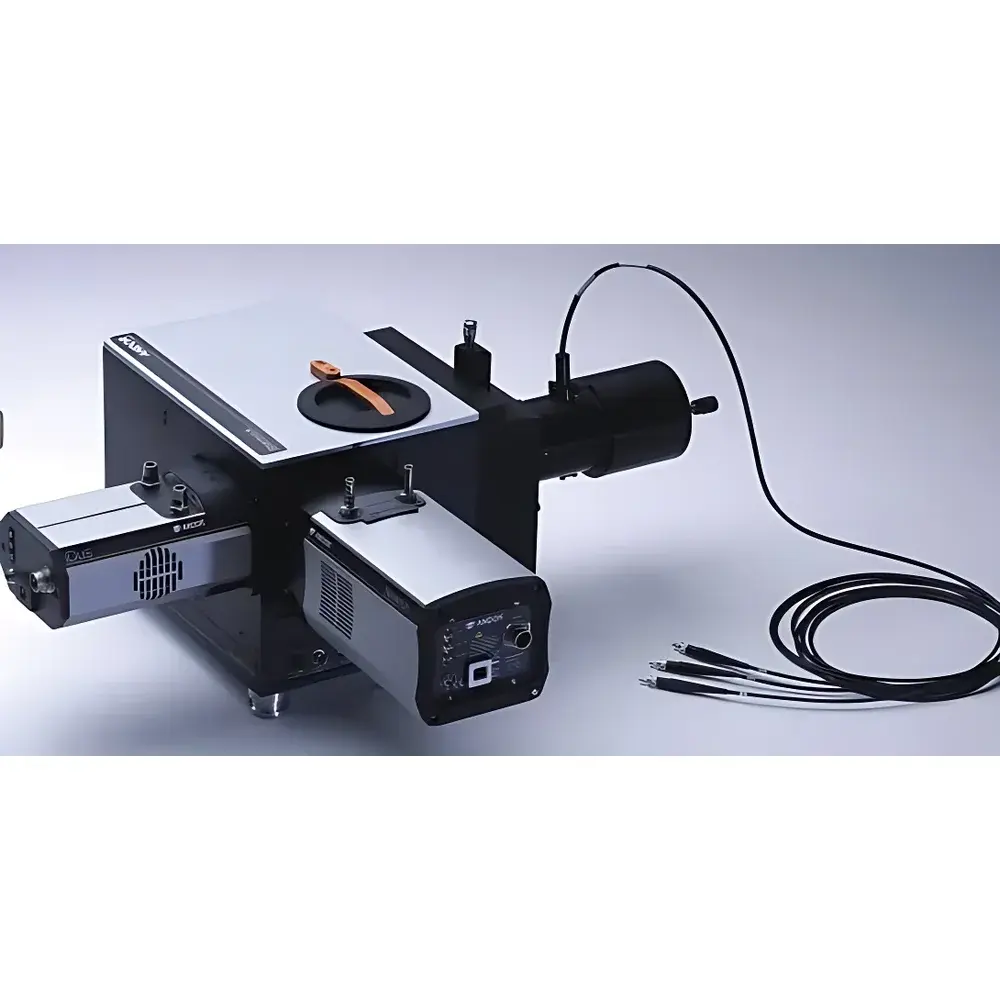
Andor SR193i Scientific-Grade Imaging-Corrected Grating Spectrometer
| Brand | Andor |
|---|---|
| Origin | Israel |
| Model | SR193i |
| Application Systems | Transmission & Reflection Spectroscopy |
| Grating Configuration | Dual-grating turret |
| Spectral Resolution | 0.21 nm @ 1200 g/mm, 500 nm |
| Dispersion | 2.6 nm/mm |
| Wavelength Range | 200–1100 nm |
| F/# | 3.6 |
| Wavelength Accuracy | ±0.2 nm |
| Stray Light | 1.5 × 10⁻⁴ |
| Focal Length | 193 mm |
| Imaging Optics | Aplanatic toroidal mirrors |
| Spectral Reproducibility | ±75 pm |
| Grating Turret | RFID-enabled, quick-release dual-grating turret |
| Detector Compatibility | Dual-output port for simultaneous CCD/EMCCD or sCMOS detector coupling |
| Slit Output Option | Configurable monochromator mode |
| Microscope Integration | C-mount and SM1-threaded interfaces compliant |
Overview
The Andor SR193i is a high-performance, imaging-corrected grating spectrometer engineered for quantitative spectral analysis in demanding scientific environments. Based on a Czerny–Turner optical architecture with athermalized mechanical design, the SR193i employs precision-machined aplanatic toroidal mirrors to eliminate coma and astigmatism across its full 200–1100 nm spectral range—enabling diffraction-limited imaging at both input and output focal planes. This optical fidelity supports multi-channel detection, spatially resolved spectroscopy, and high-fidelity coupling to microscopes, fiber arrays, and multi-pixel detectors. Its 193 mm focal length and f/3.6 aperture deliver optimal balance between resolution, throughput, and compactness—making it suitable for low-light Raman, photoluminescence, quantum dot characterization, and time-resolved emission studies where signal integrity and wavelength fidelity are non-negotiable.
Key Features
- Patented adaptive focusing mechanism: Automatically optimizes focus position across all grating angles and wavelengths—ensuring maximum spectral resolution without manual realignment.
- RFID-enabled dual-grating turret: Recognizes installed gratings instantaneously; eliminates manual parameter entry and reduces setup errors during experimental reconfiguration.
- In-axis grating scanning: Maintains optical alignment stability during wavelength sweeps—critical for long-duration kinetic measurements and hyperspectral mapping.
- Imaging-corrected toroidal mirror optics: Delivers uniform point-spread function (PSF) across the entire focal plane—enabling accurate intensity calibration and pixel-to-wavelength mapping for array detectors.
- Dual-output configuration: Independent exit ports support concurrent use of two detectors (e.g., back-illuminated CCD + NIR-optimized InGaAs array), facilitating simultaneous UV-Vis and NIR acquisition.
- Monochromator mode capability: Optional slit-based output enables precise wavelength selection for excitation filtering, laser line cleanup, or fluorescence lifetime instrumentation integration.
- Microscope-ready interface: Standard C-mount and SM1-threaded flanges allow direct coupling to upright/inverted microscopes—ideal for micro-spectroscopy and confocal spectral imaging applications.
Sample Compatibility & Compliance
The SR193i accommodates diverse sample geometries and illumination modalities—including transmission, reflection, fluorescence, and scattering configurations. Its modular input slits (10–200 µm adjustable), optional motorized filter wheels, and compatibility with fiber-optic bundles (SMA905 or FC/PC) ensure seamless integration into custom optical benches and OEM systems. The instrument conforms to ISO 17025-relevant optical calibration traceability practices and supports NIST-traceable wavelength calibration via Hg/Ne/Ar lamp sources. All firmware and control logic comply with IEC 61000-4 electromagnetic compatibility standards. For regulated environments, the device operates within GLP/GMP-aligned workflows when paired with Andor’s Solis or third-party platforms supporting audit trail logging (e.g., Micro-Manager with metadata-enriched acquisition).
Software & Data Management
Native control is provided through Andor’s Solis software suite, offering full grating positioning, slit width adjustment, wavelength scanning, and real-time spectral preview with background subtraction and dark correction. The SR193i also integrates natively with Micro-Manager (v2.0+), enabling synchronized acquisition with stage motion, shutter control, and multi-dimensional metadata tagging (time, position, exposure, grating ID). All acquired spectra are saved in vendor-neutral formats (FITS, CSV, HDF5) with embedded calibration coefficients, detector gain settings, and environmental timestamps. Firmware updates maintain backward compatibility with legacy acquisition scripts and support Python (via PyAndor SDK) and MATLAB (Instrument Control Toolbox) for automated batch processing and machine learning–driven spectral classification pipelines.
Applications
- Low-light photoluminescence spectroscopy of 2D materials (MoS₂, WS₂, perovskites)
- Micro-Raman mapping with confocal microscope integration
- Time-resolved fluorescence decay analysis using TCSPC-compatible detectors
- Quantitative reflectance and transmittance measurements per ASTM E275 and ISO 13468
- Hyperspectral imaging of biological tissue sections using line-scan or area-scan CCDs
- Plasmonic nanoparticle characterization via localized surface plasmon resonance (LSPR) tracking
- OEM integration into portable analytical instruments requiring stable, field-deployable spectral engines
FAQ
Does the SR193i support automatic grating change during spectral acquisition?
Yes—the RFID-enabled turret allows fully automated grating switching within acquisition sequences, with real-time recalibration of dispersion and zero-order offset.
Can the SR193i be used as a monochromator for laser cleanup?
Yes—when configured with the optional slit output and fixed grating, it delivers narrowband output (<0.3 nm FWHM) suitable for removing amplified spontaneous emission (ASE) or selecting specific laser lines.
Is stray light performance validated per ISO 17123-7?
While not certified under that specific geodetic standard, stray light is measured per ISO 9039 methodology using calibrated halogen and deuterium sources; reported value of 1.5 × 10⁻⁴ meets requirements for high-dynamic-range UV-Vis-NIR applications.
What detector pixel sizes yield the quoted 0.10 nm resolution?
The 0.10 nm resolution specification assumes use of a 13.5 µm pixel detector with a 2400 g/mm grating—verified experimentally using mercury lamp lines and Gaussian fitting of spectral peaks.
Does the adaptive focus system require periodic recalibration?
No—the system uses factory-characterized encoder feedback and thermal drift compensation algorithms; no user intervention is required over typical laboratory temperature ranges (15–30 °C).




