
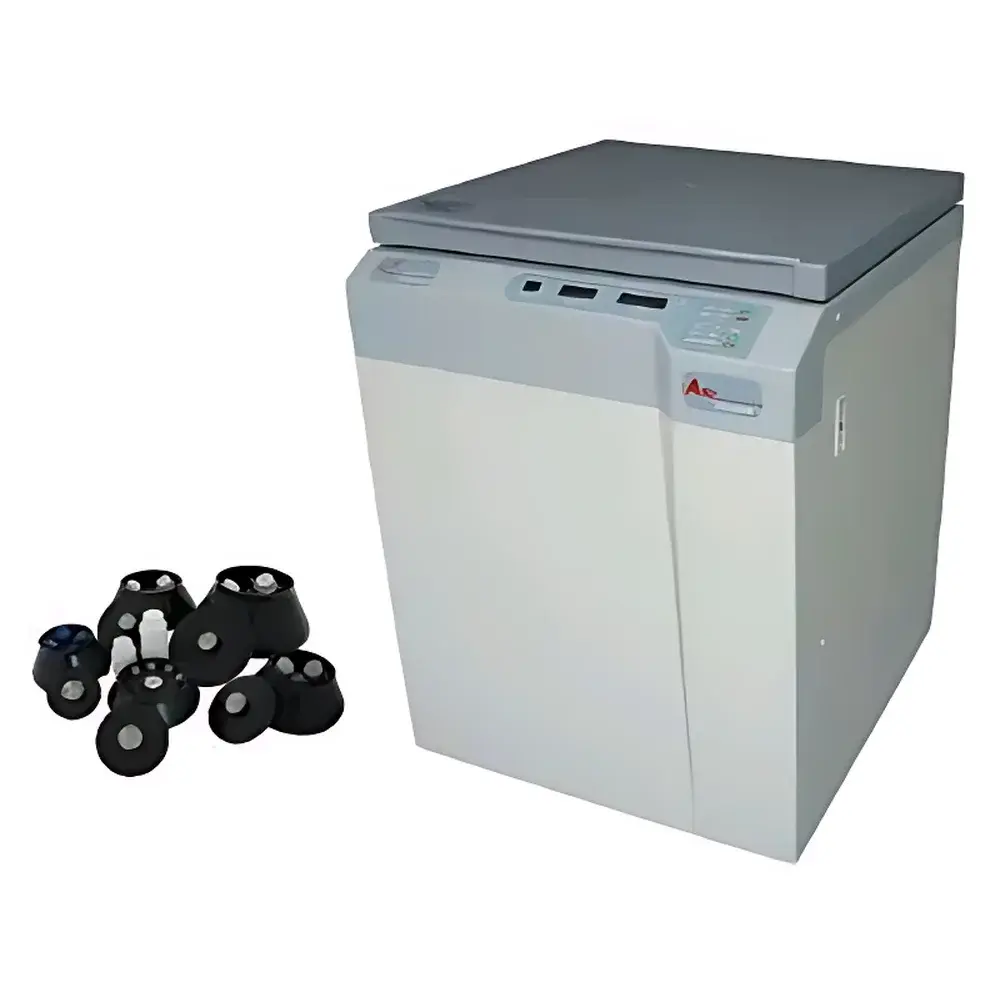
AnTing GL-21C High-Speed Refrigerated Centrifuge
| Brand | AnTing |
|---|---|
| Origin | Shanghai, China |
| Model | GL-21C |
| Max Speed | 21000 rpm |
| Max RCF | 45200 ×g |
| Angular Rotor Capacity | 500 mL × 6 |
| Timer Range | 0–60 min |
| Power Supply | 220 V, 50 Hz, 1900 VA |
| Dimensions (L×W×H) | 640 × 690 × 905 mm |
| Weight | 180 kg |
Overview
The AnTing GL-21C High-Speed Refrigerated Centrifuge is an engineered laboratory instrument designed for high-efficiency separation of biological and chemical samples under precisely controlled low-temperature conditions. Operating on the principle of sedimentation centrifugation—where differential density, particle size, and shape govern separation kinetics—the GL-21C delivers reproducible, high-resolution fractionation across a broad operational envelope. With a maximum rotational speed of 21,000 rpm and a peak relative centrifugal force (RCF) of 45,200 ×g, it supports demanding applications in subcellular organelle isolation, macromolecular purification, and clinical specimen processing. Its integrated refrigeration system maintains sample temperature stability between –20 °C and +40 °C, minimizing thermal denaturation and enzymatic degradation during prolonged runs. The unit employs a brushless frequency-controlled motor for precise speed regulation, ensuring minimal vibration, low acoustic noise (<65 dB(A)), and long-term mechanical reliability.
Key Features
- High-performance refrigeration system with independent compressor cooling and real-time PID temperature control (±1 °C accuracy over full range)
- Microprocessor-based digital control panel with intuitive LCD interface, programmable run parameters (speed, time, temperature, acceleration/deceleration profiles)
- Robust stainless-steel chamber and rotor housing compliant with IEC 61010-1 safety standards for laboratory equipment
- Automatic rotor recognition via embedded RFID tags (compatible with eight standard angular rotors, including 500 mL × 6 capacity configuration)
- Dynamic imbalance detection and automatic shutdown to prevent mechanical damage or sample loss
- Three-stage deceleration control (fast/standard/soft) to preserve pellet integrity for sensitive biomolecules
- CE-marked construction with reinforced structural frame (180 kg mass ensures operational stability at maximum RCF)
Sample Compatibility & Compliance
The GL-21C accommodates a wide spectrum of sample types—including whole blood, tissue homogenates, bacterial lysates, viral suspensions, nucleic acid preparations, and protein complexes—across volumes from 5 mL to 500 mL per tube. Its rotor configurations meet ISO 15195:2019 requirements for calibration traceability in clinical laboratories and support protocols aligned with CLSI EP05-A3 (precision evaluation) and USP (dissolution testing). All rotors are certified to ISO 21501-4 for dimensional tolerance and dynamic balancing (G ≤ 2.5 mm/s at rated speed). The system complies with GLP and GMP documentation requirements when used with optional audit-trail-enabled software modules.
Software & Data Management
While the base GL-21C operates via standalone front-panel controls, optional USB-connected PC software enables method storage, run logging, and export of CSV-formatted reports containing timestamped speed, RCF, temperature, elapsed time, and fault codes. Data files conform to ASTM E2500-22 guidelines for electronic record integrity and may be integrated into LIMS environments supporting HL7 or ASTM E1384 interfaces. Audit trail functionality—when enabled—records user login, parameter changes, start/stop events, and error alerts with immutable timestamps, satisfying FDA 21 CFR Part 11 compliance prerequisites for regulated laboratories.
Applications
- Isolation of mitochondria, lysosomes, and plasma membranes from mammalian cell lysates using differential centrifugation gradients
- Purification of plasmid DNA, genomic DNA, and RNA via high-speed pelleting and supernatant recovery
- Concentration and clarification of monoclonal antibodies, recombinant enzymes, and vaccine antigens
- Preparative separation of exosomes and extracellular vesicles (EVs) from serum, plasma, or conditioned media
- Routine hematological processing: leukocyte depletion, platelet-rich plasma (PRP) preparation, and buffy coat isolation
- Environmental microbiology: concentration of waterborne pathogens (e.g., Cryptosporidium oocysts, Legionella pneumophila) prior to PCR analysis
FAQ
What is the minimum and maximum operating temperature range?
The refrigeration system maintains chamber temperatures from –20 °C to +40 °C, with setpoint resolution of 1 °C and steady-state deviation ≤ ±1 °C.
Does the GL-21C support fixed-angle and swinging-bucket rotors interchangeably?
The GL-21C is configured exclusively for fixed-angle rotors; eight validated angular rotor options are available, each with unique speed/RCF limits and tube compatibility profiles.
Is rotor calibration traceable to national standards?
Yes—each rotor carries a factory-issued calibration certificate referencing NIST-traceable torque and speed measurement systems per ISO/IEC 17025 accredited procedures.
Can the centrifuge be integrated into automated lab workflows?
Via optional RS-232 or Ethernet interface modules, the GL-21C supports remote command execution (start/stop/pause), status polling, and alarm notification through SCADA or MES platforms.
What safety certifications does the instrument carry?
The unit meets IEC 61010-1 (Ed. 3.1), EN 61326-1 (EMC), and CE directives for electrical safety, electromagnetic compatibility, and mechanical integrity in Class II laboratory environments.



