
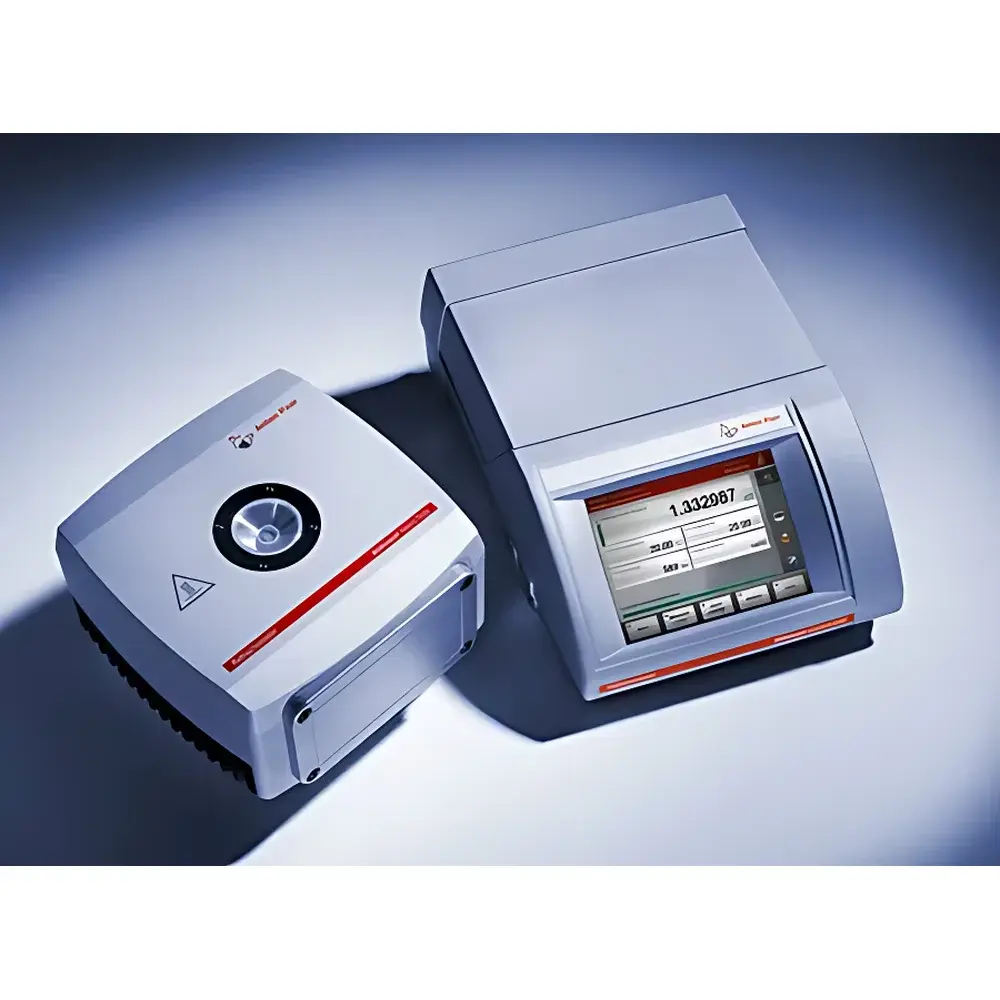
Anton Paar Abbemat Series Refractometers
| Brand | Anton Paar |
|---|---|
| Origin | Austria |
| Model | Abbemat Series |
| Temperature Control | Yes |
| Digital Display | Yes |
| IP Rating | IP68 (Abbemat 450/650) |
| Compliance | FDA 21 CFR Part 11, GLP/GMP |
| Measurement Principle | Critical Angle Method with LED-based Sodium D-Line (589.3 ± 0.1 nm) |
| Prism Material | Synthetic Sapphire (Abbemat 450/650), YAG (Abbemat HT/MW) |
| Minimum Sample Volume | ~0.2 mL |
| Measurement Time | <5 s (after thermal equilibration) |
| Temperature Range | −42 to +85 °C (Abbemat 450/650), 10 to 110 °C (Abbemat HT), adjustable for MW models |
| Refractive Index Range | 1.26–1.72 (nD), accuracy ±0.00002 to ±0.00004 nD |
| Brix Range | 0–100 %, resolution 0.001 % |
| Temperature Stability | ±0.002 °C |
| Light Source | Long-life LED (>100,000 h) |
| Interfaces | RS-232, CAN bus, Ethernet, VGA (PC-dependent) |
Overview
The Anton Paar Abbemat Series Refractometers are precision optical instruments engineered for high-accuracy refractive index (nD) and related concentration measurements—including Brix, % w/w, and molar fraction—across demanding industrial and regulated laboratory environments. Based on the critical angle principle, each Abbemat model employs a monochromatic LED light source precisely tuned to 589.3 ± 0.1 nm (sodium D-line equivalent), eliminating spectral drift and ensuring long-term photometric stability. The measurement cell integrates a thermally stabilized prism assembly with direct-contact temperature sensing, enabling real-time compensation and sub-millikelvin thermal control fidelity. Unlike traditional Abbe refractometers, the Abbemat platform eliminates moving mechanical parts—no manual focusing, no vernier adjustment—thereby eliminating mechanical hysteresis and calibration drift over time. Its robust architecture supports continuous operation in harsh settings: IP68-rated housings (for Abbemat 450 and 650), chemical resistance to acids, bases, and organic solvents, and condensation-free internal optics even under high-humidity or sub-zero ambient conditions.
Key Features
- Sealed stainless-steel or anodized aluminum housing rated IP68 (Abbemat 450/650), certified for washdown and explosive-atmosphere-adjacent use
- T-Check™ active prism surface temperature calibration—automatically verifies and adjusts thermal offset between sensor and optical interface
- Modular design supporting side-mount orientation to prevent sediment interference during measurement of suspensions, pulps, or particulate-laden samples
- No-moving-parts optical path ensures zero mechanical drift and >10-year metrological stability without recalibration
- Integrated temperature control with ramp rates up to 5 °C/min and stability of ±0.002 °C—validated per ASTM E1252 and ISO 17025 traceability protocols
- Multi-wavelength capability (Abbemat MW) enables dispersion analysis (dn/dλ) and calculation of Abbe number for polymer and pharmaceutical excipient characterization
- High-temperature variant (Abbemat HT) delivers precise nD measurements up to 110 °C, supporting hot-process monitoring in petrochemical cracking or syrup concentration lines
Sample Compatibility & Compliance
The Abbemat Series accommodates diverse sample types—including opaque emulsions, viscous syrups, volatile solvents, and abrasive slurries—without compromising optical integrity. The 0.2 mL minimum volume requirement reduces reagent consumption and waste generation, while the 90° side-mount configuration mitigates particle settling effects. All wetted materials comply with USP Class VI and FDA 21 CFR 177.2600 standards: synthetic sapphire prisms, perfluoroelastomer (FFKM) gaskets, PPS-GF40 and PEEK structural components (HT variant), and ETFE/PTFE fluid paths. Full compliance with 21 CFR Part 11 is embedded at firmware level: electronic signatures, role-based user access (admin/operator/auditor), immutable audit trails with timestamped action logs, and cryptographic hash verification of exported datasets. Optional 3Q documentation (DQ/IQ/OQ/PQ) supports GMP validation in pharmaceutical manufacturing and contract research organizations.
Software & Data Management
Operation is managed via PC-based SOP software running on Windows 7–11 (64-bit), offering method-driven workflows compliant with ISO/IEC 17025 and ICH Q2(R2). Preconfigured methods cover sugar chemistry (ICUMSA), beverage titration (AOAC 985.24), pharmaceutical excipient ID (USP ), and hydrocarbon analysis (ASTM D1218). Users may define custom calculation templates incorporating polynomial corrections, density cross-referencing (via optional Anton Paar DMA integration), or multi-parameter trending. Data export supports CSV, PDF, XML, and LIMS-ready formats with embedded metadata: instrument ID, operator signature, environmental log (ambient T/RH), calibration history, and uncertainty budgets per GUM (JCGM 100:2018). All reports include configurable headers (company logo, address, QA stamp) and digital watermarking to prevent unauthorized modification.
Applications
- Quality control of sucrose, fructose, and invert sugar solutions in food & beverage production (e.g., soft drink concentrates, jam fillings)
- In-process monitoring of ethanol-water mixtures during distillation and biofuel refining
- Concentration verification of active pharmaceutical ingredients (APIs) and lyophilized formulations pre-fill
- Refractive index profiling of polymer melts and solvent-based coatings during R&D
- Real-time Brix tracking in citrus juice evaporation and dairy ultrafiltration systems
- Dispersion analysis of nanomaterial suspensions and colloidal drug carriers using Abbemat MW
- High-temperature refractometry of molten salts, heat-transfer fluids, and lubricant base stocks (Abbemat HT)
FAQ
What temperature accuracy is guaranteed across the Abbemat series?
All models maintain ±0.03 °C absolute accuracy (at 20 °C reference) and ±0.002 °C short-term stability, verified against NIST-traceable PRTs and documented in factory calibration certificates.
Can Abbemat instruments be integrated into existing automation networks?
Yes—native support for Modbus TCP, OPC UA, and EtherNet/IP enables direct PLC interfacing; CAN bus allows daisy-chaining with Anton Paar density meters and viscometers for multi-parameter process analytics.
Is cleaning validation supported for regulated environments?
Each measurement cycle logs prism contact time, rinse volume (if connected to automated washer), and post-cleaning baseline verification—fully auditable within the 21 CFR Part 11-compliant database.
How does T-Check differ from conventional temperature calibration?
T-Check measures actual prism surface temperature—not just bath or block temperature—using micro-fabricated thin-film sensors directly bonded to the optical interface, correcting for thermal lag and interfacial resistance errors.
Are there limitations on sample volatility or vapor pressure?
Volatile samples require closed-cell measurement mode (optional accessory); maximum permissible vapor pressure is 100 kPa at operating temperature—validated per EN 61000-6-4 electromagnetic compatibility testing.



