
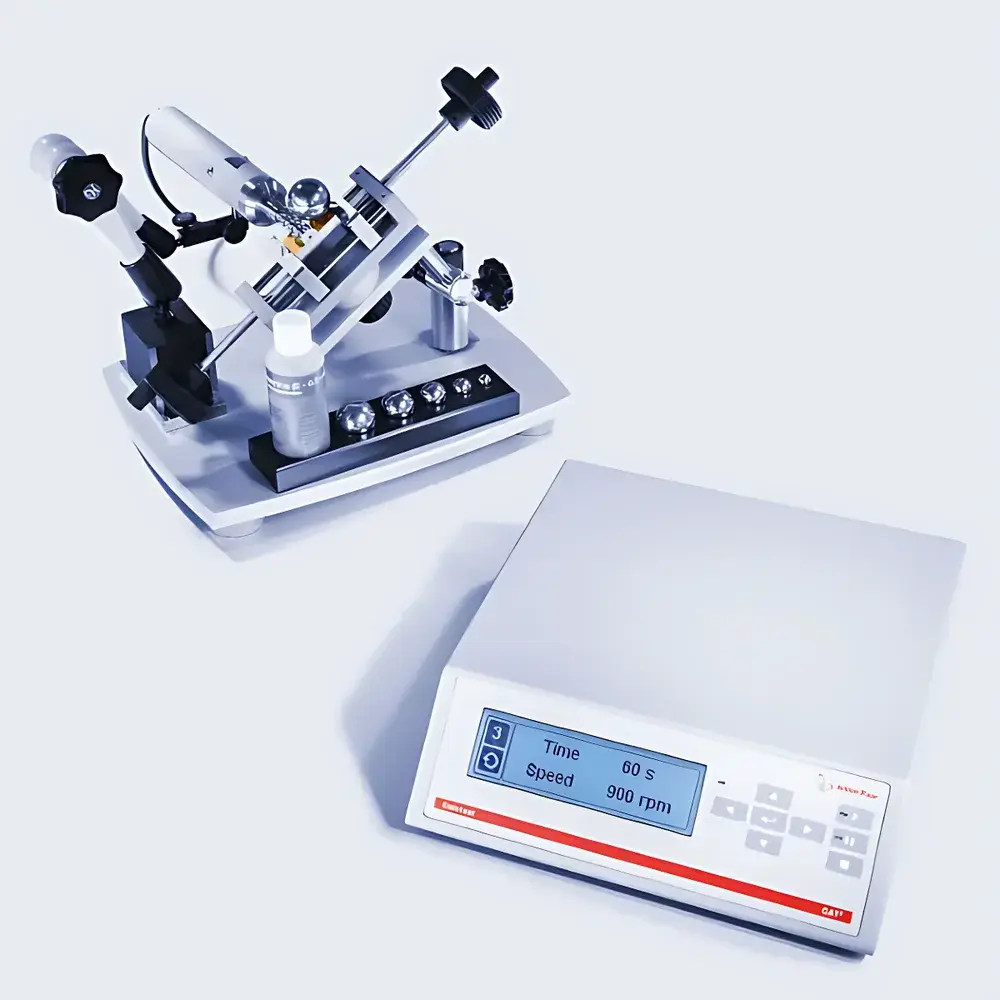

Anton Paar Calotest Series Coating Thickness Tester
| Brand | Anton Paar |
|---|---|
| Origin | Switzerland |
| Manufacturer Type | Manufacturer |
| Origin Category | Imported |
| Model | Calotest Series |
| Instrument Type | Ball Cratering Tribological Coating Thickness Tester |
| Maximum Operating Temperature | Ambient (23 °C ± 2 °C) |
| Rotational Speed Range | 10–3000 rpm |
| Wear Time Range | 1–10000 s |
| Standard Ball Diameters | 10, 15, 20, 25.4, 30 mm |
| Measurable Coating Thickness Range | 0.1–50 µm |
| Applicable Standards | ISO 1071-2, VDI 3198 |
Overview
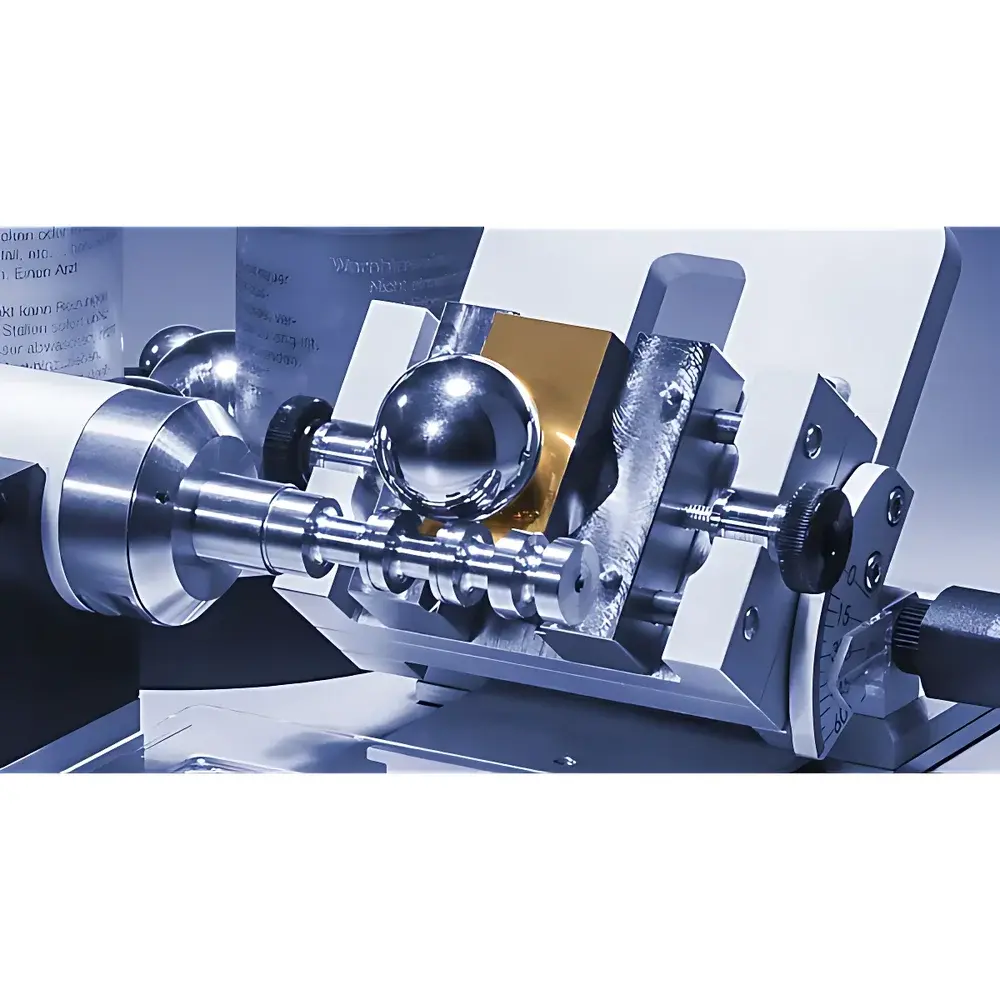
The Anton Paar Calotest Series is a precision-engineered ball cratering tribometer designed specifically for non-destructive, quantitative measurement of coating thickness on industrial components. Unlike cross-sectional microscopy or profilometry—which require time-intensive sample preparation including embedding, sectioning, grinding, polishing, and selective etching—the Calotest employs a controlled mechanical wear process based on the standardized ball cratering method. A rotating spherical indenter (typically tungsten carbide or hardened steel) is pressed against the coated surface under defined load and rotational speed, generating a precisely shaped crater through the coating layer(s) into the substrate. The resulting crater geometry is optically measured via integrated high-resolution digital microscopy or external optical profilometry, and coating thickness is calculated using established geometric relationships between crater depth, ball radius, and wear volume. This principle enables rapid, repeatable, and operator-independent thickness determination across single-layer and multilayer architectures—without altering the bulk mechanical integrity of the test specimen.
Key Features
- Three modular configurations: CAT²c (compact benchtop), CAT²i (industrial-grade with enhanced environmental stability), and CAT²combo (dual-mode system supporting both ball cratering and complementary tribological testing such as pin-on-disk or reciprocating wear)
- Measurement time per sample: 2–5 minutes—no sample mounting, embedding, or metallurgical preparation required
- Validated thickness range: 0.1 µm to 50 µm, covering CVD, PVD, anodized layers, electroplated and electrophoretic deposits, polymer films, paints, and industrial coatings
- Robust rotational drive system with digitally controlled speed range from 10 rpm to 3000 rpm, ensuring consistent shear conditions across diverse coating hardnesses and adhesion profiles
- Programmable wear duration from 1 s to 10,000 s, enabling precise crater depth control for ultra-thin (30 µm) systems
- Interchangeable spherical indenters in standard diameters (10, 15, 20, 25.4, 30 mm) to optimize crater geometry resolution versus coating thickness and substrate compliance
- Integrated environmental monitoring (temperature, humidity) to maintain ASTM E177-compliant ambient test conditions (23 °C ± 2 °C, 40–60% RH)
Sample Compatibility & Compliance
The Calotest Series accommodates planar, curved (spherical, cylindrical), and moderately rough surfaces (Ra ≤ 5 µm) without requiring surface leveling or flattening. Its algorithmic compensation for local topography—implemented in the CaloSoft analysis suite—ensures traceable thickness values independent of macroscopic sample geometry. All measurements comply with ISO 1071-2:2018 (“Metallic and inorganic coatings — Measurement of coating thickness — Ball cratering method”) and VDI 3198 (“Wear testing by ball cratering”). For regulated environments—including automotive Tier-1 suppliers, aerospace component manufacturers, and medical device coating facilities—the system supports GLP/GMP-aligned workflows: full audit trail logging, user access control, electronic signature capability, and 21 CFR Part 11–compliant data archiving when paired with validated CaloSoft v5.x software.
Software & Data Management
CaloSoft is the dedicated analysis platform for the Calotest Series. It provides automated crater edge detection, multi-layer deconvolution (for bilayer and trilayer stacks), statistical reporting (mean, SD, CV%, min/max), and customizable PDF/Excel export templates aligned with internal QA documentation or customer-specific PPAP requirements. Raw image files (TIFF, BMP), crater profile datasets (.csv), and instrument parameter logs are stored in a relational database with SHA-256 hash verification to ensure data integrity. Optional integration with LIMS (e.g., Thermo Fisher SampleManager, LabVantage) enables direct transfer of coating thickness results into enterprise quality management systems. All software modules undergo annual re-validation per ISO/IEC 17025:2017 clause 5.9.2.
Applications
- Quality assurance of hard coatings (TiN, CrN, DLC) on cutting tools and molds
- Thickness uniformity mapping of anodized aluminum aerospace skins (MIL-A-8625 Type II/III)
- Process validation of electroless nickel-phosphorus (ENP) plating on hydraulic valves
- R&D screening of gradient PVD coatings for biomedical implants (ISO 13779-2 compliant)
- Failure analysis of delaminated paint systems on automotive body panels (SAE J2334)
- Verification of barrier layer thickness in flexible electronics encapsulation (IPC-CC-830B)
FAQ
Is the ball cratering method destructive to the sample?
The method creates a localized crater (~100–500 µm diameter) but preserves functional integrity of the component; it is classified as semi-destructive per ISO 1071-2 and accepted for 100% inline QC in high-value manufacturing.
Can Calotest measure coatings on soft substrates like polymers or composites?
Yes—by selecting lower rotational speeds, reduced normal force, and larger-diameter balls, the system minimizes substrate deformation while maintaining crater geometry fidelity.
How does Calotest handle multilayer stacks with interfacial diffusion zones?
CaloSoft v5.3+ implements a constrained least-squares fitting algorithm that models interlayer mixing based on crater wall slope discontinuities observed in high-magnification optical profiles.
What calibration standards are recommended for routine verification?
NIST-traceable certified reference materials (CRMs) such as NIST SRM 2134 (TiN on Si) and PTB RM 101 (anodized Al) are advised for daily system performance checks.
Is remote operation and monitoring supported?
CAT²i and CAT²combo models include Ethernet/IP connectivity and OPC UA server support, enabling secure remote diagnostics, real-time status dashboards, and integration into Industry 4.0 MES environments.



