
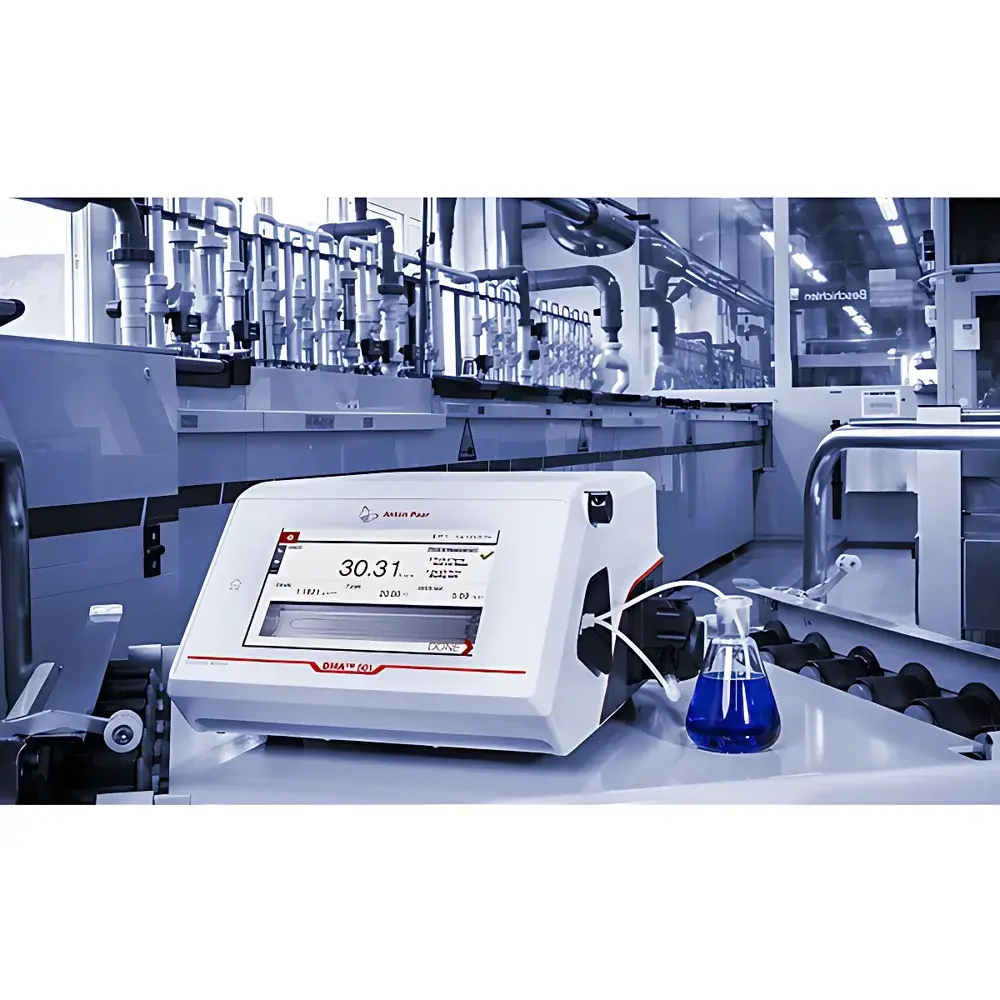
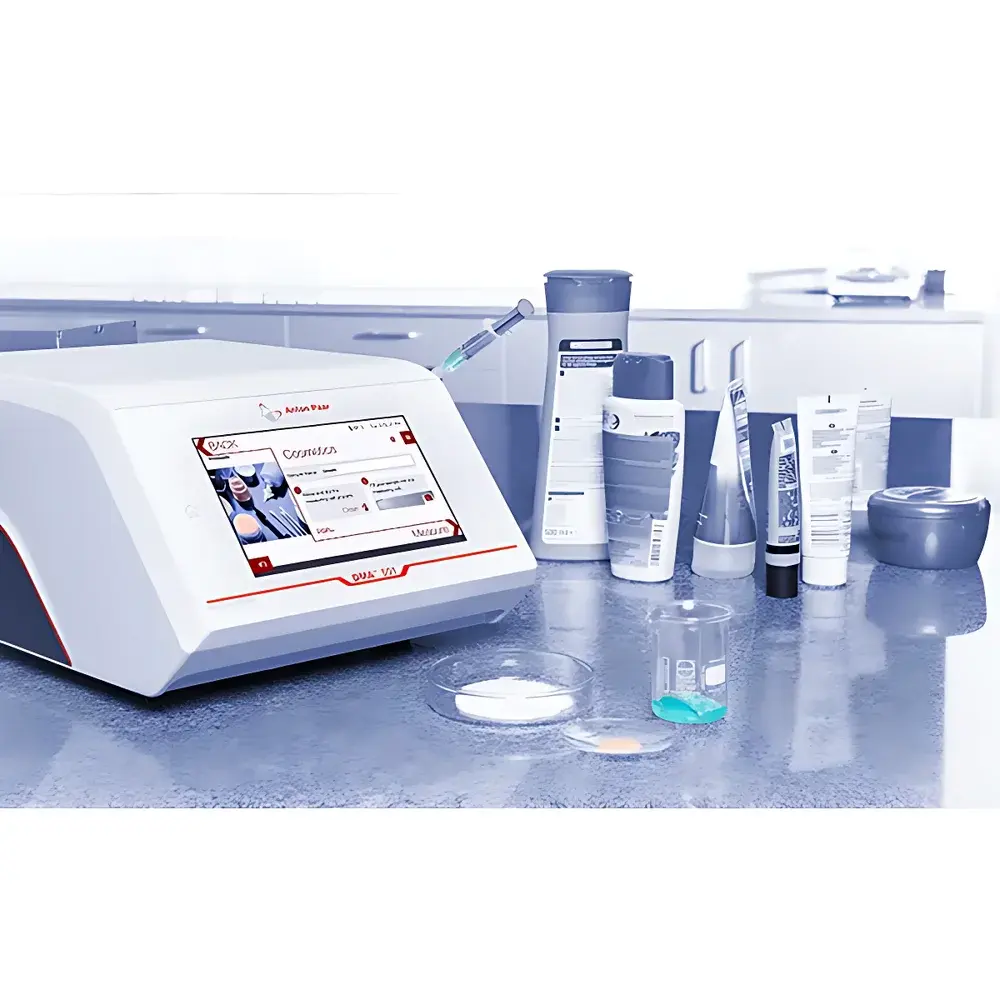
Anton Paar DMA 501 Oscillating U-Tube Digital Density Meter
| Brand | Anton Paar |
|---|---|
| Origin | Austria |
| Model | DMA 501 |
| Instrument Type | Benchtop Oscillating Tube Densitometer |
| Sample Type | Liquids, Suspensions, Emulsions, Pastes, Aerosols |
| Density Range | 0 to 3 g/cm³ |
| Density Accuracy | ±0.001 g/cm³ |
| Density Resolution | 0.0001 g/cm³ |
| Temperature Range | 15–40 °C |
| Temperature Accuracy | ±0.3 °C |
| Repeatability (Std. Dev.) | ±0.0002 g/cm³ |
| Reproducibility (Std. Dev.) | ±0.0004 g/cm³ |
| Minimum Sample Volume | 1 mL |
| Viscosity Correction | Full-range automatic |
| Compliance | ISO 5725, ASTM D4052, ISO 12185, USP <841>, GLP/GMP-ready |
| Dimensions (L×W×H) | 375 × 265 × 180 mm |
| Weight | 13.5 kg |
| Display | 7″ TFT WVGA Touchscreen (800 × 480 px) |
| Connectivity | Ethernet, 3× USB, RS232 |
| Data Storage | 5,000 measurements |
| Environmental Monitoring | Integrated temperature/humidity/pressure sensors |
| Optional Accessories | Aerosol adapter, peristaltic pump, paste sampling kit, ISO calibration certificate |
Overview
The Anton Paar DMA 501 is a benchtop oscillating U-tube digital density meter engineered for high-precision liquid density determination in regulated and non-regulated laboratory, quality control, and production environments. It operates on the fundamental physical principle of measuring the resonant frequency of a U-shaped glass tube filled with sample—where density is inversely proportional to the square of the oscillation period. This method, standardized under ISO 12185 and ASTM D4052, delivers traceable, SI-traceable results with minimal operator dependency. The instrument integrates patented Pulsed Excitation Method technology, which actively characterizes the full oscillation decay profile to suppress damping artifacts from viscous, heterogeneous, or particle-laden samples—including emulsions, suspensions, creams, and pressurized aerosols. Its robust mechanical architecture, borosilicate glass measurement cell, and PTFE-wetted components ensure long-term stability and chemical compatibility across diverse industrial matrices.
Key Features
- Patented Pulsed Excitation Method for stable oscillation analysis—even with high-viscosity, non-homogeneous, or gas-containing samples
- U-View™ optical monitoring system with integrated HD camera for real-time visualization and automated filling validation (FillingCheck™)
- Full-range automatic viscosity correction algorithm compliant with ISO 2737 and ASTM D4052 Annex A2
- Intelligent environmental monitoring: built-in temperature, humidity, and pressure sensors trigger adaptive warnings and operational guidance (e.g., dew point detection)
- 7-inch capacitive touchscreen interface with smartphone-like navigation, customizable home screen, and multi-language support (12 languages)
- Glove-compatible operation and splash-proof front panel for use in production or warehouse settings
- Modular accessory ecosystem: aerosol adapter (for pressurized liquid-phase aerosols), peristaltic pump (for low-viscosity automated sampling), and paste sampling kit
- GLP/GMP-ready data integrity features including audit trail, user access levels, electronic signatures (via optional software), and 21 CFR Part 11 compliance readiness
Sample Compatibility & Compliance
The DMA 501 accommodates a broad spectrum of liquid-phase samples without requiring dilution or phase separation: Newtonian and non-Newtonian liquids, aqueous and organic solutions, suspensions (e.g., pigment dispersions), emulsions (e.g., cosmetic lotions), pastes (e.g., toothpaste, adhesives), and liquefied aerosols (with dedicated adapter). All wetted parts—U-tube, inlet capillary, and valve seats—are constructed from borosilicate glass and PTFE, ensuring resistance to corrosion and leaching. The instrument meets international metrological standards including ISO 12185 (petroleum products), ISO 5725 (accuracy and precision), ASTM D4052 (density of crude oil and liquid petroleum products), and USP (density and specific gravity). Its design supports routine calibration verification using certified reference materials (e.g., air/water/density standards), and optional ISO-accredited calibration certificates are available.
Software & Data Management
The embedded firmware stores up to 5,000 measurement records with full metadata: timestamp, operator ID, sample ID, temperature, pressure, density, calculated concentration (via built-in conversion tables), and image snapshots from U-View™. Data export is supported via USB mass storage, Ethernet (SMB/CIFS, FTP), or RS232—compatible with LIMS, ELN, and MES systems. Internal conversion libraries include alcohol by volume (ABV), Brix, Plato, API gravity, sulfuric acid, sodium hydroxide, and hydrochloric acid concentration tables—eliminating manual interpolation. All events—including calibration, cleaning, error recovery, and parameter changes—are logged with timestamps and user attribution. For regulated environments, optional PC software (e.g., LabX® Lite or full LabX) enables centralized instrument management, electronic signature workflows, and 21 CFR Part 11-compliant audit trails.
Applications
The DMA 501 serves as a primary density measurement platform across industries where compositional control, formulation consistency, or regulatory compliance is critical. In pharmaceutical manufacturing, it verifies excipient concentrations, monitors solvent blends, and supports dissolution testing protocols. In food & beverage, it quantifies sugar content in syrups, alcohol in spirits, and extractables in brewing wort. Petrochemical labs employ it for crude assay, distillate grading, and additive dosing verification. Cosmetics QA teams rely on it for emulsion density profiling, preservative efficacy testing, and batch release of creams and serums. Third-party testing laboratories use it for accredited density reporting per ISO/IEC 17025 requirements. Its compact footprint and rugged construction also make it suitable for mobile QC stations in warehousing or field deployment.
FAQ
What sample types can the DMA 501 measure accurately?
It measures homogeneous liquids, emulsions, suspensions, pastes, and pressurized aerosols—provided minimum 1 mL volume is available and viscosity remains within operational limits (up to ~20,000 mPa·s with appropriate accessories).
Does the instrument require external temperature control?
No—it features an integrated Peltier-controlled thermostat with active temperature stabilization between 15 °C and 40 °C; ambient air cooling is sufficient for most lab environments.
How is data integrity ensured for regulated workflows?
All measurements include immutable metadata, time-stamped event logs, and optional electronic signature support via LabX software—enabling full compliance with FDA 21 CFR Part 11, EU Annex 11, and ISO/IEC 17025 documentation requirements.
Can the DMA 501 be integrated into automated production lines?
Yes—via RS232 or Ethernet interfaces, it supports SCADA communication protocols and can be triggered remotely for unattended batch analysis when paired with optional peristaltic pump or autosampler modules.
Is calibration traceable to national standards?
Yes—Anton Paar provides NIST-traceable or ISO/IEC 17025-accredited calibration services; internal verification uses certified density standards (e.g., water, air, and reference oils) following ISO 12185 procedures.
Related Products



