
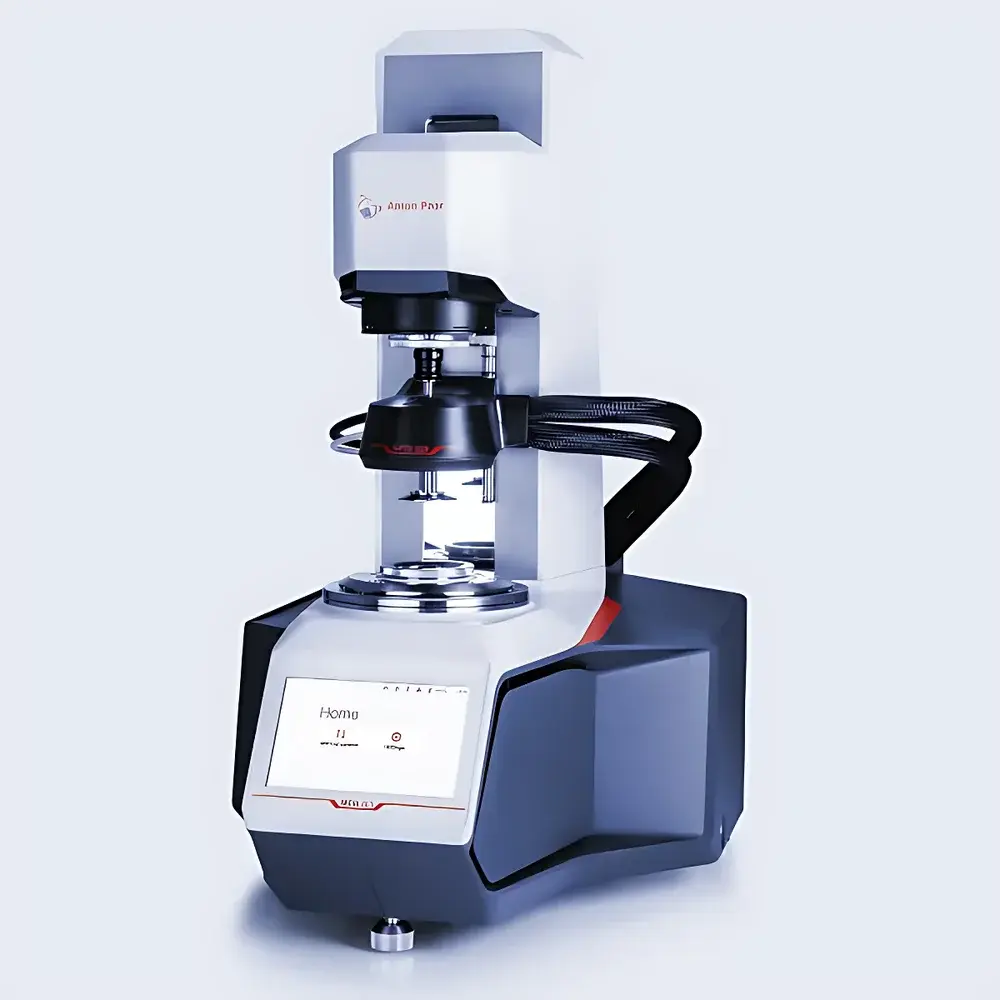

Anton Paar MCR 703 MultiDrive Advanced Rotational Rheometer
| Brand | Anton Paar |
|---|---|
| Origin | Austria |
| Manufacturer Type | Original Equipment Manufacturer (OEM) |
| Origin Category | Imported |
| Model | MCR 703 |
| Instrument Type | Rotational Rheometer |
| Sample Viscosity Range | High-Viscosity Fluids |
| Sample State | Liquid |
| Motor Bearing | Precision Porous Carbon Air Bearing |
| Frequency Range | 2 × 10⁻⁸ – 200 Hz |
| Minimum Rotational Speed | 0 rpm |
| Maximum Torque | 230 mNm |
| Maximum Rotational Speed | 6000 rpm |
| Torque Resolution | <1 nrad |
Overview
The Anton Paar MCR 703 MultiDrive is a dual-motor, air-bearing-supported advanced rotational rheometer engineered for uncompromising precision in complex fluid and soft-solid characterization. Based on Couette flow geometry and torque-controlled or strain-controlled rotational measurement principles, it delivers traceable, high-fidelity rheological data across static, transient, and dynamic regimes—including creep, stress relaxation, step-strain, large-amplitude oscillatory shear (LAOS), and frequency sweeps. Its core architecture integrates two electronically commutated (EC) synchronous permanent-magnet motors—each independently controlled and supported by ultra-low-friction porous carbon air bearings—enabling three distinct operational modes: Controlled Motor–Torque (CMT), Separated Motor–Torque (SMT), and Counter-Rotation Mode. This multi-drive topology eliminates mechanical coupling limitations inherent in single-motor systems, allowing simultaneous application of precise torque and angular displacement while maintaining nanoradian-level resolution in deformation control (TruStrain™). The instrument is designed to meet the stringent metrological requirements of ISO 16520, ASTM D4402, and ISO 3219, and supports full traceability under GLP/GMP environments when paired with compliant software and audit trail configuration.
Key Features
- Dual EC motor architecture enabling CMT, SMT, and Counter-Rotation operational modes for maximum flexibility in experimental design
- Precision porous carbon air bearing system ensuring zero mechanical hysteresis, sub-nanoradian angular resolution (<1 nrad), and long-term stability without lubrication or wear
- TruStrain™ real-time position control delivering true strain input during oscillatory and transient tests—critical for nonlinear viscoelastic analysis
- Integrated 360° capacitive non-contact normal force sensor fully embedded within the bearing assembly for accurate axial load quantification (0.001–50 N)
- High-resolution optical encoder with 0.0625 µm gap resolution for precise sample gap setting and thermal expansion compensation
- Active motor thermal management system maintaining stable temperature gradients during extended dynamic tests
- Toolmaster™ auto-recognition technology for seamless plug-and-play integration of >200 compatible measuring systems, temperature units, and accessories
- QuickConnect™ one-hand coupling mechanism reducing setup time and minimizing alignment errors
Sample Compatibility & Compliance
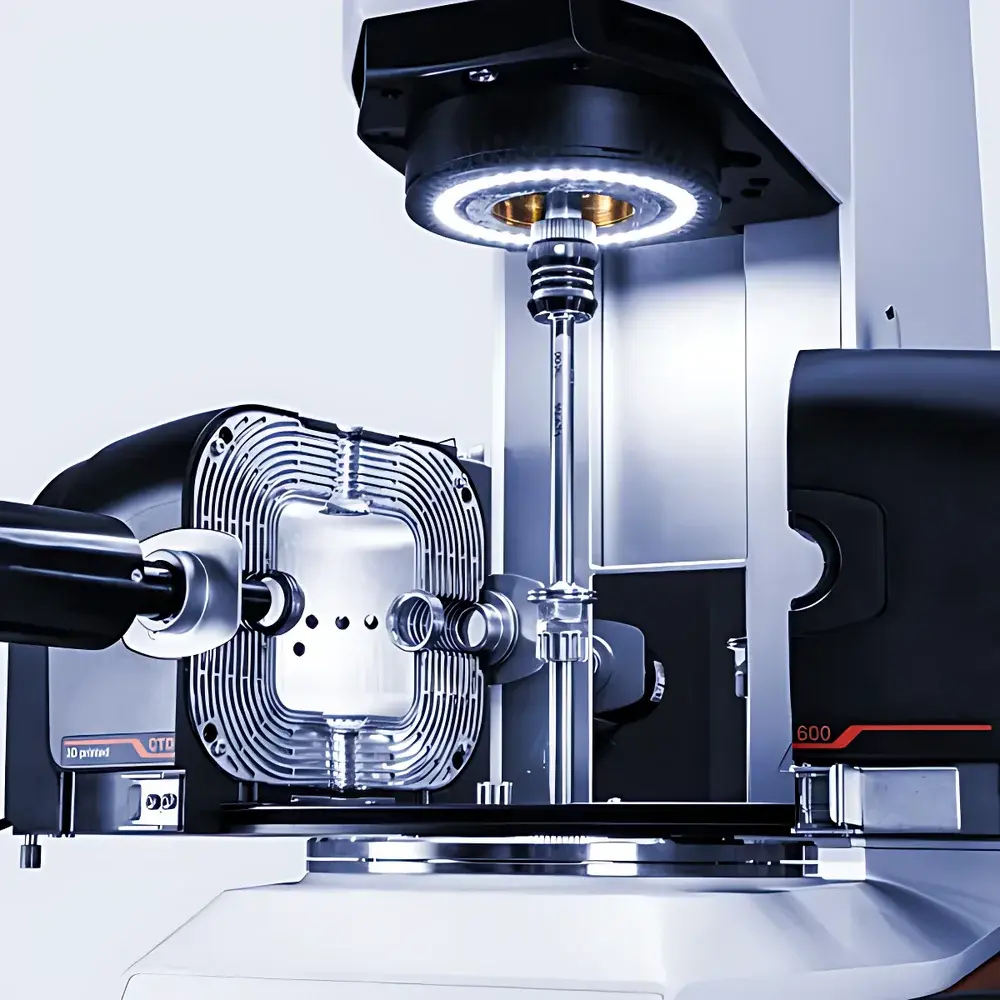
The MCR 703 MultiDrive accommodates liquid, paste, gel, and semi-solid samples with viscosities ranging from millipascal-seconds to >10⁹ Pa·s. It supports standardized geometries—including parallel plates, cone-plate, concentric cylinder (Couette), and vane—and is fully compatible with specialized fixtures for extensional rheology (UXF), DMA in tension/compression/bending/torsion, and tribological testing. All measurement systems comply with ISO 6721 (DMA), ISO 11443 (injection molding simulation), and ASTM D7175 (extensional viscosity). When configured with inert-gas purged enclosures or glovebox-integrated electronics cabinets, the system operates under nitrogen or argon atmospheres—essential for oxygen-sensitive polymers, battery electrolytes, or reactive organometallics. Full compliance with FDA 21 CFR Part 11 is achievable via RheoCompass™ software with electronic signatures, role-based access, and immutable audit trails.
Software & Data Management
RheoCompass™ v5.x serves as the unified platform for instrument control, method development, real-time visualization, and post-processing. It provides pre-validated test templates aligned with ISO, ASTM, and USP standards; automated parameter validation (e.g., edge fracture detection, inertia correction); and batch processing for multi-sample comparative analysis. Raw data files are stored in vendor-neutral HDF5 format with embedded metadata (timestamp, operator ID, calibration history, environmental conditions). Export options include CSV, Excel, and MATLAB-compatible structures. For regulated environments, optional modules enable electronic signature workflows, change control logs, and 21 CFR Part 11-compliant audit trail generation—including user actions, parameter modifications, and data exports. Integration with LIMS via RESTful API enables automated result transfer and quality documentation linkage.
Applications
- Nonlinear viscoelasticity of polymer melts and solutions using LAOS and Fourier-transform rheology (FT-rheology)
- Time–temperature superposition (TTS) and master curve construction for thermorheologically complex materials
- In situ structural evolution studies via coupled rheology–microscopy (e.g., confocal, Raman, or SAXS)
- Extensional rheology of low-viscosity fluids using UXF fixture with Hencky strain >8
- Multi-mode DMA of films, fibers, and composites—including axial-torsional coupling to determine Poisson’s ratio and anisotropic moduli
- Yield stress and thixotropic recovery quantification in colloidal dispersions, cosmetics, and pharmaceutical suspensions
- High-temperature rheology of bitumen, asphalt binders, and thermoset precursors under inert atmosphere
FAQ
What distinguishes the MCR 703 MultiDrive from conventional single-motor rheometers?
It employs two independent EC motors and air bearings to decouple torque generation and measurement—enabling SMT mode for superior signal-to-noise in low-torque transients and Counter-Rotation mode for fixed-plane deformation during microscopy.
Can the MCR 703 perform both rotational rheology and dynamic mechanical analysis (DMA)?
Yes—by replacing the lower rotary drive with a linear actuator, it supports compression, bending, and tensile DMA per ISO 6721, while the upper rotary drive enables torsional DMA, including simultaneous axial–torsional testing.
Is Toolmaster™ compatibility limited to Anton Paar accessories?
No—Toolmaster™ recognizes all Anton Paar–certified measuring systems, temperature units (e.g., Peltier, electric furnace, cryo), and third-party accessories with certified digital interfaces.
How does the system ensure measurement traceability in regulated labs?
Through integrated calibration certificate management, automatic logging of sensor drift corrections, and RheoCompass™’s 21 CFR Part 11–compliant audit trail module with electronic signatures and version-controlled SOPs.
What is the minimum measurable torque in oscillatory mode?
0.2 nNm—achieved via optimized signal conditioning, low-noise electronics, and air-bearing isolation from environmental vibration.



