
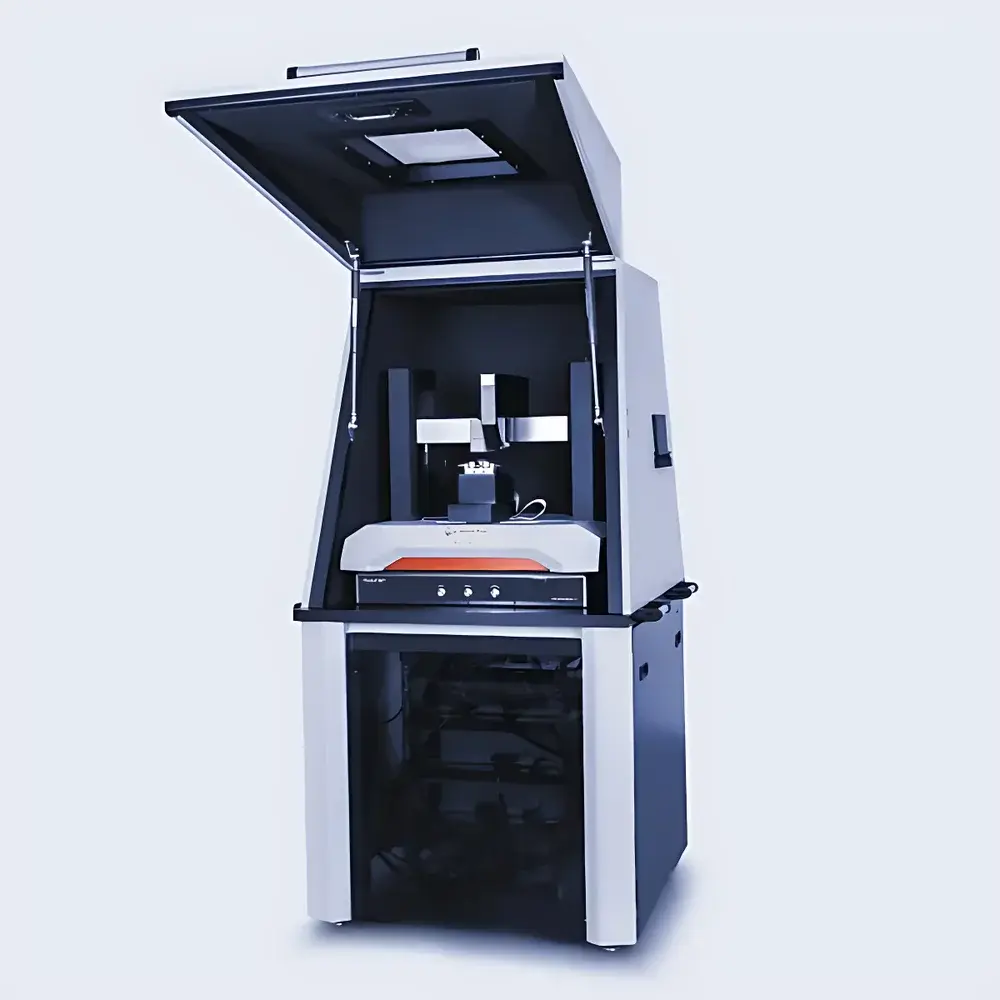
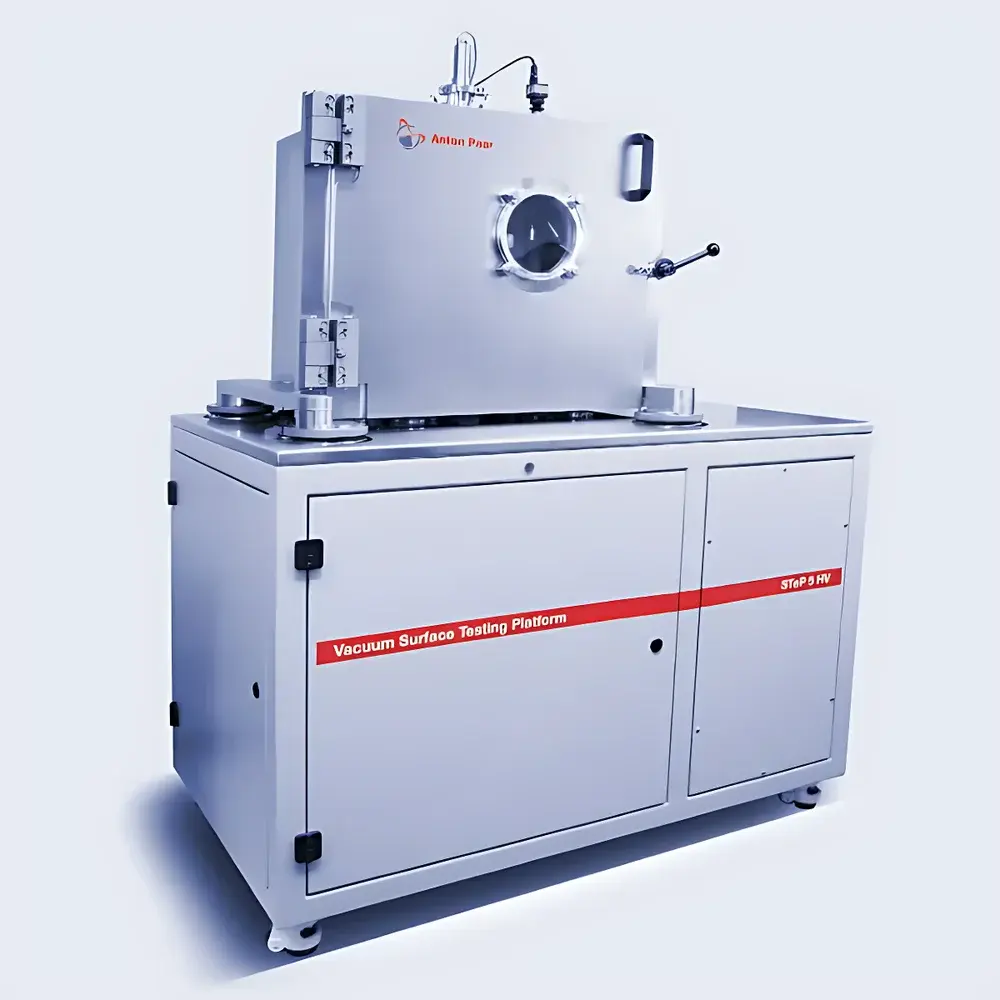
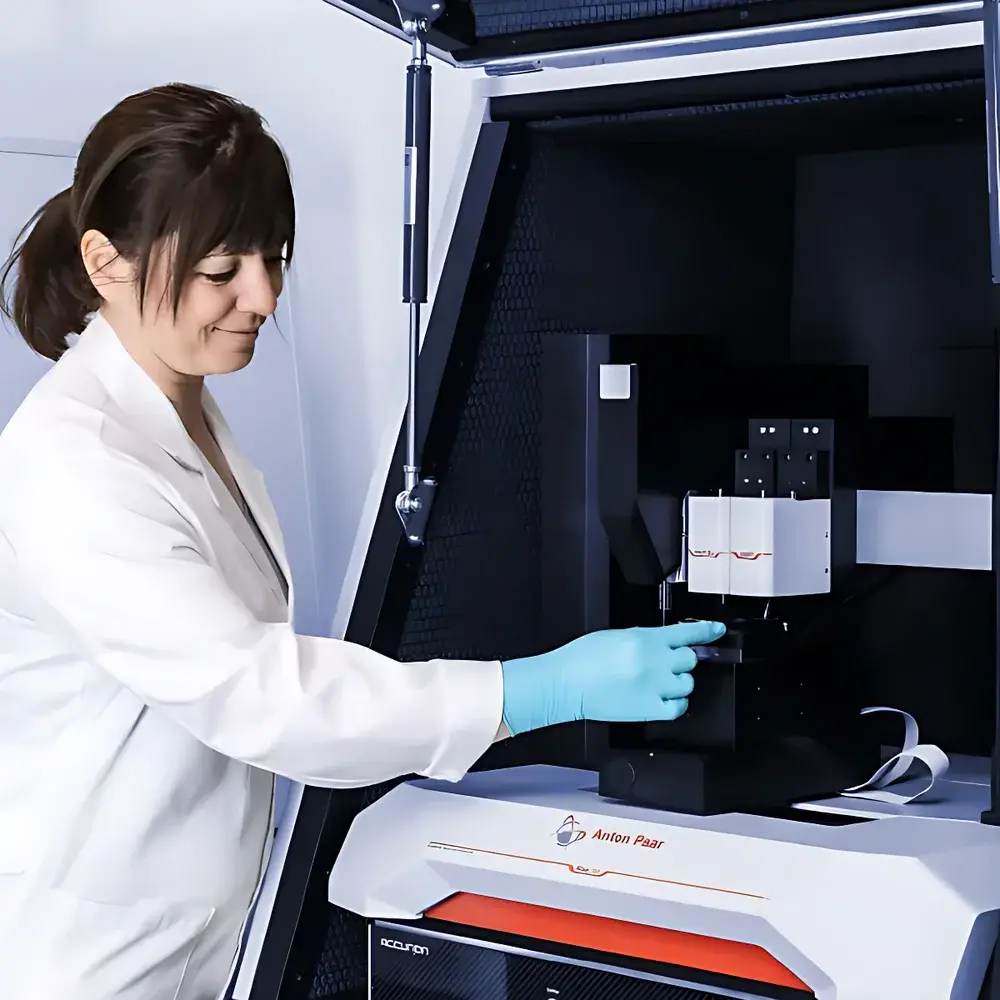
Anton Paar UNHT³ HTV High-Temperature High-Vacuum Ultra-Nanoindentation Tester
| Brand | Anton Paar |
|---|---|
| Origin | Switzerland |
| Manufacturer Type | Original Equipment Manufacturer (OEM) |
| Product Origin | Imported |
| Model | UNHT³ HTV |
| Instrument Type | Ultra-Nanoindentation Tester |
| Maximum Indentation Depth | 100 µm |
| Effective Load Range | 100 mN |
| Load Resolution | 3 nN |
| Displacement Resolution | 0.003 nm |
| Thermal Drift (Ambient) | < 0.5 nm/min |
| Thermal Drift (Up to 800 °C) | < 3 nm/min |
| Frame Stiffness | > 10⁶ N/m |
| Frame Compliance | < 0.1 nm/mN |
| Vacuum Base Pressure | 1×10⁻⁷ mbar |
| Maximum Operating Temperature | 800 °C |
| Temperature Stability | ±0.1 °C (surface-controlled) |
| Compliance Standards | ISO 14577, ASTM E2546 |
Overview
The Anton Paar UNHT³ HTV is the world’s first commercially available high-temperature, high-vacuum ultra-nanoindentation tester engineered for quantitative mechanical characterization of thin films, coatings, and nanostructured materials under rigorously controlled thermal and environmental conditions. Based on continuous-contact, depth-sensing indentation principles compliant with ISO 14577 and ASTM E2546, the system employs a dual-sensor architecture—separate high-resolution capacitive displacement and piezoresistive load transducers—to enable true closed-loop control in both load- and displacement-controlled modes. Its core innovation lies in the integration of three independently regulated infrared (IR) heating elements—targeting the indenter tip, reference tip, and sample surface—and four embedded thermocouples enabling real-time, surface-referenced temperature feedback with ±0.1 °C stability across the full 25–800 °C operating range. The ultra-stable mechanical frame (>10⁶ N/m stiffness, <0.1 nm/mN compliance) and sub-nanometer displacement resolution (0.003 nm RMS) ensure measurement fidelity even during prolonged high-temperature dwell sequences or creep testing.
Key Features
- Triple IR heating system with independent thermal regulation of indenter tip, reference tip, and sample—eliminating thermal gradient artifacts and enabling true isothermal indentation at elevated temperatures.
- Active vacuum environment maintained by a 5-axis magnetically levitated turbomolecular pump with buffer isolation; primary roughing pump can be switched off during measurement to suppress mechanical vibration below detectable thresholds.
- Dual-sensor metrology architecture: separate capacitive displacement sensor (0.003 nm resolution) and piezoresistive load sensor (3 nN resolution), decoupled from frame deformation effects via optimized kinematic design.
- Thermal drift performance: <0.5 nm/min at ambient temperature; <3 nm/min across the entire 800 °C operational range—validated per ISO 14577 Annex B protocols.
- High-vacuum compatibility (base pressure ≤1×10⁻⁷ mbar) enables oxidation-free testing of reactive metals, nitrides, carbides, and 2D materials, as well as in situ studies of surface diffusion and interfacial degradation kinetics.
Sample Compatibility & Compliance
The UNHT³ HTV supports planar samples up to 50 mm in diameter and 25 mm in thickness, including conductive and insulating substrates (Si, sapphire, fused silica, metallic alloys, CVD-grown graphene, and ALD-deposited oxides). All measurements adhere to ISO 14577-1:2022 (Metallic materials — Instrumented indentation test for hardness and materials parameters) and ASTM E2546-21 (Standard Test Method for Instrumented Indentation Testing). Data acquisition and reporting are structured to support GLP/GMP audit readiness, with optional 21 CFR Part 11-compliant electronic signatures, user access control, and full audit trail logging through the included Nanoscan software platform.
Software & Data Management
Nanoscan v4.x provides fully integrated instrument control, real-time thermal monitoring, automated multi-point mapping (up to 10,000 indents per session), and advanced post-processing modules—including Oliver–Pharr analysis, modulus mapping, creep recovery fitting, and thermal expansion coefficient derivation from unloading slope temperature dependence. Raw data (load–displacement–time–temperature quadruples) are stored in vendor-neutral HDF5 format with embedded metadata (calibration history, environmental logs, operator ID, timestamp, and uncertainty annotations). Export options include CSV, MATLAB .mat, and MTEX-compatible formats for third-party microstructure-property correlation workflows.
Applications
- Quantification of temperature-dependent hardness and elastic modulus gradients in thermal barrier coatings (e.g., YSZ, Gd₂Zr₂O₇) and bond coats (NiCoCrAlY) used in gas turbine engines.
- In situ nanomechanical evaluation of interfacial delamination onset in Cu/low-k dielectric stacks under thermal cycling, supporting reliability modeling for advanced IC packaging.
- Mechanical property mapping of irradiated nuclear fuel cladding materials (e.g., Zr–Nb alloys) under inert vacuum to prevent hydride formation artifacts.
- Creep and stress relaxation behavior of amorphous metal–organic frameworks (MOFs) and polymer-derived ceramics between 300–700 °C.
- Validation of ab initio predicted elastic anisotropy in epitaxial transition metal dichalcogenide monolayers (MoS₂, WSe₂) under controlled UHV conditions.
FAQ
What vacuum level is required to perform oxidation-sensitive measurements?
The system achieves a base pressure of ≤1×10⁻⁷ mbar using a magnetically levitated turbomolecular pump and cryo-trapped foreline; this is sufficient to suppress oxide nucleation on Ti, Al, and Mg-based thin films during heating to 800 °C.
Can the UNHT³ HTV perform continuous hold tests at elevated temperature?
Yes—thermal stability of ±0.1 °C at the sample surface, combined with sub-nanometer displacement resolution and active drift compensation algorithms, enables reliable 10,000-second creep holds with <1% measurement uncertainty in displacement rate.
Is calibration traceable to national metrology institutes?
All load and displacement calibrations are performed using NIST-traceable reference standards (SRM 2099 for load, NIST SRM 2194 for displacement), with calibration certificates issued per ISO/IEC 17025 requirements.
How is tip geometry verified at high temperature?
A dedicated high-temperature tip characterization module uses atomic force microscopy (AFM)-based tip scanning at ambient and elevated temperatures to quantify thermal expansion-induced geometry shifts; correction factors are applied in real time during Oliver–Pharr analysis.
Does the system support third-party environmental chambers or custom fixtures?
The UNHT³ HTV features standardized flange interfaces (CF100) and programmable I/O ports, enabling integration with external gas dosing systems, laser heating stages, or synchrotron beamline sample positioning units—subject to Anton Paar’s mechanical and electromagnetic compatibility validation protocol.



