
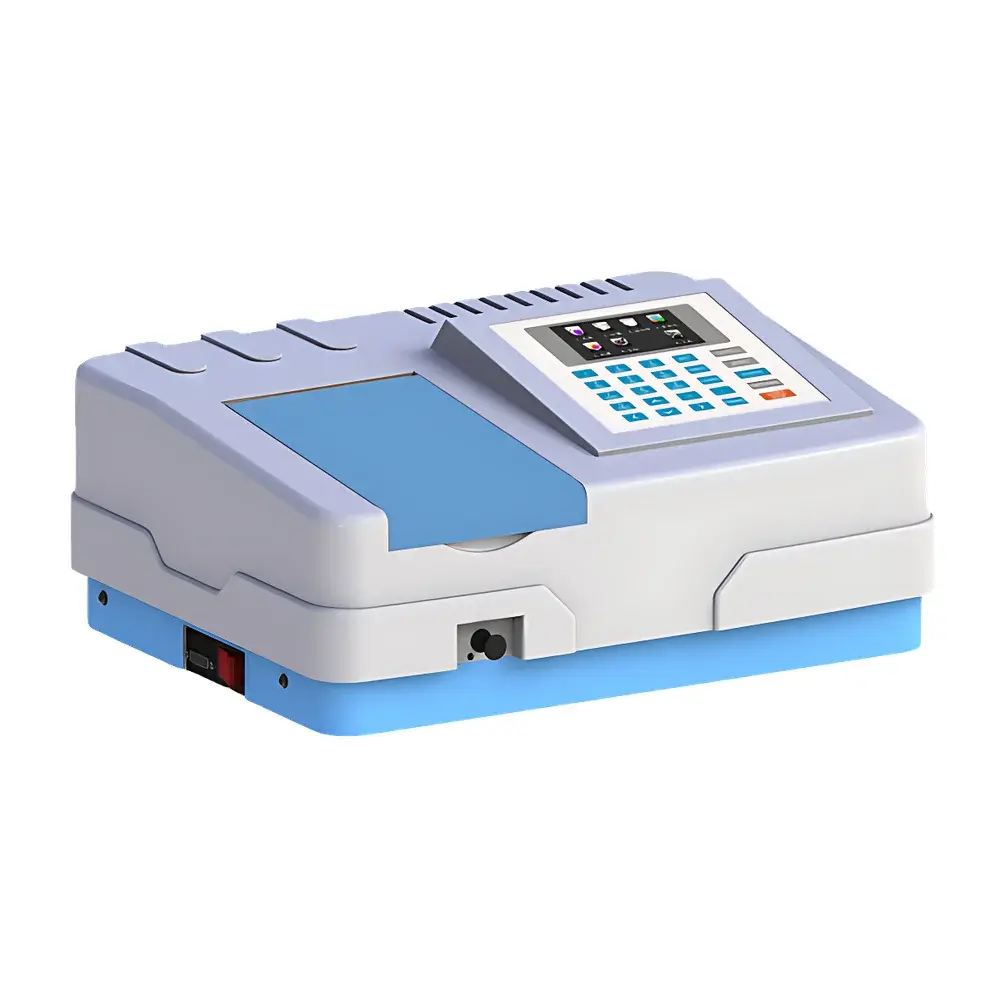
AOE A390 Scanning Ultraviolet-Visible Spectrophotometer
| Brand | AOE |
|---|---|
| Origin | Shanghai, China |
| Manufacturer Type | Authorized Distributor |
| Product Origin | Domestic (China) |
| Model | A390 |
| Price Range | USD 4,200–7,000 (FOB Shanghai) |
| Optical Design | Single-Beam with Dual-Beam Ratio Monitoring |
| Detector Type | Silicon Photocell |
| Wavelength Range | 190–1100 nm |
| Wavelength Accuracy | ±0.3 nm |
| Wavelength Repeatability | ≤0.1 nm |
| Spectral Bandwidth | 0.5, 1.0, 2.0, 4.0, 5.0 nm |
| Stray Light | ≤0.03% T at 360 nm |
| Display | 6.5K-color TFT LCD (800 × 480) |
| Data Storage | 240 calibration curves (240 data points each) onboard |
| Interface | Dual USB 2.0 ports (data export & printer), USB 1.1 host port for firmware update |
| Software | AOE Basic Spectroscopy Suite (certified under PRC Copyright Registration No. 2021SRXXXXXX) |
| Compliance | ISO 9001:2015, CE (2014/30/EU & 2011/65/EU), CMC License (PRC Metrology Certification), RoHS Directive 2011/65/EU |
Overview
The AOE A390 Scanning Ultraviolet-Visible Spectrophotometer is a precision single-beam optical instrument engineered for quantitative and qualitative analysis across the ultraviolet, visible, and near-infrared spectral regions (190–1100 nm). It employs a high-efficiency holographic grating (1200 lines/mm) coupled with dual-beam ratio monitoring—a design that compensates for source intensity drift and detector sensitivity variation without requiring a physical reference beam path. This architecture delivers robust baseline stability and high photometric reproducibility essential for routine QC testing, academic research, and method validation in regulated environments. The instrument operates on Beer–Lambert law-based absorbance (A), transmittance (T), concentration (C), and energy (E) measurement modes, supporting both kinetic and wavelength-scan acquisition protocols. Its modular optical path and thermally stabilized monochromator ensure consistent spectral resolution across the full wavelength range, making it suitable for applications demanding trace-level detection and multi-component spectral deconvolution.
Key Features
- High-resolution 6.5K-color TFT display (800 × 480 pixels) with intuitive graphical user interface for real-time spectrum visualization and parameter adjustment
- Onboard data management: stores up to 240 independent calibration curves, each accommodating 240 measurement points—enabling full method portability without external PC dependency
- Dual USB 2.0 interfaces: one dedicated to PCL-compatible A4 thermal or inkjet printer output; the other for direct U-disk data export in CSV or XML format compliant with LIMS ingestion standards
- Firmware upgradability via USB 1.1 host port: secure, authenticated updates using instrument-specific activation keys downloaded from AOE’s official support portal
- Optical system certified to ISO 9001:2015 quality management requirements and validated per CE Electromagnetic Compatibility (2014/30/EU) and Restriction of Hazardous Substances (2011/65/EU) directives
- Pre-installed AOE Basic Spectroscopy Software—registered with the China National Copyright Administration (Certificate No. 2021SRXXXXXX)—ensuring intellectual property compliance and audit-ready software lineage
Sample Compatibility & Compliance
The A390 accommodates standard 10-mm rectangular quartz or optical glass cuvettes (pathlengths: 1–50 mm optional), as well as microvolume adapters (0.5–2 µL) and solid-sample reflectance accessories. It meets critical regulatory prerequisites for laboratory instrumentation used in pharmaceutical, food safety, and environmental testing workflows—including alignment with USP , ISO/IEC 17025:2017 clause 6.4.7 (equipment verification), and GLP Annex 3 (instrument qualification documentation). While not FDA 21 CFR Part 11–enabled out-of-the-box, its audit trail–capable firmware architecture supports integration with third-party electronic lab notebooks (ELNs) and chromatography data systems (CDS) via standardized ASCII/CSV export protocols.
Software & Data Management
AOE Basic Spectroscopy Suite provides native control of scan speed (60–1200 nm/min), smoothing algorithms (Savitzky–Golay, 3–15 point), peak detection thresholds, and multi-curve overlay functions. All measurement metadata—including date/time stamp, operator ID, instrument serial number, lamp hours, and spectral acquisition parameters—is embedded in exported files. The software supports calibration verification against NIST-traceable standards (e.g., Holmium Oxide filter for wavelength accuracy, Potassium Dichromate for photometric linearity) and generates PDF reports compliant with internal QA documentation templates. Raw spectral data (.spc or .csv) retains full 0.1-nm step resolution, enabling post-acquisition derivative analysis and multivariate regression modeling.
Applications
- Pharmaceutical assay development and dissolution testing per USP and
- Water quality analysis (COD, NO₃⁻, PO₄³⁻, Fe²⁺/Fe³⁺) following APHA Standard Methods 4500 series
- Enzyme kinetics (e.g., NADH/NADPH oxidation at 340 nm) and protein quantification (Bradford, Lowry, BCA)
- Thin-film thickness and bandgap estimation in materials science via Tauc plot analysis
- Food additive identification and concentration profiling (e.g., synthetic dyes, preservatives)
- Educational laboratories requiring ISO/IEC 17025-aligned teaching platforms with verifiable uncertainty budgets
FAQ
Is the A390 compliant with FDA 21 CFR Part 11 for electronic records and signatures?
No—the A390 does not include built-in electronic signature capability or audit trail generation required by Part 11. However, its deterministic data export format enables integration into validated ELN or LIMS environments where Part 11 controls are centrally managed.
What is the recommended recalibration interval for wavelength accuracy?
AOE recommends annual verification using a Holmium Oxide reference filter (NIST SRM 2034) or holmium perchlorate solution per ISO 6326-1:2019. Daily zeroing with deionized water is advised prior to sample measurement.
Can the instrument be operated without a connected computer?
Yes—the A390 functions autonomously with full spectral acquisition, curve storage, arithmetic operations (A+B, A−B, A×B), and print-to-USB-PCL capability. PC connectivity is optional and used only for advanced reporting or firmware updates.
Does the 0.5 nm spectral bandwidth setting maintain specified stray light performance?
Stray light specification (≤0.03% T at 360 nm) is verified at all bandwidth settings. However, optimal signal-to-noise ratio in narrow-bandwidth mode requires use of quartz cuvettes and fresh solvent blanks due to increased diffraction-related intensity loss.
Is CMC certification recognized internationally for metrological traceability?
CMC (China Metrology Certification) validates conformance with JJG 178–2016 (Chinese national verification regulation for UV-Vis spectrophotometers) and supports traceability to NIM (National Institute of Metrology, China), which maintains mutual recognition agreements (MRAs) with BIPM signatories including NIST and PTB.





