
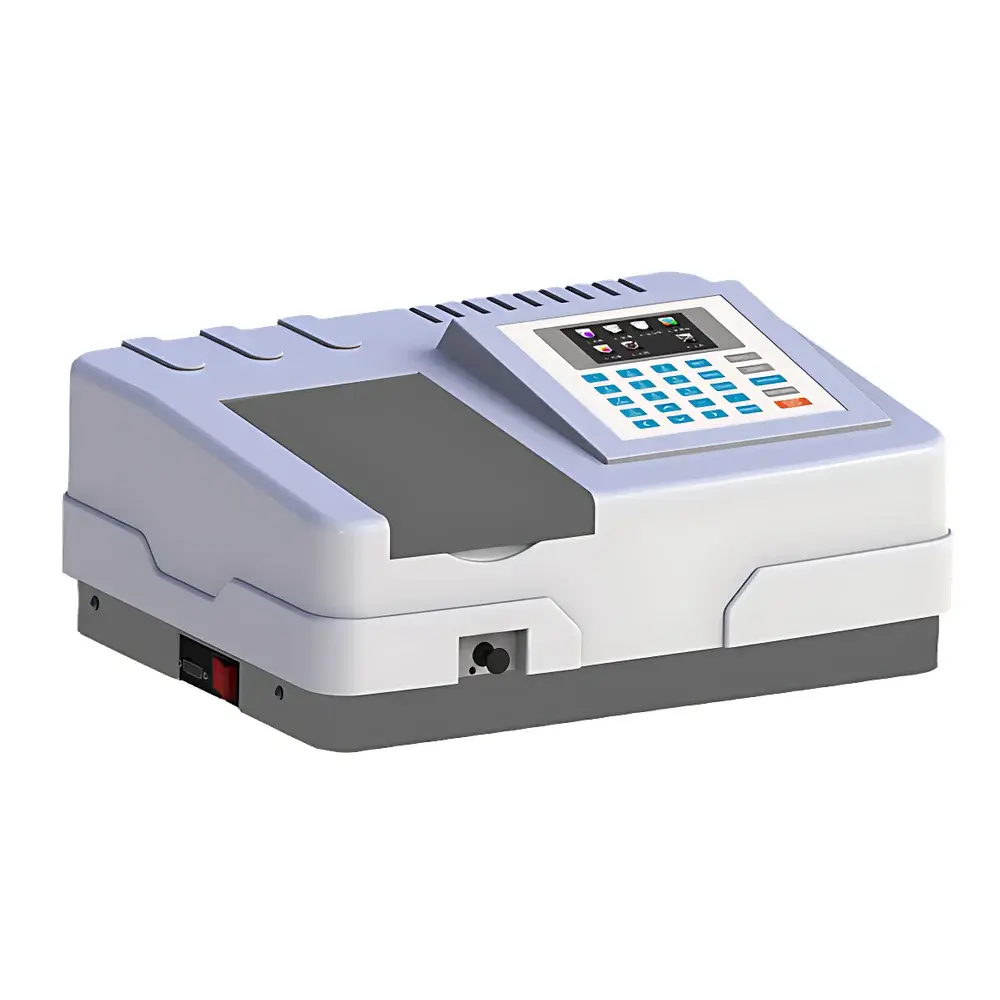
AOE A580 Dual-Beam Ultraviolet-Visible Spectrophotometer
| Brand | AOE |
|---|---|
| Origin | Shanghai, China |
| Model | A580 |
| Optical System | Dual-beam ratio-monitoring |
| Detector Type | Silicon photodiode |
| Wavelength Range | 190–1100 nm |
| Spectral Bandwidth | 1.0 nm |
| Wavelength Accuracy | ±0.2 nm |
| Stray Light | ≤0.02% T @ 360 nm |
| Wavelength Repeatability | ≤0.1 nm |
| Display | 800 × 480 pixel, 65K-color TFT LCD |
| Data Storage | 240 curves (240 data points each) onboard |
| Interface | Dual USB 2.0 ports (data export & printer), USB 1.0 for PC connectivity |
| Software | AOE Basic Spectroscopy Software (certified under PRC Copyright Registration No. 2021SRXXXXXX) |
| Compliance | ISO 9001, CE, CMC, RoHS |
Overview
The AOE A580 Dual-Beam Ultraviolet-Visible Spectrophotometer is an engineered analytical instrument designed for high-stability quantitative and qualitative analysis across research laboratories, quality control environments, and educational institutions. It operates on the principle of dual-beam ratio-monitoring spectroscopy: a single light source is split into two parallel beams—one passes through the sample cuvette, the other through a matched reference—enabling real-time compensation for source intensity drift, lamp aging, and electronic fluctuations. This architecture ensures superior photometric stability and long-term measurement reproducibility without manual baseline recalibration between runs. The optical path incorporates a high-efficiency holographic grating (1200 lines/mm), optimized for minimal aberration and maximal diffraction efficiency across the full 190–1100 nm spectral range. With a fixed spectral bandwidth of 1.0 nm and wavelength accuracy of ±0.2 nm, the A580 meets the performance criteria required for compliance-driven applications in pharmaceutical assay validation, environmental water testing, and food additive quantification per ISO/IEC 17025-accredited workflows.
Key Features
- Dual-beam ratio-monitoring optical design for enhanced baseline stability and reduced photometric noise
- High-resolution 800 × 480 pixel, 65K-color TFT LCD display with intuitive graphical interface and real-time spectrum visualization
- Onboard data storage supporting up to 240 independent calibration curves, each accommodating 240 absorbance/transmittance data points
- Dual USB 2.0 interfaces: one dedicated to direct export of spectral data and method files to USB flash drives; the other compatible with PCL-class printers for A4-format report generation
- Firmware upgrade capability via USB drive using authenticated firmware packages downloaded from the official AOE support portal (instrument-specific serial number required)
- Pre-installed AOE Basic Spectroscopy Software, registered with the China National Copyright Administration (Certificate No. 2021SRXXXXXX), ensuring traceable software lineage and protection against unauthorized redistribution
Sample Compatibility & Compliance
The A580 accommodates standard 10 mm square quartz or glass cuvettes (pathlengths: 1–50 mm with optional holders) and supports both liquid and solid film measurements via accessory modules. Its optical configuration complies with core international standards governing spectrophotometric instrumentation: ISO 9001:2015 for quality management systems, IEC 61000-6-3 for electromagnetic compatibility, and RoHS Directive 2011/65/EU for hazardous substance restriction. The instrument’s certified wavelength accuracy (±0.2 nm) and stray light performance (≤0.02% T at 360 nm) align with ASTM E275–22 and ISO 6223:2021 requirements for UV-Vis spectrophotometer verification. While not pre-configured for 21 CFR Part 11 compliance out-of-the-box, the system supports audit-trail-enabled data archiving when integrated with validated third-party LIMS or ELN platforms meeting GLP/GMP documentation standards.
Software & Data Management
The embedded AOE Basic Spectroscopy Software provides core operational modes—Absorbance (A), Transmittance (T), Concentration (C), and Energy (E)—with multi-point calibration, kinetic scan, and time-based monitoring functions. All spectral acquisitions are timestamped and tagged with operator ID, method name, and instrument serial number. Raw data exports follow CSV and ASCII formats, enabling seamless import into MATLAB, OriginLab, or JMP for advanced statistical modeling. USB-based data transfer preserves metadata integrity, and no proprietary binary formats are used—ensuring long-term data accessibility and interoperability. Software updates are digitally signed and verified during installation to prevent unauthorized modification, reinforcing data integrity in regulated environments.
Applications
- Pharmaceutical QC: Quantitative assay of active pharmaceutical ingredients (APIs) per USP and EP 2.2.25
- Environmental analysis: Nitrate, phosphate, and heavy metal ion determination in surface and wastewater per EPA Method 365.2 and ISO 15681-1
- Food & beverage testing: Colorant concentration (e.g., tartrazine, sunset yellow), antioxidant capacity (FRAP assay), and protein content (Bradford method)
- Academic teaching labs: Beer–Lambert law validation, enzyme kinetics (e.g., LDH activity), and spectral identification of organic chromophores
- Materials science: Thin-film transmittance/absorption profiling for solar cell coatings and optical filters
FAQ
Does the A580 support GLP-compliant data handling?
The instrument records complete metadata (operator, date/time, method, serial number) with every measurement. Full GLP compliance requires integration with external validated software for electronic signatures and audit trails.
Can the A580 perform kinetic measurements?
Yes—it supports time-scan mode with user-defined interval durations (0.1 s to 60 s) and up to 10,000 data points per run, suitable for monitoring enzymatic reactions or photolysis processes.
Is the 1.0 nm spectral bandwidth fixed or variable?
The spectral bandwidth is fixed at 1.0 nm, optimized for resolution–sensitivity balance in routine analytical applications. Variable bandwidth models are available in the A590 series.
What cuvette materials are supported across the full 190–1100 nm range?
Quartz cuvettes are required for measurements below 340 nm. Standard optical glass cuvettes are suitable for visible-range work (≥340 nm).
How is firmware authenticity verified during USB-based upgrades?
Each firmware package includes an embedded digital signature validated by the instrument’s bootloader prior to installation—preventing execution of tampered or mismatched binaries.





