
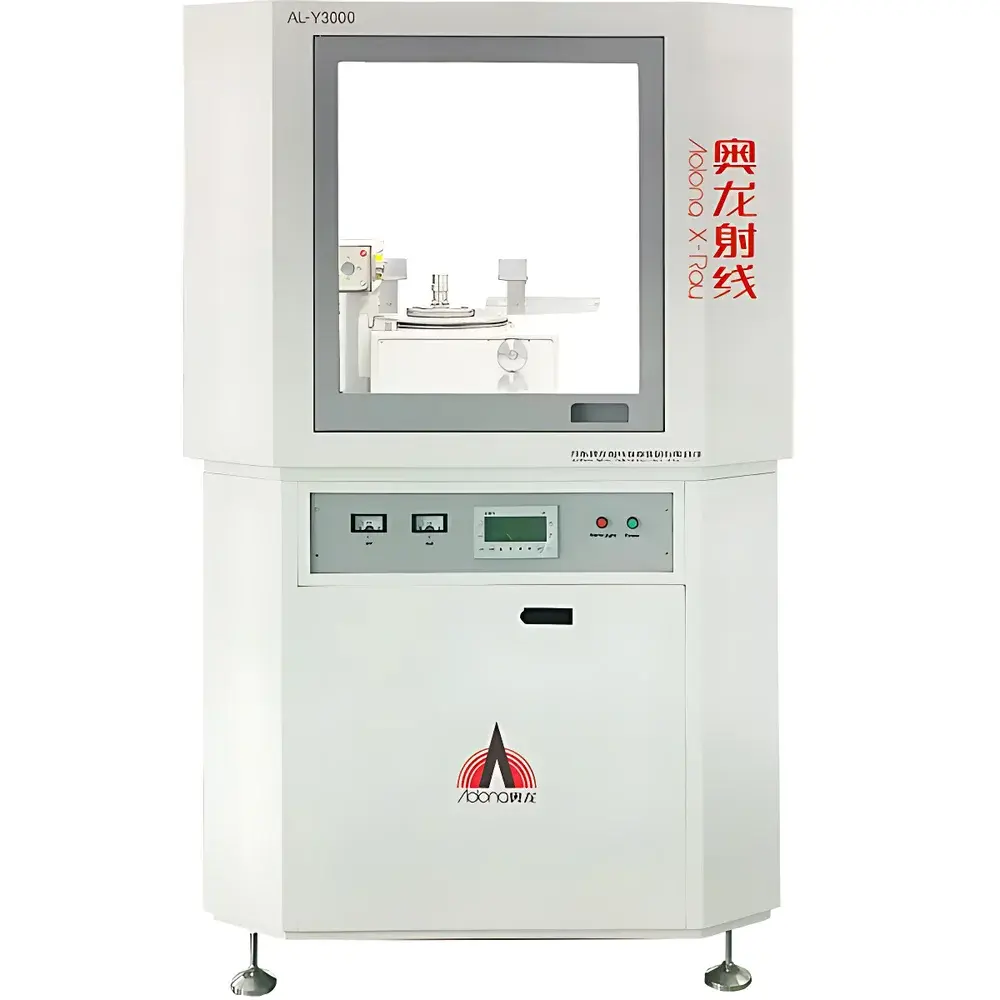
Aolong AL-Y3000 Powder X-ray Diffractometer
| Brand | Aolong |
|---|---|
| Origin | Liaoning, China |
| Manufacturer Type | Manufacturer |
| Product Category | Domestic |
| Model | AL-Y3000 |
| Instrument Type | Powder X-ray Diffractometer |
| Angular Resolution | 0.001° (1/1000°) |
| Geometry | θ–θ configuration |
| X-ray Source | Sealed Metal-Ceramic Tube |
| Detector | Silicon Drift Detector (SDD) |
| Primary Optics | Interchangeable Focusing and Parallel-Beam Optics via 90° Monochromator Rotation |
| Software | Integrated Rietveld Refinement, ICDD/ICSD Database Integration, Stress & Texture Analysis Modules |
| Compliance | Designed for GLP-compliant laboratories |
Overview
The Aolong AL-Y3000 Powder X-ray Diffractometer is a benchtop θ–θ geometry instrument engineered for high-precision crystallographic characterization of polycrystalline and multiphase solid materials. Based on Bragg’s law (nλ = 2d sinθ), it enables quantitative phase identification, lattice parameter determination, crystallite size estimation, microstrain analysis, and residual stress mapping through angularly resolved diffraction intensity measurements in the 2θ range of 5°–120° (extendable with optional goniometer modules). Its sealed metal-ceramic X-ray tube delivers stable output at up to 45 kV / 40 mA, ensuring reproducible intensity profiles across repeated acquisitions. The instrument employs a silicon drift detector (SDD) with intrinsic energy resolution <130 eV at Mn-Kα, enabling rapid acquisition with improved peak-to-background ratio and enhanced discrimination of overlapping reflections—particularly critical for complex mineral assemblages or pharmaceutical polymorph mixtures.
Key Features
- θ–θ goniometer architecture minimizes sample displacement errors and simplifies alignment for thin-film, bulk, and irregular specimens.
- Interchangeable optical configurations—focusing (Bragg–Brentano) and parallel-beam—achieved via 90° rotation of the graphite monochromator and tool-free Soller slit replacement; no realignment required.
- Sealed metal-ceramic X-ray tube ensures long-term stability, low thermal drift, and reduced maintenance intervals compared to glass-envelope tubes.
- High-resolution SDD detector provides ≥3× faster data collection versus conventional scintillation counters, without compromising angular fidelity.
- Modular accessory interface supports plug-and-play integration of heating stages (RT–1200°C), cryo-coolers (80–500 K), stress analyzers, and texture goniometers.
- Precision-machined sample stage guarantees ≤±2 µm positional repeatability—essential for multi-position stress mapping and pole-figure acquisition.
Sample Compatibility & Compliance
The AL-Y3000 accommodates powders, pressed pellets, flat solids, coatings, multilayers, and anisotropic substrates (e.g., rolled metals, polymer films, ceramic tiles). It complies with ISO 17873:2014 (XRD for phase analysis), ASTM E975 (residual stress measurement), and ASTM E1423 (crystallite size by Scherrer method). When operated with validated software and electronic signature modules, the system meets data integrity requirements outlined in FDA 21 CFR Part 11 and EU Annex 11 for regulated environments. All firmware and control logic are traceable to factory calibration certificates issued per ISO/IEC 17025 standards.
Software & Data Management
The integrated acquisition and analysis suite includes real-time background subtraction, automatic peak search with adjustable sensitivity thresholds, Ka₂ stripping, profile fitting (Pseudo-Voigt, Pearson VII), and full-pattern Rietveld refinement using GSAS-II or TOPAS-compatible output formats. Quantitative analysis leverages ICDD PDF-4+ and user-defined libraries (ICSD, COD); amorphous halo subtraction supports semi-crystalline polymer analysis. Stress calculation follows sin²ψ methodology with automated strain scanning and elastic constant database lookup. Texture analysis includes ODF reconstruction via harmonic expansion (WIMV algorithm) and pole figure visualization in stereographic projection. Audit logs record operator ID, timestamp, parameter changes, and raw file checksums—enabling full traceability for GLP/GMP audits.
Applications
- Phase identification and quantification in cement clinkers, fly ash, and geopolymer binders per ASTM C1365.
- Polymorph screening and crystallinity assessment in active pharmaceutical ingredients (APIs) under ICH Q5A guidelines.
- Residual stress profiling in aerospace alloys (Ti-6Al-4V, Inconel 718) following EN 15305.
- Thin-film epitaxy verification and strain relaxation analysis in perovskite solar cell layers.
- Clay mineral quantification in soil and sediment samples per ASTM D4319.
- Texture evolution monitoring during cold rolling of aluminum and copper sheets.
- Crystallite size and microstrain evaluation in nanocatalysts and battery electrode materials.
FAQ
What X-ray tube voltage and current settings are supported?
The sealed metal-ceramic tube operates at 20–45 kV and 5–40 mA, with programmable ramping and interlock protection.
Is the system compatible with third-party databases such as Crystallography Open Database (COD)?
Yes—software supports import of CIF files from COD, ICSD, and user-generated structures for pattern simulation and Rietveld refinement.
Can the AL-Y3000 perform in-situ heating experiments?
With the optional HTK-1200N high-temperature stage, continuous acquisition up to 1200°C is possible under inert or reducing atmospheres.
Does the system support automated sample changers?
A 16-position autosampler module is available as a factory-installed option, fully integrated into the acquisition workflow.
How is angular calibration maintained over time?
The goniometer incorporates an absolute optical encoder with thermal compensation; annual recalibration against NIST SRM 660c (LaB₆) is recommended.




