
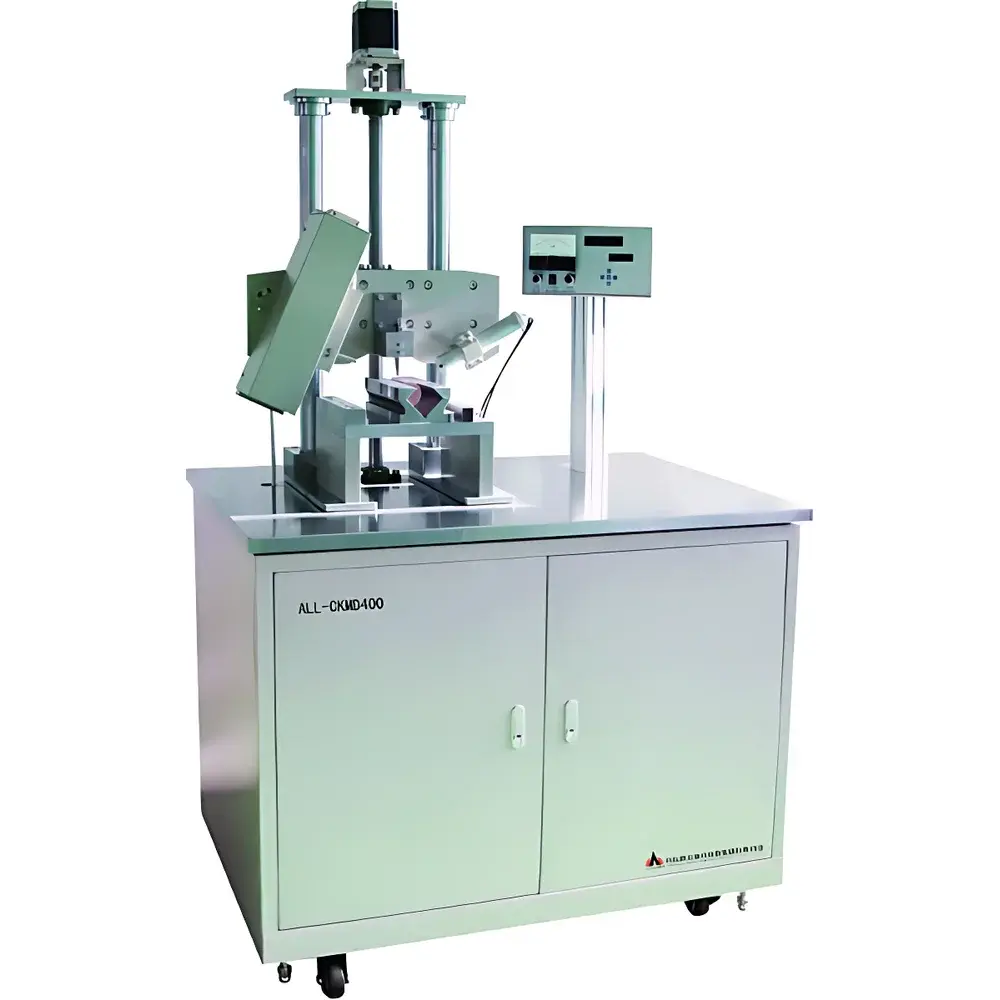
Aolong ALL-CKMD400 X-ray Crystal Orientation Instrument for Reference Plane Alignment
| Brand | Aolong |
|---|---|
| Model | ALL-CKMD400 |
| Type | Benchtop X-ray Crystallographic Orientation Analyzer |
| X-ray Source | Cu-anode, air-cooled, grounded anode |
| Max. Tube Voltage/Current | 30 kV / 5 mA (continuous, adjustable |
| Detector | Proportional Counter (DC 1000 V max) or Scintillation Detector (DC 1200 V max) |
| Time Constant Settings | Fast (1 s) / Slow (2 s) |
| Angular Measurement | θ = 18.917° (18°55′00″) for <A> reference plane |
| Sample Diameter Compatibility | 2", 4", 6" cylindrical crystal rods |
| Primary Shutter | Motorized automatic shutter |
| Display | Analog μA meter (radiation intensity indicator) |
| Dimensions (L×W×H) | 1132 × 642 × 1460 mm |
| Weight | 200 kg |
| Power Input | AC 220 V, 50 Hz, 0.25 kW |
Overview
The Aolong ALL-CKMD400 X-ray Crystal Orientation Instrument is a precision benchtop system engineered for deterministic angular alignment of single-crystal ingots relative to their intrinsic crystallographic reference planes—specifically the plane (θ = 18.917°, equivalent to 18°55′00″). Operating on the Bragg diffraction principle, the instrument utilizes monochromatic Cu-Kα radiation (λ = 1.5418 Å) generated by a sealed, fan-cooled X-ray tube with grounded anode configuration. When incident X-rays strike the curved cylindrical surface of a rotating crystal rod, constructive interference occurs only at the precise Bragg angle corresponding to the lattice spacing and orientation of the target plane. The detector—either a gas-proportional counter or scintillation detector—captures the diffracted intensity peak, which is displayed in real time on an analog microampere (μA) meter. This enables operators to identify and mechanically lock the crystal orientation at maximum signal amplitude prior to downstream processing (e.g., lapping, slicing, or grinding). Designed exclusively for reference-plane-based alignment—not full-pattern XRD—the ALL-CKMD400 delivers repeatable, operator-independent angular positioning essential for semiconductor, optoelectronic, and piezoelectric crystal manufacturing where wafer yield and device performance depend critically on crystallographic registration.
Key Features
- Fixed-angle Bragg geometry optimized for rapid -plane detection at θ = 18.917°, with optional C- or R-plane configurations available per customer specification
- Modular, rigid base platform with precision-machined locating surface (right side) and screw-actuated clamping mechanism (left side) ensuring repeatable sample centering and mechanical stability during rotation
- Motor-driven automatic X-ray shutter synchronized with sample rotation, minimizing operator exposure and enabling consistent beam-on timing
- Dual time-constant electronics (1 s fast / 2 s slow) for adaptive signal integration—critical for distinguishing true Bragg peaks from background noise in low-intensity diffraction scenarios
- Interchangeable detector options: proportional counter (DC 1000 V max) for high-count-rate stability or scintillation detector (DC 1200 V max) for enhanced sensitivity in low-flux conditions
- Integrated analog μA meter providing immediate visual feedback of diffracted intensity—eliminating dependency on software interfaces and supporting GLP-compliant manual recordkeeping
Sample Compatibility & Compliance
The ALL-CKMD400 accommodates cylindrical single-crystal rods of 2-inch (50.8 mm), 4-inch (101.6 mm), and 6-inch (152.4 mm) diameters, including but not limited to silicon (Si), germanium (Ge), gallium arsenide (GaAs), lithium niobate (LiNbO₃), and quartz (SiO₂). Sample mounting requires no cutting or polishing—only surface cleaning—enabling non-destructive pre-processing orientation verification. The instrument conforms to IEC 61000-6-3 (EMC emission standards) and incorporates primary shielding consistent with national regulatory limits for Class II X-ray generating devices (GBZ 138–2002, China; equivalent to ANSI N43.3–2020 in functional safety scope). While not certified to ISO/IEC 17025, its calibration protocol—using traceable NIST-equivalent standard crystal rods—supports internal quality system validation under ISO 9001 and IATF 16949 frameworks. Radiation safety interlocks, key-controlled power activation, and shutter status indicators meet basic ALARA (As Low As Reasonably Achievable) operational requirements.
Software & Data Management
The ALL-CKMD400 operates as a hardware-centric, manually guided instrument with no embedded operating system or proprietary software suite. All measurement data—including peak position, exposure duration, tube voltage/current settings, and operator ID—are recorded manually in laboratory notebooks or LIMS-compatible spreadsheets. This architecture eliminates cybersecurity vulnerabilities, ensures long-term data portability, and simplifies FDA 21 CFR Part 11 compliance for audit trails when paired with controlled documentation procedures (e.g., dated, signed log entries). Optional RS-232 or USB-to-serial interface modules can be integrated to transmit analog meter output (0–10 V or 4–20 mA) to external DAQ systems for automated peak logging—though such configurations require user-developed acquisition scripts and fall outside factory warranty coverage.
Applications
- Pre-slicing orientation verification of boules prior to wafering in Si, GaAs, and sapphire production lines
- Quality control of crystal rod batches entering epitaxial growth facilities—ensuring consistent -plane alignment across ingot lots
- Reference-plane calibration of diamond-turned optical substrates (e.g., KDP, BBO) used in nonlinear frequency conversion
- Process validation for piezoelectric crystal blank fabrication (e.g., quartz resonators), where AT-cut orientation tolerance is ±0.02°
- Educational use in solid-state physics laboratories for hands-on Bragg’s law demonstration using macroscopic crystal samples
FAQ
What crystallographic planes can the ALL-CKMD400 measure besides the plane?
The standard configuration is calibrated for the plane at θ = 18.917°, but custom angular setups for C-plane (e.g., 0001 in hexagonal systems) or R-plane orientations are available upon request and require mechanical recalibration using certified reference crystals.
Is the instrument suitable for measuring oriented thin films or wafers?
No. The ALL-CKMD400 is designed exclusively for bulk cylindrical crystal rods. It does not support flat wafer mounting, ω-2θ scanning, or rocking curve analysis.
Does the system include radiation shielding certification documentation?
Yes—manufacturer-supplied shielding test reports (per GBZ 138–2002) and leakage radiation measurements (<1 µSv/h at 5 cm) are provided with each unit. Site-specific installation surveys remain the responsibility of the end-user’s radiation safety officer.
Can the detector be upgraded in-field to a silicon drift detector (SDD)?
No. The detector interface is electrically and mechanically fixed to either proportional or scintillation types. SDD integration would require redesign of HV supply, pulse processing electronics, and mechanical housing—beyond retrofit feasibility.
What maintenance intervals are recommended for the X-ray tube?
Under recommended operating conditions (≤2.0 mA, intermittent use ≤4 h/day), tube lifetime exceeds 5,000 hours. Annual vacuum integrity check and filament resistance verification are advised; replacement tubes are field-swappable with factory calibration revalidation.





