
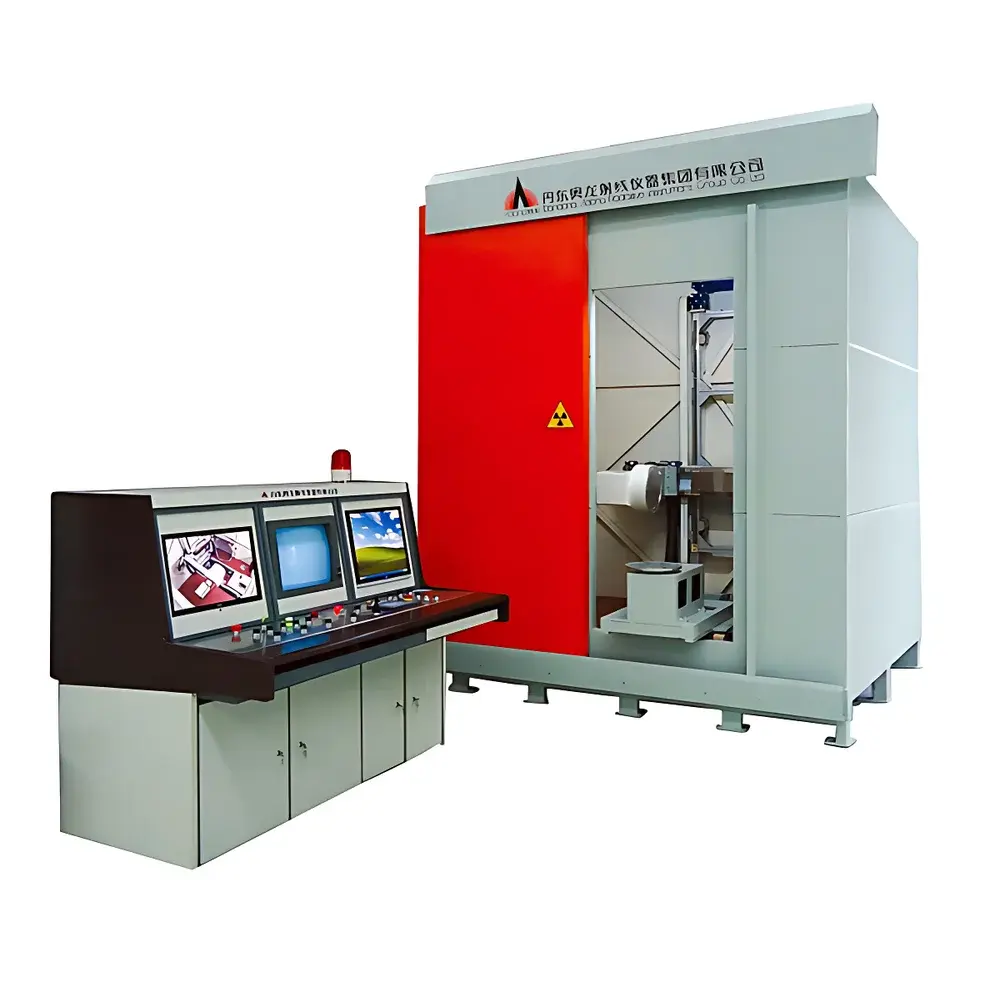
Aolong Industrial Micro-CT Imaging Service
| Brand | Aolong |
|---|---|
| Origin | Liaoning, China |
| Manufacturer Type | Direct Manufacturer |
| Region | Domestic (China) |
| Model | AOLONG1 |
| Pricing | Available Upon Request |
Overview
Aolong Industrial Micro-CT Imaging Service delivers high-resolution, non-destructive 3D volumetric inspection using cone-beam X-ray computed tomography (CBCT) principles. Based on the physical principle of differential X-ray attenuation across material densities and atomic numbers, the service reconstructs cross-sectional slices and full 3D volume datasets from hundreds to thousands of angular projections acquired during sample rotation. Engineered for precision metrology and defect characterization in industrial R&D and quality assurance environments, this service supports both static and dynamic (4D) acquisition protocols—enabling time-resolved analysis of structural evolution under thermal, mechanical, or environmental stimuli. The system operates with microfocus X-ray sources (typically <5 µm focal spot size) and high-DQE flat-panel detectors, ensuring sub-micron spatial resolution capability in optimized configurations.
Key Features
- Non-destructive 3D internal structure visualization with isotropic voxel resolution down to 1–5 µm (dependent on sample size and magnification)
- Quantitative porosity, inclusion, and void analysis compliant with ASTM E1559, ISO 10893-10, and GB/T 26641 standards
- Multi-energy imaging support for material discrimination and effective atomic number (Zeff) mapping
- Automated defect detection and dimensional metrology via calibrated CT reconstruction (NIST-traceable geometry)
- Full-field digital radiography (DR) mode for rapid 2D inspection and real-time imaging applications
- Integrated motion control for in situ mechanical testing (tensile/compression) and thermal cycling experiments
Sample Compatibility & Compliance
The service accommodates a broad range of industrial specimens—from small electronic components (<5 mm diameter) to large castings and assemblies up to Ø400 mm × H500 mm. Compatible materials include aluminum, magnesium, titanium, steel, ceramics, composites, polymers, rubber (e.g., tires), concrete, and geological samples. All scanning protocols adhere to ISO/IEC 17025:2017 requirements for testing laboratories. Reports include full traceability of exposure parameters (kV, µA, integration time), geometric magnification, reconstruction kernel, and calibration metadata. Data packages meet GLP/GMP documentation standards and support FDA 21 CFR Part 11-compliant audit trails when integrated with validated LIMS environments.
Software & Data Management
Data acquisition, reconstruction, and analysis are performed using vendor-validated software platforms supporting GPU-accelerated FDK and iterative (SART, SIRT) reconstruction algorithms. Post-processing includes segmentation (thresholding, region-growing, machine-learning-assisted classification), defect quantification (size, shape, sphericity, location), wall thickness analysis, GD&T evaluation (ISO 1101), and mesh export (STL, PLY) for reverse engineering and CAE simulation input. Raw projection data, reconstructed volumes (DICOM, TIFF stack, NRRD), and annotated reports are archived in encrypted, version-controlled repositories with role-based access control. Export formats comply with ASME Y14.41 and ISO 10303-21 (STEP AP242) for CAD interoperability.
Applications
- Automotive: Porosity analysis in die-cast wheel hubs, cylinder heads, and EV battery housings; tire cord integrity and tread separation assessment
- Aerospace: Inspection of turbine blade cooling channels, additive-manufactured brackets, and composite layup uniformity
- Electronics: Solder joint voiding, wire bond integrity, package delamination, and PCB trace continuity
- Materials Science: In-situ observation of crack propagation in ceramics, foam collapse dynamics, and particle distribution in metal matrix composites
- Cultural Heritage: Non-invasive examination of archaeological artifacts, fossil internal morphology, and conservation state assessment
- Energy: Wall thickness mapping of pressure vessels, weld integrity verification in pipeline fittings, and ceramic insulator defect screening
FAQ
What is the typical turnaround time for a standard CT scan report?
Standard reporting (including reconstruction, basic defect quantification, and PDF deliverables) is completed within 3–5 business days after sample receipt. Expedited service (24–48 hr) is available upon prior agreement.
Can you perform CT scanning on assembled components containing electronics or batteries?
Yes—provided safety protocols are followed. Batteries must be fully discharged and certified inert; active electronics are de-energized and shielded where necessary. Pre-scan risk assessment is conducted for all sensitive assemblies.
Do you provide raw projection data and reconstruction parameters for independent reprocessing?
Yes. Full raw data sets—including detector frames, source geometry files, and reconstruction configuration logs—are delivered alongside final reports upon request.
Is your CT service accredited to ISO/IEC 17025?
Our laboratory holds CNAS accreditation (Certificate No. CNAS LXXXXX) covering industrial CT dimensional measurement and void analysis per ISO 15732 and ASTM E2737.
Can you support custom algorithm development for automated defect recognition?
Yes. We offer collaborative development of AI-driven segmentation and classification models trained on client-specific defect libraries, deployable within our secure processing environment.



