
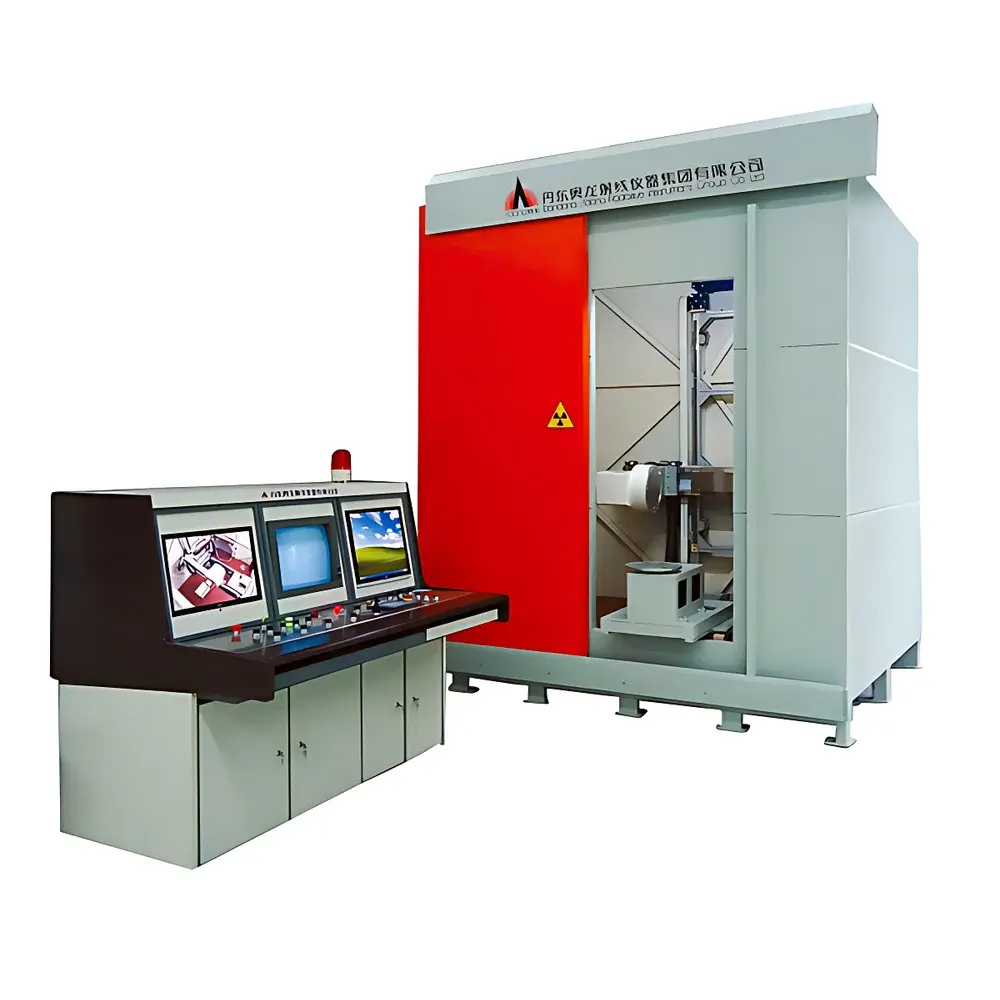
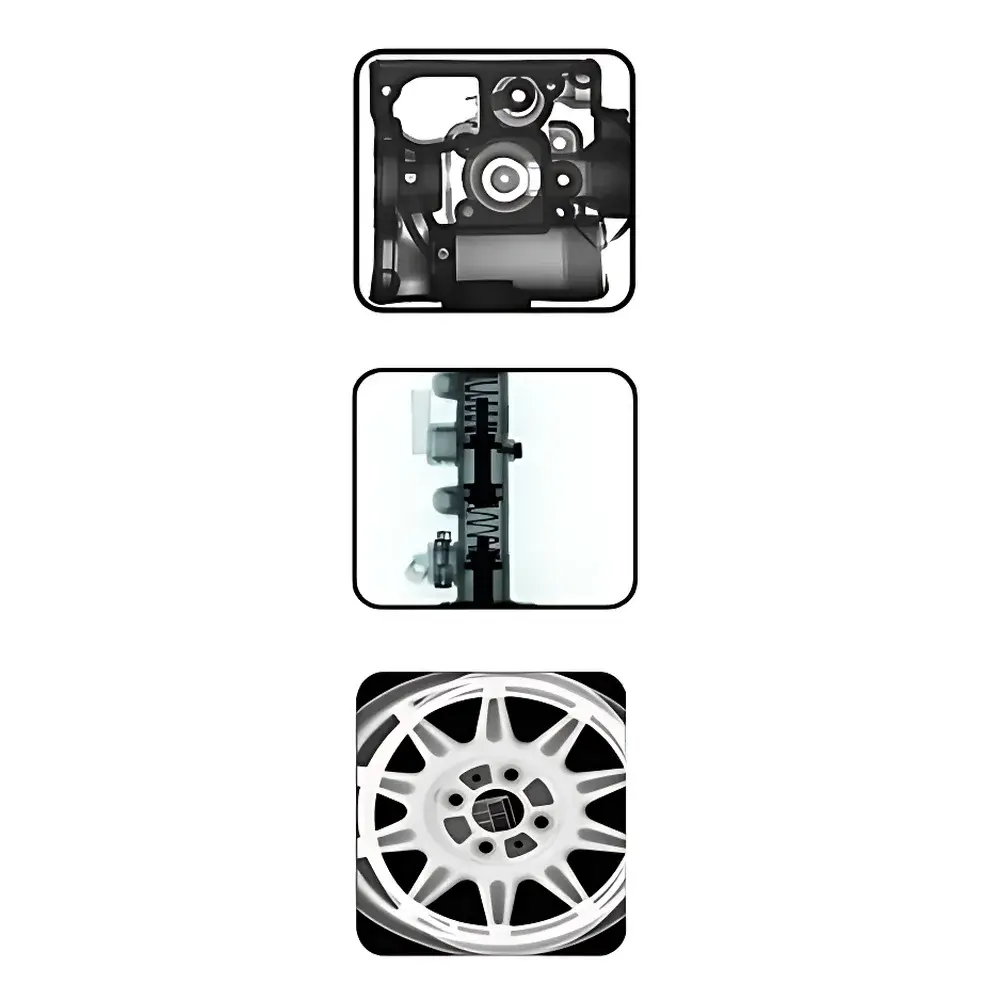
Aolong X-ray Real-time Imaging Inspection System
| Brand | Aolong |
|---|---|
| Origin | Liaoning, China |
| Manufacturer Type | OEM Manufacturer |
| Region of Origin | Domestic (China) |
| Model | X-ray Real-time Imaging Inspection System |
| Pricing | Upon Request |
| Spatial Resolution | 16–60 lp/cm (selectable configurations) |
| Contrast Sensitivity | 0.7%–2% |
| Tube Voltage Range | 20–450 kV |
| Tube Current Range | 0–20 mA |
| Detector Options | Digital Flat-panel Detector / High-resolution Micron-scale Line-scan Digital Detector / Image Intensifier |
| Motion Control | 4-axis / 5-axis / Multi-axis Programmable Scanning Platform |
| Radiation Compliance | Meets GBZ 138–2002 and GB 18871–2002 |
Overview
The Aolong X-ray Real-time Imaging Inspection System is an industrial-grade digital radiographic inspection platform engineered for high-throughput, non-destructive evaluation (NDE) of structural integrity and internal geometry in safety-critical components. Based on the principle of differential X-ray attenuation, the system captures real-time projection images as X-rays pass through test objects—enabling dynamic visualization of internal features including voids, inclusions, porosity, cracks, assembly misalignments, and dimensional deviations. Unlike conventional film-based or static DR systems, this platform integrates synchronized motion control, high-frame-rate acquisition, and adaptive image processing to support both offline laboratory analysis and inline production monitoring. Its modular architecture allows configuration scaling from basic 4-axis manual positioning to fully programmable multi-axis scanning with sub-millimeter repeatability—making it suitable for complex geometries encountered in aerospace castings, pressure vessel welds, automotive die-castings, and electronic packaging assemblies.
Key Features
- Multi-voltage X-ray source (20–450 kV) with adjustable tube current (0–20 mA), supporting inspection of materials ranging from thin PCB laminates to thick-walled steel forgings.
- Selectively configurable detection subsystems: amorphous silicon flat-panel detectors (for high dynamic range and large FOV), micron-resolution line-scan detectors (for ultra-fine detail in long, repetitive parts), or image intensifier-based systems (for cost-optimized real-time fluoroscopy).
- Programmable mechanical scanning platforms: 4-axis (X/Y/Z/rotation), 5-axis (adds tilt), or custom multi-axis configurations enabling full 360°+180° tomographic data acquisition paths.
- Real-time imaging engine capable of ≥30 fps continuous acquisition at full detector resolution, with on-the-fly contrast optimization and hardware-accelerated noise suppression.
- Integrated lead-shielded enclosure compliant with GBZ 138–2002 (Chinese standard for industrial X-ray equipment radiation protection) and certified under national radiation safety licensing requirements.
- Dedicated firmware-level synchronization between X-ray pulsing, detector readout, and stage motion—ensuring geometric fidelity and minimizing motion blur during dynamic scans.
Sample Compatibility & Compliance
The system accommodates samples up to 800 mm × 600 mm × 600 mm (L×W×H) and 50 kg maximum weight, with optional custom fixtures for turbine blades, weld joints, composite laminates, and additive-manufactured parts. It supports ASTM E1742/E1742M (Standard Practice for Radiographic Examination), ISO 17636-2 (Radiographic testing of welded joints), and EN 1435 (Radiographic testing of welded joints). While not a micro-CT scanner per se, its high-resolution line-scan mode achieves effective voxel sizes down to ~20 µm under optimal magnification—supporting quantitative dimensional metrology traceable to NIST-traceable calibration artifacts. All operational logs, exposure parameters, and image metadata are timestamped and stored with audit trail capability, aligning with GLP documentation requirements for regulated industries.
Software & Data Management
The proprietary Aolong Imaging Suite provides FDA 21 CFR Part 11–compatible user access control, electronic signature workflows, and immutable audit logs for all image acquisition, annotation, measurement, and report generation events. Core functions include dual-window dynamic subtraction, multi-scale Gaussian and non-local means denoising (2–512 pixel kernel options), edge-enhanced segmentation, pseudo-color mapping based on Hounsfield-equivalent grayscale thresholds, and calibrated linear measurements with ±0.02 mm uncertainty (validated per ISO 15530-3). Automated defect classification modules leverage supervised learning models trained on labeled datasets from aerospace and energy sector use cases—capable of flagging anomalies exceeding user-defined size/contrast thresholds. All reports export to PDF/A-2b or XML formats compatible with enterprise QMS platforms such as MasterControl and Veeva.
Applications
This system serves as a primary inspection tool across multiple regulated sectors: verification of internal bond integrity in ceramic-to-metal seals for satellite propulsion systems; porosity mapping in investment-cast turbine vanes; wall thickness uniformity assessment in seamless stainless steel tubing; solder joint void analysis in high-reliability avionics modules; and crack propagation monitoring during fatigue testing of rail axle forgings. Its real-time capability enables closed-loop feedback for robotic welding stations and automated casting lines—reducing reliance on destructive sampling while maintaining statistical process control (SPC) compliance per ISO 9001:2015 clause 8.5.1.
FAQ
Is this system certified for use in Class 100 cleanroom environments?
No—while the detector and electronics meet IP54 ingress protection, the system is designed for controlled industrial environments (ISO 8 / Class 100,000) rather than semiconductor-grade cleanrooms.
Can the software interface with PLC-based factory automation networks?
Yes—OPC UA and Modbus TCP drivers are included for bidirectional communication with Siemens S7, Rockwell Logix, and Beckhoff controllers.
Does the system support DICOM export for integration into PACS infrastructure?
DICOM SR (Structured Reporting) export is available as an optional module; native DICOM imaging export requires third-party middleware due to modality-specific conformance requirements.
What is the typical lead time for installation and on-site qualification?
Standard delivery and IQ/OQ execution require 12–16 weeks from PO confirmation, including radiation shielding validation and performance qualification per ASTM E2737.
Are service contracts and remote diagnostics supported outside mainland China?
Yes—global technical support includes encrypted remote access, annual preventive maintenance visits, and spare parts logistics via regional hubs in Singapore, Germany, and the USA.
Related Products



