
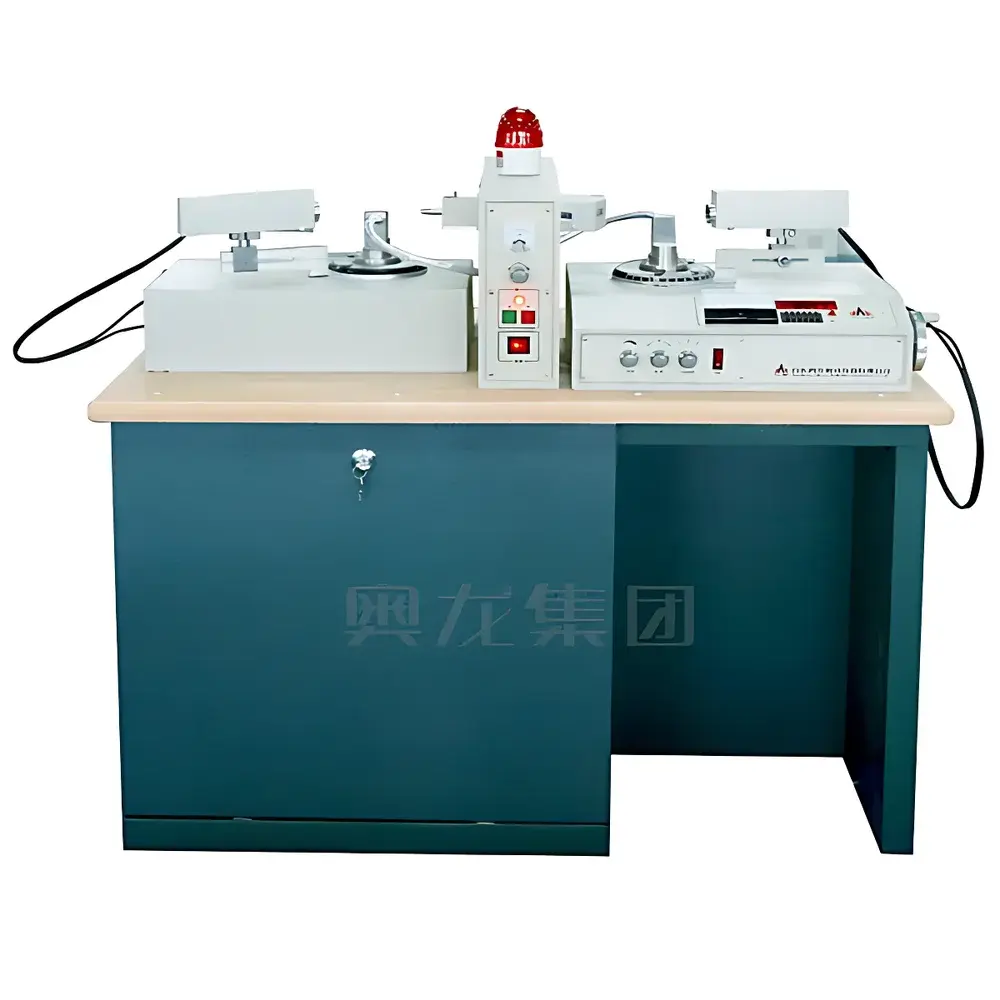
Aolong YX-200 Double-Crystal X-Ray Crystal Orientation Instrument
| Brand | Aolong |
|---|---|
| Origin | Liaoning, China |
| Manufacturer Type | Direct Manufacturer |
| Origin Category | Domestic (China) |
| Model | YX-200 |
| Price | Upon Request |
| X-ray Tube | Cu anode, air-cooled, 30 kV / 0–5 mA |
| Detector | Geiger-Müller counter |
| Angular Range | θ = −10° to +50°, 2θ = −10° to +100° |
| Angular Resolution | 10 arcseconds (″) |
| Digital Display | Degrees, Minutes, Seconds |
| Time Constants | 0.1 s, 0.4 s, 3 s |
| Input Power | 220 V AC, 50 Hz, 0.3 kW |
| Dimensions | 1140 × 650 × 1030 mm (L×W×H) |
| Weight | 150 kg |
Overview
The Aolong YX-200 Double-Crystal X-Ray Crystal Orientation Instrument is a precision Bragg-angle alignment system engineered for high-accuracy crystallographic orientation determination in single-crystal materials. Based on the double-crystal diffraction principle—where a reference crystal and sample crystal are aligned in parallel lattice planes using monochromatic Cu-Kα radiation (λ = 1.5418 Å)—the instrument enables precise angular calibration of crystallographic axes relative to defined Miller indices. This methodology ensures traceable, repeatable orientation measurements critical for the fabrication and quality control of piezoelectric substrates (e.g., quartz, LiNbO₃, LiTaO₃), optical crystals (e.g., KDP, BBO, YAG), semiconductor wafers (e.g., Si, GaAs), and nonlinear optical components. Unlike powder or polycrystalline XRD systems, the YX-200 operates in a fixed-geometry, two-axis (θ/2θ) goniometric configuration optimized for angular reproducibility rather than phase identification, making it purpose-built for industrial crystal slicing, boule orientation marking, and wafer metrology workflows.
Key Features
- Double-crystal Bragg diffraction architecture with Cu-target X-ray tube (30 kV, 0–5 mA), delivering stable, monochromatic output for consistent Laue or Bragg peak detection
- Digital angular readout with resolution of 10 arcseconds (±10″ total system accuracy), supporting degree-minute-second (DMS) display and programmable angle presets
- Manually actuated optical shutter and mechanical goniometer with calibrated vernier scale (1° minimum mechanical graduation) for redundancy and operator verification
- Three selectable time constants (0.1 s, 0.4 s, 3 s) on the Geiger-Müller detector circuit to optimize signal-to-noise ratio across varying crystal reflectivity and absorption conditions
- Robust steel-frame construction (150 kg mass) with vibration-damped base and enclosed X-ray shielding compliant with IEC 61010-1 and GB/T 18871-2002 radiation safety requirements
- Compact footprint (1140 × 650 × 1030 mm) designed for integration into cleanroom environments, crystal growth labs, and semiconductor front-end processing areas
Sample Compatibility & Compliance
The YX-200 accommodates flat, polished single-crystal samples up to Ø100 mm and 30 mm thickness, including but not limited to quartz (AT-, BT-, SC-cut), lithium niobate, sapphire (C-plane, R-plane), silicon (100), germanium, and cadmium telluride. Sample mounting utilizes vacuum chucks or kinematic three-point fixtures to minimize tilt-induced angular error. All operational parameters—including tube voltage, current, exposure duration, and shutter timing—are manually controlled to ensure full procedural transparency and auditability. The instrument conforms to Chinese national standards GB/T 15061–2019 (X-ray crystal orientation instruments) and supports GLP-compliant documentation through external logbook integration. While not FDA 21 CFR Part 11–certified out-of-the-box, its deterministic analog control architecture allows full manual audit trails suitable for ISO/IEC 17025-accredited testing laboratories.
Software & Data Management
The YX-200 operates as a hardware-centric, operator-guided instrument with no embedded microprocessor or proprietary software stack. All angular positioning, exposure timing, and intensity reading are performed via front-panel controls and real-time digital display. This design eliminates firmware dependencies, reduces cybersecurity surface area, and ensures long-term operational continuity without OS upgrades or license renewals. Users record measurement sequences—including incident angle (θ), diffracted angle (2θ), count rate, time constant, and sample ID—in standardized lab notebooks or LIMS-compatible spreadsheets. For automated data capture, optional RS-232 or USB-to-serial adapters enable ASCII-formatted angle and count output to third-party acquisition software (e.g., LabVIEW, Python-based PySerial scripts), supporting CSV export and statistical process control (SPC) charting.
Applications
- Pre-slicing orientation verification of quartz, lithium tantalate, and langasite boules prior to ingot sawing
- Calibration of crystallographic cut angles for resonator-grade piezoelectric wafers used in RF filters and SAW devices
- Verification of C-axis alignment in sapphire substrates for GaN epitaxy and LED manufacturing
- Quality assurance of optical axis orientation in birefringent crystals (e.g., calcite, α-BBO) for polarizer and waveplate production
- Educational use in solid-state physics and materials science laboratories for teaching Bragg’s law, reciprocal lattice concepts, and Laue symmetry analysis
- In-process monitoring during crystal annealing or post-growth cooling where lattice strain may induce angular drift
FAQ
What crystal systems can the YX-200 orient?
The instrument is optimized for cubic, hexagonal, and trigonal single crystals exhibiting strong Bragg reflections under Cu-Kα radiation. It is routinely applied to quartz, LiNbO₃, LiTaO₃, Si, GaAs, sapphire, and KDP.
Does the YX-200 support automatic scanning or motorized goniometry?
No. It features manual θ and 2θ adjustment via precision micrometer drives and vernier scales, prioritizing mechanical stability and operator control over automation.
Is radiation shielding integrated into the instrument enclosure?
Yes. The lead-lined housing meets national Class II X-ray equipment shielding requirements per GB/T 18871-2002, with interlocked door safety switches and leakage <1 μSv/h at 5 cm distance.
Can the YX-200 be used for residual stress or lattice parameter analysis?
No. It lacks variable incidence optics, energy-dispersive detection, or Rietveld-capable software; it is strictly a crystallographic orientation alignment tool.
What maintenance is required for long-term angular accuracy?
Annual recalibration of the digital encoder against NIST-traceable angle standards is recommended, along with periodic verification of goniometer mechanical runout and X-ray tube focal spot stability.
Related Products






