
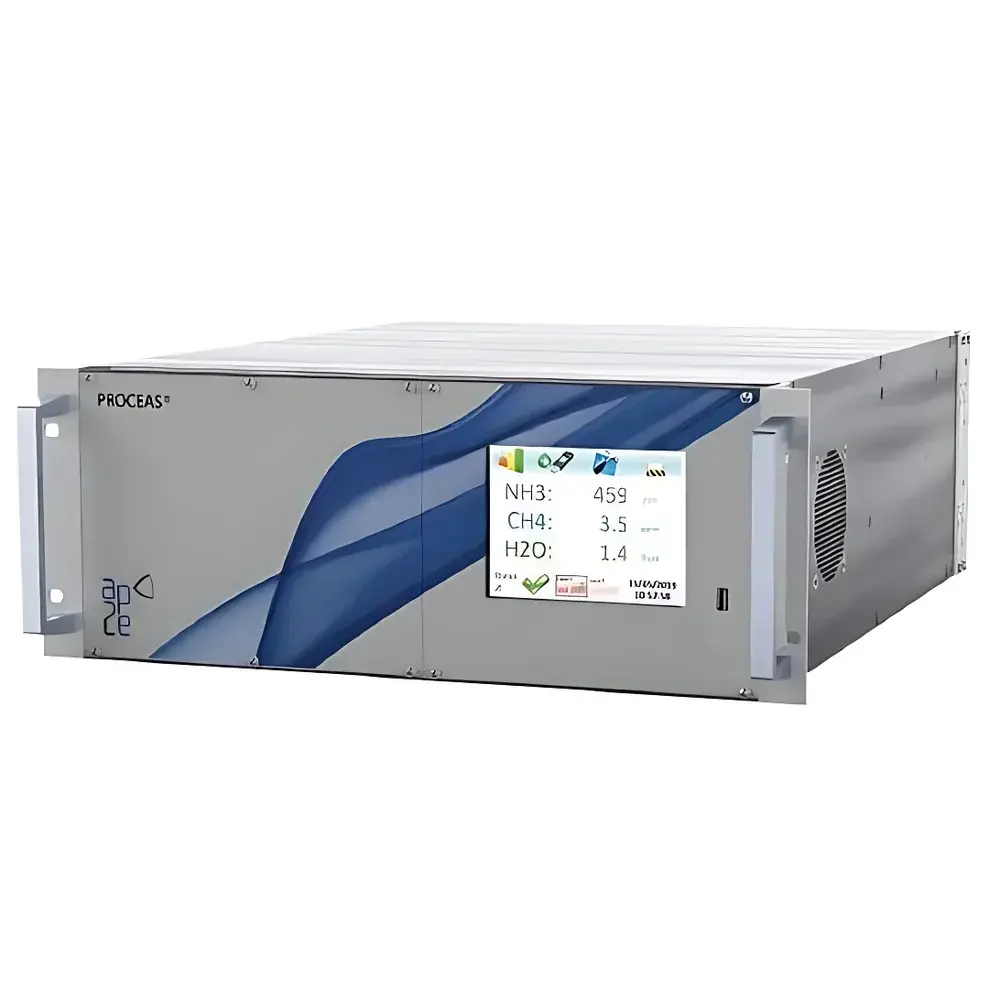
AP2E ProCeas® H₂ Purity Control Analyzer
| Brand | AP2E |
|---|---|
| Origin | France |
| Model | ProCeas H₂ |
| Detection Principle | Optical-feedback Cavity Enhanced Absorption Spectroscopy (OF-CEAS) |
| Operating Pressure | <100 mbar (absolute) |
| Detection Limits (3σ) | H₂O ≤ 0.01 ppm, CH₄ ≤ 0.001 ppm, O₂ ≤ 5 ppm, CO₂ ≤ 0.2 ppm, CO ≤ 0.001 ppm, H₂S ≤ 0.001 ppm, HCHO ≤ 0.001 ppm, HCOOH ≤ 0.005 ppm, NH₃ ≤ 0.001 ppm, HCl ≤ 0.001 ppm |
| Compliance | T/CECA-G0015-2017 (equivalent to ISO 14687-2:2019) |
| Calibration | Factory-pre-calibrated, integrated auto-zero and span verification |
| Carrier Gas | None required |
| Sample Volume Requirement | Minimal (<10 mL/min at sub-atmospheric pressure) |
Overview
The AP2E ProCeas® H₂ Purity Control Analyzer is a high-precision, factory-precalibrated multi-component gas analyzer engineered for continuous, quantitative measurement of trace impurities in hydrogen streams at parts-per-trillion (ppt) to sub-parts-per-billion (sub-ppb) levels. It employs Optical-feedback Cavity Enhanced Absorption Spectroscopy (OF-CEAS), a robust laser-based spectroscopic technique that combines ultra-high optical pathlength amplification (>20 km effective path) with active laser frequency stabilization via optical feedback. Unlike conventional CRDS systems, OF-CEAS measures steady-state transmission intensity rather than cavity ring-down time—enabling superior long-term stability, simplified optomechanical architecture, and immunity to pulse-timing jitter or detector bandwidth limitations. The analyzer operates under controlled sub-atmospheric sampling conditions (<100 mbar absolute pressure), minimizing sample volume demand, reducing residence time, and eliminating dilution-related uncertainty. Designed specifically for compliance with ISO 14687-2:2019 (hydrogen fuel quality for proton exchange membrane fuel cells), it delivers metrologically traceable measurements across up to 12 critical contaminants—including H₂O, CH₄, CO, CO₂, O₂, H₂S, NH₃, HCHO, HCOOH, and HCl—without requiring external zero gases, purge gases, or carrier streams.
Key Features
- Sub-ppb detection limits (3σ) for key impurities: CO (1 ppt), H₂S (1 ppt), HCHO (1 ppt), NH₃ (1 ppt), HCl (1 ppt), and CO₂ (0.2 ppm)
- Integrated auto-calibration system with periodic zero/span verification using internal reference cells—eliminates daily manual calibration and mitigates drift over extended operation
- No consumables or auxiliary gases required: fully self-contained optical measurement core with no need for zero air, nitrogen, or synthetic calibration blends
- Low-pressure sampling architecture (<100 mbar abs) reduces required sample flow to <10 mL/min while maintaining rapid response time (T₉₀ < 30 s)
- Pre-aligned, sealed optical cavity with ultra-low-loss mirrors (R > 99.999%) ensures long-term photonic stability and minimal maintenance intervals
- Real-time spectral deconvolution engine resolves overlapping absorption features from co-present species without cross-sensitivity artifacts
Sample Compatibility & Compliance
The ProCeas H₂ analyzer is validated for direct analysis of high-purity hydrogen streams (≥99.999% H₂) containing low-molecular-weight polar and nonpolar impurities. Its low-pressure inlet design prevents catalytic decomposition or surface adsorption artifacts common in stainless-steel high-pressure manifolds, particularly for reactive species such as NH₃, HCl, and HCHO. All measurements are traceable to NIST-certified standards and conform to the analytical performance requirements defined in ISO 14687-2:2019 Annex B for fuel cell-grade hydrogen. Additionally, the instrument supports audit-ready data logging compliant with GLP and GMP frameworks, including full electronic records of calibration events, spectral baselines, and raw interferogram archives. Optional 21 CFR Part 11-compliant software modules provide role-based access control, electronic signatures, and immutable audit trails for regulated industrial environments.
Software & Data Management
The embedded Linux-based firmware runs AP2E’s proprietary SpectraView™ acquisition and processing suite, delivering real-time concentration plots, spectral overlays, and automated alarm thresholds per ISO limit. Data export supports CSV, HDF5, and OPC UA protocols for seamless integration into SCADA, MES, or LIMS platforms. Remote diagnostics, firmware updates, and spectral health monitoring are accessible via secure TLS-encrypted web interface or Modbus TCP. All raw spectra and processed results are timestamped with GPS-synchronized UTC and stored locally on industrial-grade SSD with configurable retention policies (up to 12 months). Optional cloud synchronization enables centralized fleet-wide analytics and predictive maintenance alerts based on cavity mirror degradation trends.
Applications
- Fuel hydrogen production monitoring (electrolysis, SMR, ATR) for ISO 14687-2 conformance
- In-line purity verification prior to compression, liquefaction, or refueling station dispensing
- Geoscientific hydrogen flux studies in fault-zone monitoring networks, where sub-ppb sensitivity enables detection of tectonic-scale degassing anomalies
- Process gas qualification in semiconductor manufacturing, metallurgical annealing, and glass float baths
- Research applications in catalysis kinetics, membrane permeation testing, and hydrogen safety threshold studies
<liLaboratory-grade validation of hydrogen storage materials and getter performance
FAQ
Does the ProCeas H₂ require daily calibration?
No. Its integrated auto-calibration system performs scheduled zero and span checks using internal reference cells, ensuring measurement continuity without operator intervention.
Can it measure humid hydrogen samples without condensation artifacts?
Yes. The sub-atmospheric sampling path maintains dew point depression well below typical ambient conditions, and the heated optical cell prevents water condensation on cavity mirrors.
Is OF-CEAS susceptible to vibration or temperature fluctuations?
The monolithic cavity design, active laser locking, and thermal mass optimization provide operational stability across ±2°C ambient variation and standard laboratory floor vibrations (ISO 20283-2 Class 2).
How is traceability to ISO 14687-2 ensured?
Each unit ships with a certificate of conformance referencing NIST-traceable calibration gases and interlaboratory comparison data against primary standards per ISO/IEC 17025-accredited laboratories.
What maintenance is required over a 5-year service interval?
Annual verification of optical alignment and cavity reflectivity; no routine consumables or gas replacements—only periodic filter replacement and inlet line inspection.
Related Products







