
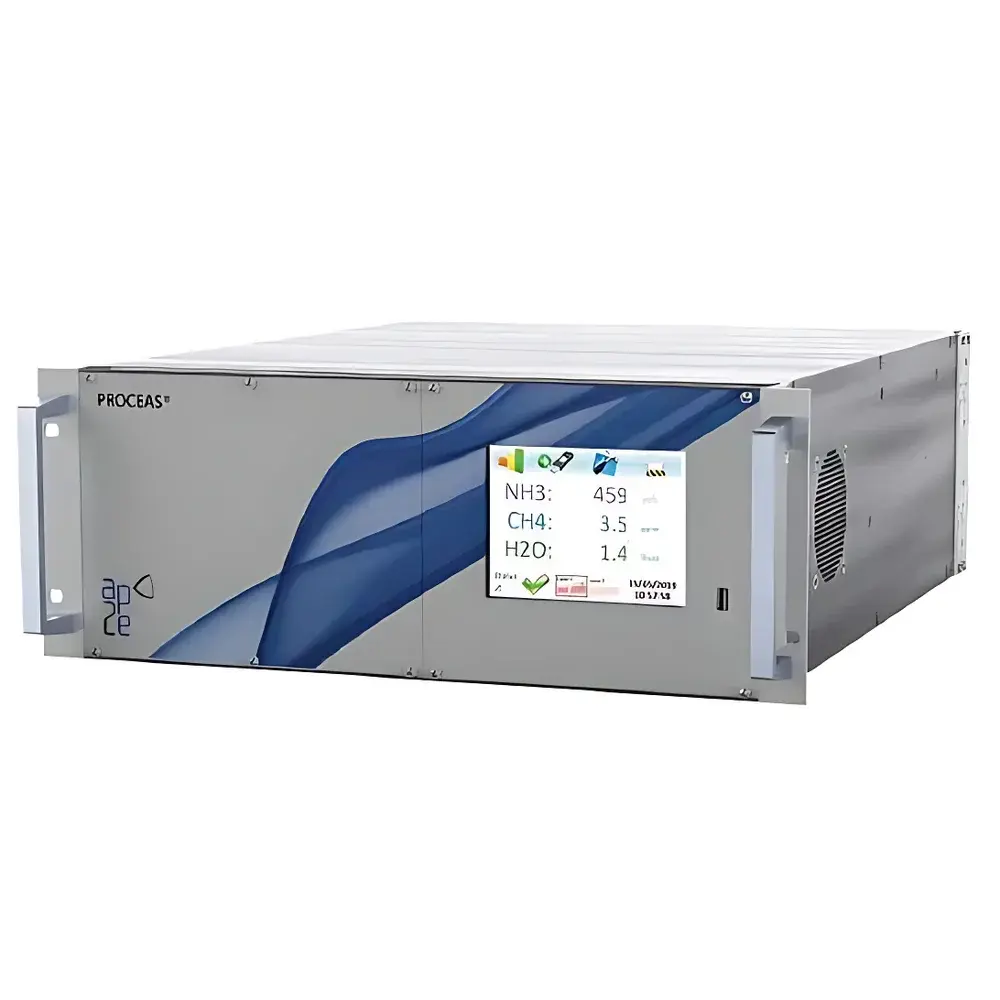
AP2E ProCeas® H₂S Analyzer
| Brand | AP2E |
|---|---|
| Origin | France |
| Model | ProCeas H₂S |
| Detection Principle | Optical-feedback Cavity-enhanced Absorption Spectroscopy (OF-CEAS) |
| Detection Limit (3σ, 60 s) | 1 ppb |
| Accuracy (1σ) | 0.3 ppb |
| Zero Drift (72 h) | ±0.20 ppb |
| Measurement Interval | 1 s |
| Response Time (10–90%) | <5 s |
| Measurement Range | 0–5000 ppb |
| Cavity Temperature Stability | ±0.002 K (1 s), ±5×10⁻⁵ K (30 min) |
| Cavity Pressure Stability | ±0.016 mbar |
| Sample Temperature Range | −10 to +45 °C |
| Sample Humidity Limit | <99% RH, non-condensing |
| Sample Flow Rate | >400 mL/min |
| Output Interfaces | Ethernet, Modbus TCP/IP & RTU, 4–20 mA analog, USB |
| Power Supply | 110–230 VAC, 50–60 Hz |
| Power Consumption | 150 VA |
| Form Factor | 19″ rack-mount, 4U |
| Weight | 20 kg |
Overview
The AP2E ProCeas® H₂S Analyzer is a high-precision, continuous online gas analyzer engineered for trace-level sulfur dioxide (H₂S) quantification in ambient air, cleanroom environments, and industrial process streams. It employs Optical-feedback Cavity-enhanced Absorption Spectroscopy (OF-CEAS), a patented spectroscopic technique (WO03031949) that combines ultra-high-finesse optical cavities with active laser frequency stabilization. Unlike conventional NDIR or electrochemical sensors, OF-CEAS achieves exceptional selectivity by probing the fundamental ro-vibrational absorption line of H₂S near 2.6 µm with sub-Doppler resolution. The measurement cavity—thermally isolated and actively controlled to ±0.002 K over 1 second—contains three supermirrors (R > 99.999%) that yield an effective optical path length exceeding 20 km, enabling part-per-quadrillion-level sensitivity in optimized configurations. This architecture eliminates reliance on calibration gases during routine operation and ensures long-term stability without measurable drift.
Key Features
- Patented OF-CEAS detection technology delivering intrinsic specificity for H₂S without cross-sensitivity to CO₂, CH₄, H₂O, or SO₂
- Sub-ppb detection limit: 1 ppb (3σ, 60 s integration), with 0.3 ppb (1σ) measurement precision
- Real-time acquisition at 1 Hz native sampling rate and <5 s response time (10–90%)
- Integrated low-pressure sampling module (patent WO2010058107) preventing condensation-induced artifacts in humid samples
- Low-adsorption stainless-steel flow path and chemically passivated measurement cell minimizing memory effects
- Active thermal and barometric control of the optical cavity: ±0.002 K temperature stability (1 s), ±0.016 mbar pressure stability
- Self-calibrating design with embedded reference channel and zero-check algorithm—no external span gas required for daily operation
- Rack-mounted 4U chassis (19″ standard) with industrial-grade power supply (110–230 VAC, 50–60 Hz) and <150 VA consumption
Sample Compatibility & Compliance
The ProCeas® H₂S Analyzer accepts sample gas across −10 to +45 °C at up to 99% RH (non-condensing), with minimum flow requirement of 400 mL/min. Its proprietary low-pressure inlet system maintains laminar flow and suppresses water vapor interference—critical for applications involving biogas, flue gas, or semiconductor fab exhaust. The analyzer complies with IEC 61000-6-2/6-4 for electromagnetic compatibility and meets CE marking requirements under Directive 2014/30/EU (EMC) and 2014/35/EU (LVD). Data integrity adheres to principles aligned with FDA 21 CFR Part 11 for electronic records and signatures, supporting audit trails, user access controls, and secure data export via encrypted Ethernet protocols. All firmware and calibration routines are traceable to NIST-traceable reference standards and validated per ISO/IEC 17025 requirements for testing laboratories.
Software & Data Management
The embedded Linux-based firmware provides dual-mode operation: standalone autonomous monitoring or network-integrated deployment. Configuration, real-time diagnostics, and historical trend review are accessible via web interface (HTTPS) or native Windows/Linux client software. Raw spectral data, cavity transmission signals, and environmental metadata (T, P, flow) are timestamped and stored locally on a removable SD card (optional) or streamed continuously via Modbus TCP/IP or RS-485. Analog outputs (4–20 mA) support legacy SCADA integration, while USB enables firmware updates and offline spectral analysis. All data exports include ISO 8601 timestamps, instrument serial number, and measurement uncertainty estimates derived from real-time noise statistics and cavity condition monitoring.
Applications
- Continuous emissions monitoring (CEMS) at waste incineration plants, cement kilns, glass furnaces, and aluminum smelters
- Ambient air quality networks requiring compliance with EU Directive 2008/50/EC and U.S. EPA Method TO-15 equivalents
- Process safety and leak detection in petrochemical refineries and natural gas processing facilities
- Ultra-clean environment surveillance in semiconductor fabrication cleanrooms (ISO Class 1–5)
- Biogas upgrading and anaerobic digestion optimization where H₂S removal efficiency must be verified hourly
- Research-grade atmospheric chemistry studies requiring stable, calibration-free trace-gas time series
FAQ
Does the ProCeas® H₂S Analyzer require periodic calibration with certified gas standards?
No—its OF-CEAS architecture enables continuous self-referencing through internal cavity transmission monitoring and zero-point validation algorithms. Certified gas challenges are only recommended annually for verification against metrological standards.
Can the analyzer operate reliably in high-humidity environments such as landfill gas streams?
Yes—the patented low-pressure sampling system reduces dew point depression and prevents liquid water ingress. Combined with heated sample lines (optional), it maintains stable performance at up to 99% RH without condensation.
Is the measurement affected by particulate matter or aerosols in the sample stream?
The integrated 5-µm particulate filter and laminar-flow conditioning ensure minimal optical scattering. For highly contaminated streams, an optional heated coalescing filter or cyclonic pre-separator can be installed upstream.
What cybersecurity measures are implemented for remote data access?
The device supports TLS 1.2 encryption for web interface sessions, configurable firewall rules, role-based user authentication, and disabled default credentials upon first boot—all aligned with IEC 62443-3-3 Level 1 requirements.
How is temperature and pressure compensation handled during measurement?
Cavity temperature and pressure are measured in real time using calibrated platinum resistance thermometers (PRTs) and piezoresistive transducers. Compensation is applied dynamically within the spectral fitting algorithm using HITRAN-based line shape modeling.
Related Products







