
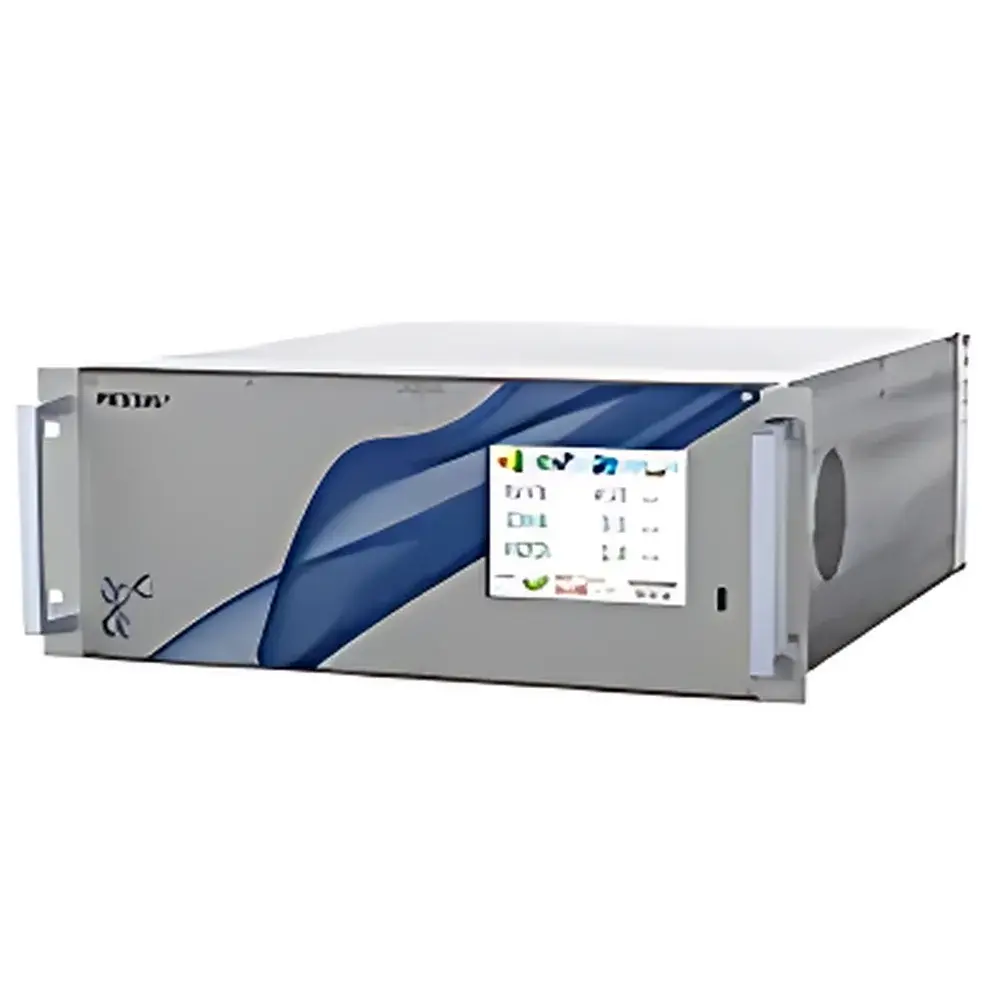
AP2E ProCeas® NH₃ Ammonia Analyzer
| Brand | AP2E |
|---|---|
| Origin | France |
| Model | ProCeas NH₃ |
| Detection Principle | Optical-feedback Cavity-enhanced Absorption Spectroscopy (OF-CEAS) |
| Detection Limit (3σ, 300 s) | < 0.05 ppb |
| Accuracy (1σ) | 0.015 ppb + 0.1% of reading @ 300 s |
| Zero Drift (72 h) | ±0.20 ppb |
| Measurement Interval | 1 Hz |
| Measurement Range | 0–1000 ppb (guaranteed), 0–10 ppm (operational) |
| Cavity Volume | 25 mL |
| Temperature Control Stability | ±0.002 K @ 1 s |
| Pressure Control Stability | ±0.016 mbar |
| Sample Flow Rate | >400 mL/min |
| Operating Ambient Temperature | −10 to +45 °C |
| Relative Humidity | <99% RH (non-condensing) |
| Data Outputs | Ethernet, Modbus TCP/IP & RTU, Analog (4–20 mA), USB |
| Power Supply | 110–230 VAC, 50–60 Hz |
| Power Consumption | 150 VA |
| Dimensions | 19″ rack-mount, 4U |
| Weight | 20 kg |
Overview
The AP2E ProCeas® NH₃ Ammonia Analyzer is a high-precision, continuous online gas analyzer engineered for trace-level quantification of ammonia (NH₃) in ambient air, cleanroom environments, industrial exhaust streams, and ultra-pure gas supply lines. It employs Optical-feedback Cavity-enhanced Absorption Spectroscopy (OF-CEAS), a patented laser absorption technique (WO03031949) that delivers exceptional selectivity, long-term stability, and sub-part-per-trillion sensitivity without chemical interference or cross-sensitivity to common atmospheric constituents. Unlike conventional NDIR or electrochemical sensors, OF-CEAS leverages a three-mirror optical cavity with mirror reflectivity exceeding 99.999%, enabling an effective optical path length of up to 50 km within a compact 25 mL measurement cell. This architecture ensures robust quantification of NH₃ at concentrations as low as <0.05 ppb (3σ, 300 s integration), with minimal zero drift (±0.20 ppb over 72 h) and no requirement for external calibration gases during routine operation.
Key Features
- Patented OF-CEAS detection technology—provides intrinsic specificity for NH₃ via fundamental ro-vibrational absorption lines near 658 nm, eliminating spectral interferences from H₂O, CO₂, CH₄, or NO₂.
- Integrated low-pressure sampling system (patent WO2010058107)—prevents condensation-induced measurement artifacts and enables stable operation across wide humidity ranges (<99% RH, non-condensing).
- Active thermal and pressure stabilization—cavity temperature controlled to ±0.002 K (1 s) and pressure regulated to ±0.016 mbar, ensuring metrological-grade reproducibility under variable ambient conditions.
- Direct-draw sampling architecture—no sample conditioning, scrubbing, or permeation dryers required; inlet flow >400 mL/min ensures rapid chamber turnover and real-time response (<90 s T₁₀₋₉₀).
- Self-calibrating optical alignment—automated cavity locking and feedback loop compensation eliminate mechanical drift and reduce maintenance intervals to annual cycles.
- Rack-mount 4U industrial enclosure—designed for 24/7 unattended operation in semiconductor fab environments, stack monitoring stations, and GLP-compliant laboratories.
Sample Compatibility & Compliance
The ProCeas NH₃ Analyzer accommodates gaseous samples across diverse matrices: ambient air (urban, rural, agricultural), flue gas (post-SCR, post-DeNOₓ), compressed process gases (e.g., nitrogen carrier gas in chip manufacturing), and cleanroom supply air. Its low-adsorption stainless-steel and electropolished flow path minimizes surface retention of NH₃, preserving quantitative integrity even after extended exposure to sub-ppb levels. The instrument meets critical regulatory and quality frameworks including ISO 14644-1 (cleanroom classification), ASTM D6348 (standard test method for gaseous emissions), and supports audit-ready data integrity per FDA 21 CFR Part 11 when paired with compliant software configurations. Optional co-measurement channels for N₂O (0–50 ppm), CH₄ (0–50 ppm), and H₂O (0–5% v/v) are factory-integrated and independently validated per IEC 61290-1.
Software & Data Management
The embedded firmware provides real-time signal processing, baseline correction, and spectral fitting using least-squares multivariate regression against high-resolution reference spectra. Data output interfaces include Ethernet (Modbus TCP/IP), RS-485/232 (Modbus RTU), isolated 4–20 mA analog outputs, and USB host mode for local diagnostics and firmware updates. Remote configuration and live spectral monitoring are supported via secure HTTPS web interface. All raw interferograms and processed concentration values are timestamped with NTP-synchronized precision and stored onboard (16 GB internal flash). Export formats include CSV and NetCDF, compatible with LIMS integration and automated reporting workflows aligned with ISO/IEC 17025 documentation requirements.
Applications
- Environmental monitoring networks—quantifying NH₃ emissions from livestock operations, fertilizer application, and wastewater treatment plants in compliance with EU NEC Directive and US EPA Method TO-15 extensions.
- Semiconductor manufacturing—continuous verification of NH₃ contamination in Class 1–10 cleanrooms and ultrapure nitrogen delivery systems, where sub-ppb excursions risk gate oxide degradation.
- Industrial stack monitoring—real-time compliance tracking for NH₃ slip in selective catalytic reduction (SCR) systems used in power generation and cement kilns.
- Atmospheric chemistry research—high-temporal-resolution measurements (1 Hz) for eddy covariance flux studies and boundary layer modeling.
- Pharmaceutical manufacturing—verification of ammonia residuals in purified compressed air and inert gas systems per USP and Annex 1 (EU GMP).
FAQ
Does the ProCeas NH₃ Analyzer require span gas calibration?
No. It features an integrated self-referencing optical calibration routine that maintains accuracy without external standard gases. Periodic verification using certified NH₃ standards is recommended annually for audit compliance.
Can it operate in high-humidity environments?
Yes. The patented low-pressure sampling module actively suppresses water vapor condensation, enabling reliable operation up to 99% RH without desiccant traps or heated lines.
What is the typical maintenance schedule?
Routine maintenance is limited to annual inspection of inlet filters and verification of optical alignment—no consumables, lasers, or detectors require replacement within the first five years of operation.
Is the system compatible with existing SCADA or DCS platforms?
Yes. Native Modbus TCP/IP and RTU protocols ensure seamless integration with industry-standard control systems, including Siemens Desigo, Honeywell Experion, and Yokogawa CENTUM VP.
How is measurement traceability ensured?
Each unit ships with NIST-traceable factory calibration documentation. Spectral line positions and intensities are referenced to HITRAN2020 database parameters, and cavity length is stabilized via Pound-Drever-Hall locking to an internal frequency standard.







