
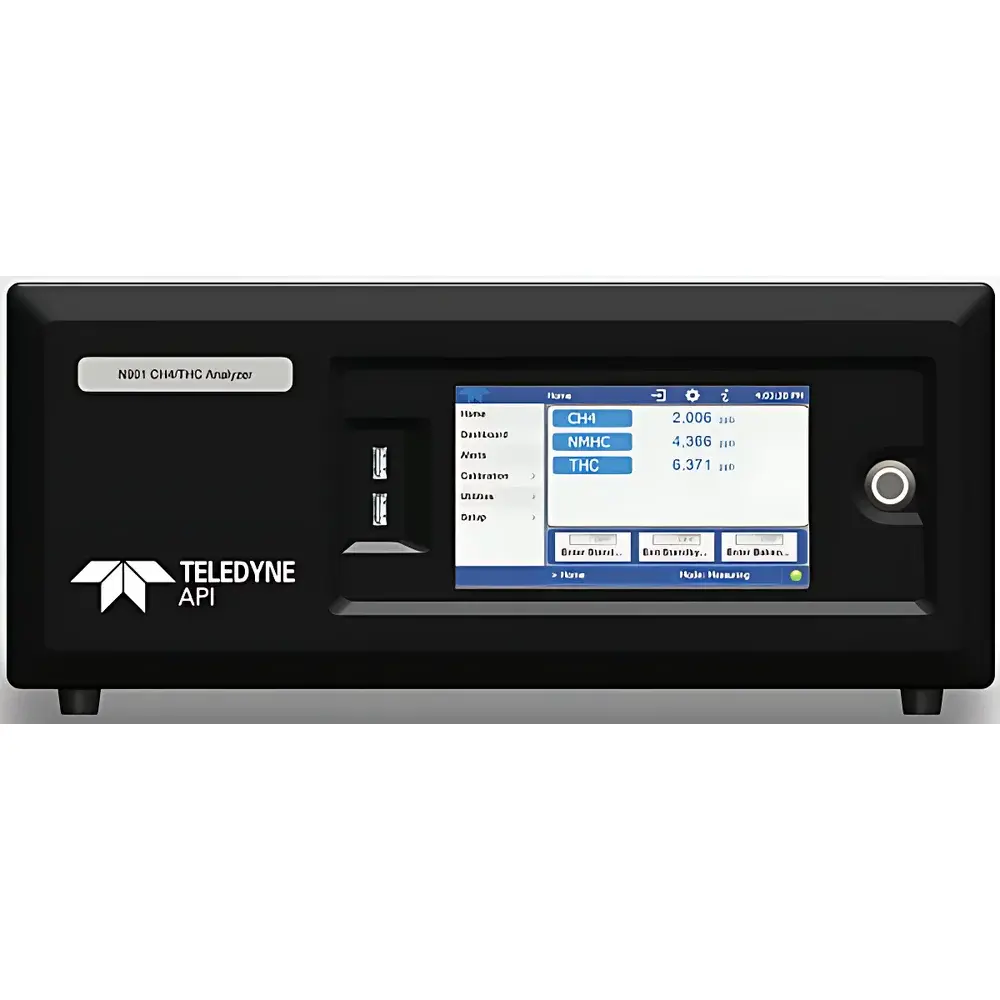
API N901 THC/CH₄/NMHC Gas Chromatograph with FID Detection
| Brand | API |
|---|---|
| Model | N901 |
| Detection Principle | Gas Chromatography–Flame Ionization Detection (GC-FID) |
| Measured Parameters | Total Hydrocarbons (THC), Methane (CH₄), Non-Methane Hydrocarbons (NMHC) |
| NMHC Calculation Method | NMHC = THC − CH₄ |
| Detector Type | Flame Ionization Detector (FID) |
| Sample Inlet Filtration | Stainless Steel Sintered Filter |
| Control & Data Processing | Integrated NumaView™ Software (NVS), Standalone Operation |
| Compliance Context | Designed for EPA Method 25A, ASTM D6348, ISO 8573-5, and EU Directive 2008/50/EC ambient air monitoring requirements |
| Power Consumption | Low-power embedded architecture |
| Design Philosophy | Modular hardware, field-serviceable electronics, maintenance-minimized gas path |
Overview
The API N901 THC/CH₄/NMHC Gas Chromatograph is an integrated, laboratory-grade ambient air monitoring instrument engineered for continuous or semi-continuous quantification of total hydrocarbons (THC), methane (CH₄), and non-methane hydrocarbons (NMHC) in outdoor and indoor atmospheric environments. It employs dual-column gas chromatography coupled with a flame ionization detector (GC-FID), a reference measurement technique endorsed by the U.S. Environmental Protection Agency (EPA) under Method 25A and aligned with ASTM D6348 for gaseous hydrocarbon speciation. The system separates methane from other C₂–C₁₀+ hydrocarbons on a dedicated pre-column (e.g., Porapak Q or equivalent), followed by total hydrocarbon elution on a second column. Methane concentration is measured directly via selective retention; THC is quantified as the sum of all hydrocarbon species eluting before the methane peak or across the full chromatogram depending on configuration. NMHC is then derived arithmetically as the difference: NMHC = THC − CH₄. This calculation-based approach eliminates the need for catalytic methanizers or oxidation reactors, enhancing long-term stability and reducing calibration drift—critical for unattended operation in remote or networked air quality stations.
Key Features
- Standalone GC-FID architecture with fully embedded control electronics—no external PC required for routine operation, calibration, or data export.
- Modular design enabling rapid field replacement of critical subsystems: injection valve, column oven, detector base, and power supply modules.
- Stainless steel sintered filter (pore size ≤5 µm) at the sample inlet, providing >12-month service life under typical urban ambient conditions and eliminating particulate-induced column contamination.
- Low-power consumption (<120 W average), suitable for solar-powered or battery-backed deployments in off-grid monitoring sites.
- Auto-calibration capability using certified standard gas cylinders (e.g., 1–100 ppmv CH₄ in air); supports multi-point linear and quadratic response verification per ISO/IEC 17025 traceability protocols.
- Thermally stabilized column oven (±0.1 °C) and precision mass flow controllers (MFCs) ensure retention time reproducibility <0.05 min over 30-day intervals.
Sample Compatibility & Compliance
The N901 accepts uncompressed ambient air samples at atmospheric pressure (101.3 kPa ±10%) and temperatures ranging from −20 °C to +50 °C. It is compatible with common sampling interfaces including Nafion dryers, activated carbon scrubbers (for ozone removal), and heated sample lines (optional). The instrument meets functional requirements of multiple regulatory frameworks: EPA Compendium Method TO-15 for VOC screening (when configured with appropriate columns), EU Air Quality Directive 2008/50/EC Annex VIII for NMHC reporting, and ISO 8573-5:2010 for hydrocarbon contamination in compressed air systems. Its data structure and audit trail capabilities support GLP-compliant operation, with timestamped calibration logs, detector gain history, and chromatogram metadata stored internally for ≥6 months.
Software & Data Management
NumaView™ Software (NVS) is a purpose-built, embedded Linux application running on the instrument’s ARM-based controller. NVS provides real-time chromatogram visualization, peak integration using tangent skim or valley-to-valley algorithms, automatic baseline correction, and configurable reporting intervals (1-min to 1-hour averages). All raw chromatograms (in .CDF format) and processed results (CSV/Excel-compatible) are exportable via USB or Ethernet. Audit trails include user login events, method changes, calibration actions, and detector parameter adjustments—all time-stamped and digitally signed to satisfy FDA 21 CFR Part 11 electronic record requirements where applicable. Remote diagnostics and firmware updates are supported via secure SSH tunneling.
Applications
- Ambient air quality monitoring networks (AQMS) for NMHC trend analysis in urban, industrial, and background sites.
- Emissions testing at landfills, wastewater treatment plants, and natural gas distribution facilities per EPA Method 21 and 40 CFR Part 60.
- Indoor air quality assessment in semiconductor cleanrooms, pharmaceutical manufacturing suites, and research laboratories requiring hydrocarbon-free environments.
- Validation of catalytic oxidizer efficiency in VOC abatement systems via inlet/outlet NMHC differential measurement.
- Climate research campaigns measuring atmospheric CH₄ fluxes and photochemical reactivity indices (e.g., MIR-weighted NMHC concentrations).
FAQ
What detection limit does the N901 achieve for methane?
The system achieves a method detection limit (MDL) of 0.05 ppmv CH₄ (3σ, 1 L sample volume), validated per EPA Guidance for Determining LOD/LOQ.
Can the N901 measure individual VOCs such as benzene or toluene?
No—the N901 is optimized for bulk hydrocarbon class quantification (THC/CH₄/NMHC). For speciated VOC analysis, API recommends the N905 series GC-MS platform.
Is the NMHC calculation compliant with European EEA reporting guidelines?
Yes—NMHC derivation follows EEA Technical Guidance Note No. 17 (2021), which explicitly permits subtraction-based calculation when methane is resolved with ≥95% chromatographic separation efficiency.
How often is preventive maintenance required?
Under normal operation (24/7 ambient air sampling), recommended maintenance includes FID nozzle cleaning every 6 months and column bake-out every 3 months; full system verification is advised annually.
Does the instrument support Modbus TCP or MQTT for SCADA integration?
Yes—NVS firmware v3.2+ includes native Modbus TCP server functionality and optional MQTT client module for cloud telemetry to platforms such as AWS IoT Core or Azure IoT Hub.







