
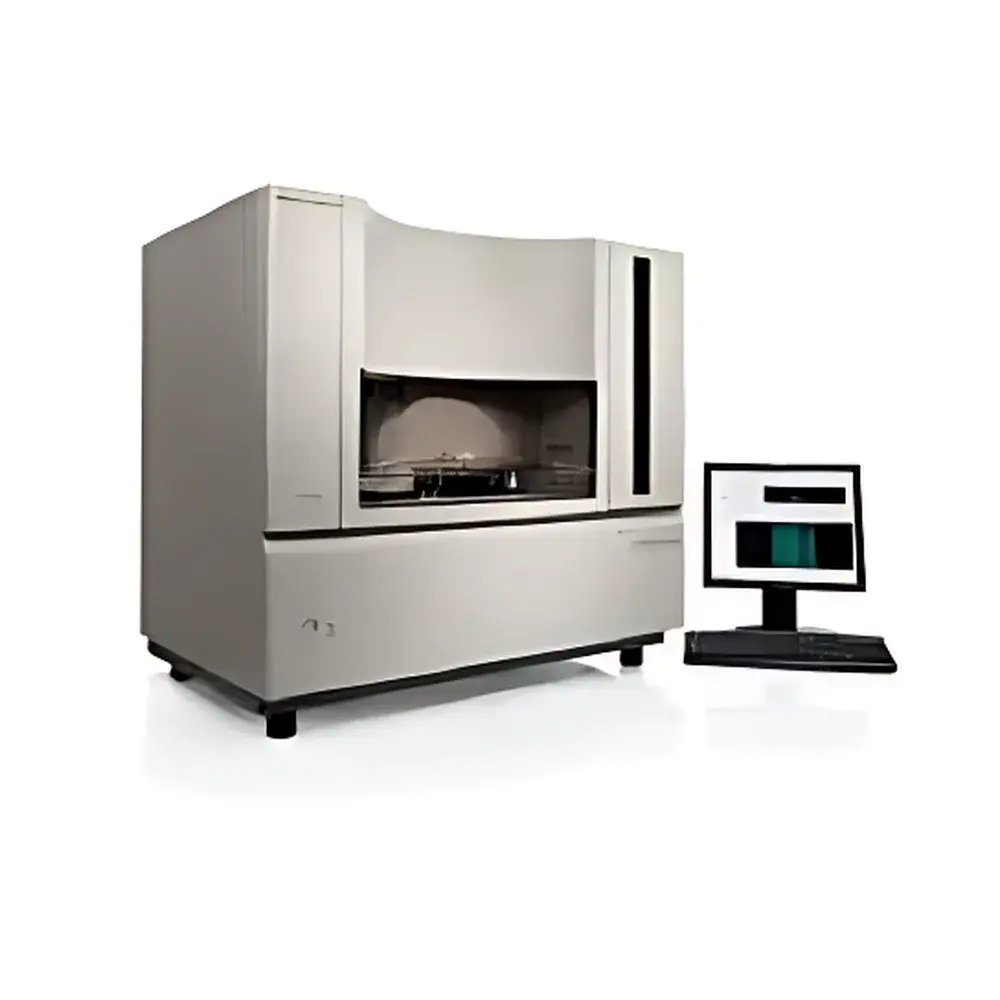
Applied Biosystems 3730xl DNA Analyzer
| Brand | Thermo Fisher Scientific |
|---|---|
| Origin | USA |
| Manufacturer Type | Original Equipment Manufacturer (OEM) |
| Product Category | Imported Instrument |
| Model | 3730xl |
| Instrument Type | First-Generation Capillary Electrophoresis DNA Sequencer |
| Read Length Range | 400–600 bp |
| Throughput | 768–3,936 reads/day |
| Detection Accuracy | 99.99% |
| Reproducibility | 90% |
| Run Frequency | 8–72 runs/day |
| Capillary Array Compatibility | 48- and 96-capillary formats |
| Laser Source | 505 nm solid-state laser |
| Temperature Control Range | 18–70 °C |
| Polymer System | POP-7™ polymer |
| Dye Capacity | Up to 6-color detection |
| Unattended Operation | Up to 48 hours |
| Integrated Barcode Reader | Yes |
| Onboard Plate Piercing | Yes |
| Automated Base Calling & Quality Value (QV) Scoring | Yes |
Overview
The Applied Biosystems 3730xl DNA Analyzer is a high-throughput, capillary electrophoresis–based genetic analysis platform engineered for precision, reproducibility, and operational robustness in core sequencing and fragment analysis laboratories. As a first-generation Sanger sequencer, it employs fluorescent dye-terminator chemistry coupled with high-resolution capillary electrophoresis to resolve DNA fragments by size. Its optical architecture—featuring dual-side capillary excitation and in-capillary fluorescence detection—delivers exceptional signal-to-noise ratios across broad input DNA concentration ranges (0.1–100 ng/µL). Designed for sustained deployment in academic, clinical, pharmaceutical, and government genomics facilities, the 3730xl supports mission-critical applications including de novo sequencing, resequencing, microsatellite analysis, SNP genotyping, and plasmid verification. Its compliance-ready design accommodates GLP and GMP-aligned workflows through audit-trail–enabled software logging and instrument-level calibration traceability.
Key Features
- High-sensitivity optical detection system with 505 nm solid-state laser and dual excitation geometry for uniform signal intensity across all 96 capillaries
- Integrated thermal control module (18–70 °C) enabling precise polymer viscosity management and run-to-run consistency
- Automated sample handling with dual-mode plate loader: compatible with both 48-well and 96-well standard PCR plates
- Onboard barcode reader and integrated plate-piercing mechanism eliminating manual intervention during multi-plate runs
- POP-7™ polymer delivery system optimized for extended read lengths and reduced electrophoretic run times
- Multi-dye support (up to six spectrally distinct dyes) enabling multiplexed fragment analysis without spectral overlap correction
- Unattended operation capability for up to 48 hours—validated for continuous sequencing of ≥12 plates per run cycle
- Embedded base-calling engine with real-time quality value (QV) scoring and Phred-based confidence metrics
Sample Compatibility & Compliance
The 3730xl accepts standard ABI-format sequencing reaction products generated using BigDye® Terminator v3.1 or earlier chemistries. It supports both forward and reverse strand sequencing on plasmid, PCR-amplified, and BAC-derived templates. Fragment analysis applications include STR profiling, AFLP, AFLP-SCAR, and allelic ladder sizing using GeneScan™–compatible dyes (e.g., LIZ, ROX, TAMRA). The system meets ISO/IEC 17025 requirements for testing laboratories and supports documentation practices aligned with FDA 21 CFR Part 11 for electronic records and signatures when used with Sequence Analysis Software v5.4 or later. Instrument calibration logs, run metadata, and raw data files are time-stamped and cryptographically hashed to ensure chain-of-custody integrity.
Software & Data Management
Data acquisition and analysis are managed via the Sequence Analysis Software suite (v5.4+), which provides automated base calling, quality filtering, consensus assembly, and chromatogram visualization. Raw .ab1 files are stored in vendor-neutral binary format compliant with NCBI Trace Archive submission standards. Batch processing modules enable parallel analysis of hundreds of samples with configurable QV thresholds (Q20–Q40), trimming parameters, and vector masking rules. Export options include FASTA, QUAL, PHD, and XML-encoded trace metadata—facilitating integration into LIMS environments such as LabVantage or STARLIMS. Audit trails record user actions, parameter changes, and calibration events with immutable timestamps and operator IDs.
Applications
- De novo genome sequencing: High-fidelity read generation for bacterial, viral, and organelle genomes where long-read continuity remains critical
- Targeted resequencing: Validation of NGS variants in clinical diagnostics, especially for low-frequency somatic mutations requiring orthogonal confirmation
- Microsatellite instability (MSI) testing: Multiplexed fragment sizing with internal size standards for oncology biomarker panels
- SNP genotyping by fragment length: Allele-specific sizing in pharmacogenomic and population genetics studies
- Plasmid and clone verification: Rapid confirmation of insert orientation, size, and sequence fidelity prior to functional assays
- Forensic STR profiling: CE-based allele calling compliant with SWGDAM guidelines and CODIS database submission criteria
FAQ
What is the maximum recommended number of samples per 96-capillary run?
Up to 96 samples can be loaded simultaneously; however, optimal data quality is maintained at ≤80 samples per run when targeting >500 bp reads.
Is the 3730xl compatible with third-party polymer formulations?
Only POP-7™ polymer is validated and supported by Thermo Fisher Scientific for use with this platform; substitution may compromise resolution, migration time stability, and warranty coverage.
How does the system handle carryover between runs?
Each capillary undergoes automated electrokinetic rinsing with deionized water and 0.1 M NaOH between injections, followed by polymer refill—verified via daily QC gel checks and capillary resistance monitoring.
Can raw data be exported for third-party variant calling pipelines?
Yes: .ab1 trace files and associated quality scores are fully exportable and interoperable with open-source tools including phred/phrap, Consed, and Geneious Prime.
What maintenance intervals are required for sustained performance?
Capillary array replacement every 300–500 runs; laser alignment verification quarterly; polymer delivery tubing replacement every 6 months—documented in the instrument’s service log and accessible via remote diagnostics portal.




