
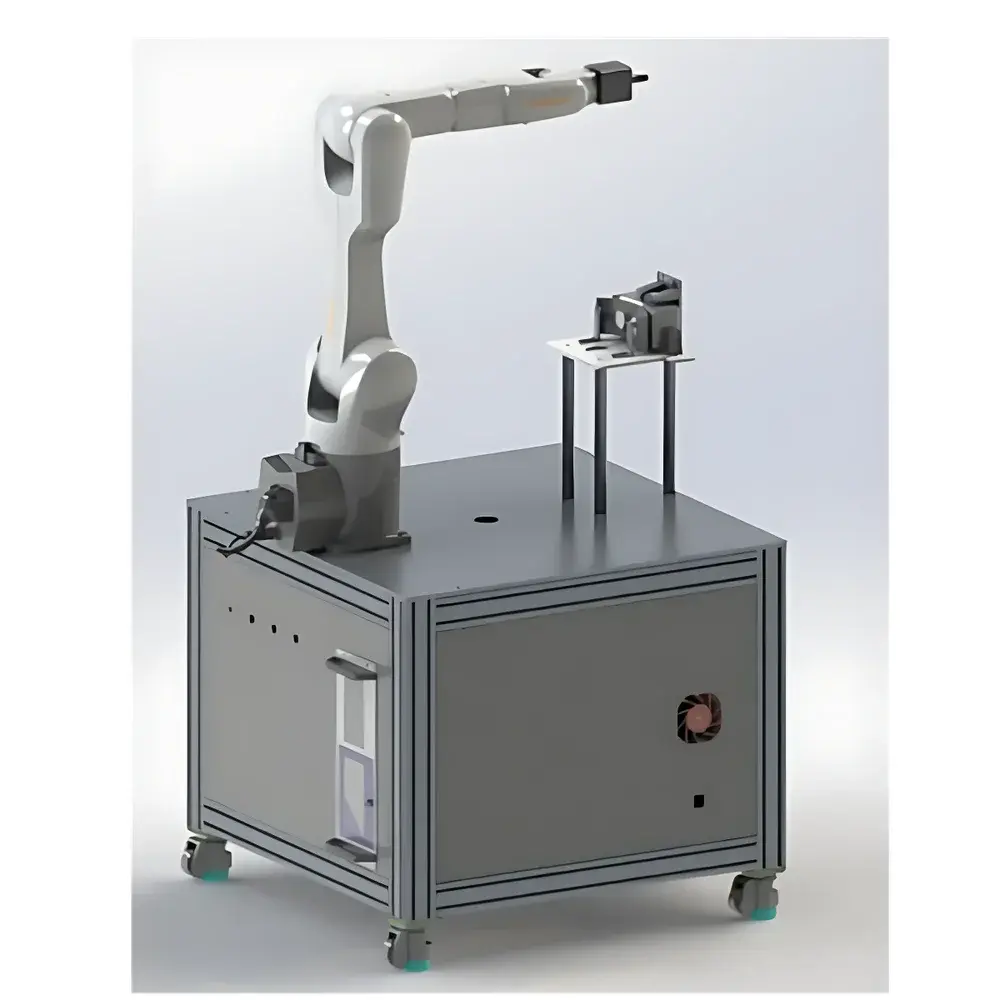
AR/VR Optical and Color Performance Integrated Test System
| Brand | ZOLIX |
|---|---|
| Origin | Beijing, China |
| Manufacturer Type | Authorized Distributor |
| Product Origin | Domestic (China) |
| Price Range | USD 14,000 – 70,000 |
Overview
The AR/VR Optical and Color Performance Integrated Test System is a fully automated metrology platform engineered for objective, repeatable evaluation of near-eye display (NED) optical and photometric characteristics. Built upon a precision robotic positioning architecture coupled with calibrated imaging photometry and spectroradiometry, the system implements standardized measurement geometries to quantify parameters critical to user visual experience and regulatory compliance. Its core methodology integrates spatially resolved luminance and chromaticity mapping—using an imaging colorimeter or high-dynamic-range (HDR) scientific camera calibrated traceably to NIST standards—with angular scanning via six-axis serial kinematics to reconstruct field-of-view (FOV), eye-box volume, and angular distortion profiles. This architecture enables conformance testing against industry benchmarks including ISO 9241-307 (Ergonomics of human-system interaction — Part 307: Analysis and compliance test methods for electronic visual displays), VESA DisplayHDR™ specifications, and internal OEM optical performance gates.
Key Features
- Modular six-axis serial robotic arm (optional delta-type parallel kinematic configuration available for enhanced dynamic stability and sub-millisecond repeatability in angular positioning)
- Integrated industrial control computer running real-time deterministic motion control firmware with synchronized trigger logic for camera/spectrometer acquisition
- Automated alignment routines using fiducial-based vision guidance to register device-under-test (DUT) coordinate frame to robot base frame
- Multi-point luminance and chromaticity mapping across full FOV at user-defined angular increments (0.1°–5° resolution configurable)
- Real-time computation of spatial uniformity metrics: ANSI contrast ratio, peak-to-average luminance ratio (PAR), Δu’v’ chromaticity deviation maps, and CIEDE2000-based color uniformity indices
- Automated geometric distortion analysis via checkerboard or dot-grid pattern projection and reverse ray-tracing reconstruction
- Full audit trail generation compliant with GLP/GMP documentation requirements, including timestamped raw image stacks, calibration certificates, and motion trajectory logs
Sample Compatibility & Compliance
The system accommodates a wide range of head-mounted display (HMD) form factors—including standalone VR headsets, tethered AR glasses, and waveguide-based microdisplay modules—via interchangeable mechanical fixtures with passive alignment pins and vacuum-assisted clamping. All fixtures are designed to maintain DUT optical axis alignment within ±0.05° tolerance during robotic articulation. The measurement methodology aligns with ASTM E308-22 (Standard Practice for Computing the Colors of Objects by Using the CIE System), CIE 15:2018 (Colorimetry), and IEC 62471 (Photobiological safety of lamps and lamp systems). Data export formats include CSV, HDF5, and vendor-neutral XML schemas supporting traceability under FDA 21 CFR Part 11 when deployed in regulated R&D environments.
Software & Data Management
The proprietary ZOLIX VisionTest Suite provides a unified GUI for test plan definition, hardware orchestration, and metrological analysis. It supports scriptable test sequences via Python API (PyZOLIX SDK), enabling integration into CI/CD pipelines for production line qualification. All measurement data—including raw radiance images, spectral power distributions (SPDs), and distortion correction LUTs—are stored with embedded metadata (calibration date, lens ID, environmental temperature/humidity, operator ID). Software includes built-in statistical process control (SPC) dashboards, batch comparison tools, and automated report generation in PDF/HTML with digital signature support. Audit logs record all user actions, parameter modifications, and software updates in immutable append-only format.
Applications
- Objective validation of optical design iterations during AR/VR display development
- Production-line pass/fail screening of luminance uniformity, chromaticity shift, and FOV consistency
- Eye-box characterization for ergonomic assessment and IPD (interpupillary distance) accommodation analysis
- Distortion modeling for software-based geometric correction (e.g., pre-warping in Unity/Unreal rendering pipelines)
- Regulatory submission support for CE marking, FCC ID certification, and medical-grade AR device clearance (e.g., Class I/IIa under MDR 2017/745)
- Comparative benchmarking against competitive HMDs using standardized test protocols
FAQ
Does the system support calibration traceability to national metrology institutes?
Yes—primary sensors are calibrated annually by CNAS-accredited laboratories with NIST-traceable reference standards; calibration certificates include uncertainty budgets per ISO/IEC 17025.
Can the software generate reports compliant with ISO/IEC 17025 requirements?
Yes—the reporting module embeds instrument calibration status, environmental monitoring data, and analyst credentials, satisfying clause 7.8.2 on reporting of results.
Is remote operation supported for distributed R&D teams?
Yes—secure TLS-encrypted web interface enables real-time remote monitoring, test queue management, and result download without compromising local network security policies.
What spectral range does the integrated spectroradiometer cover?
Standard configuration covers 380–780 nm (CIE 1931 V(λ)-weighted), with optional extension to 350–1050 nm for NIR leakage and LED phosphor characterization.
How is thermal drift compensated during extended measurement sequences?
The system performs automatic dark-frame subtraction and references a stabilized internal white-light source every 15 minutes to correct for sensor gain drift and ambient thermal effects.




