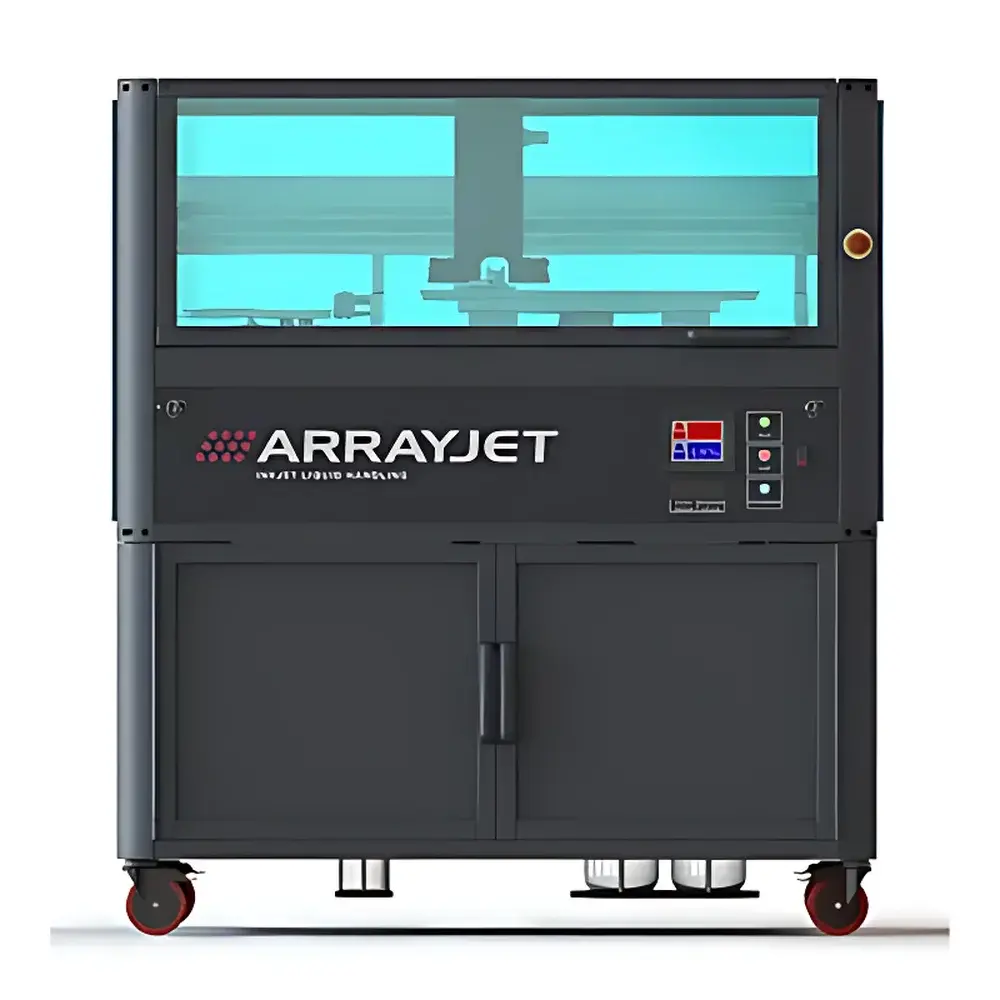
ArrayJet Mercury 100-S Non-Contact Piezoelectric Microarray Spotting System
| Brand | ArrayJet |
|---|---|
| Origin | United Kingdom |
| Model | Mercury 100-S |
| Spotting Method | Non-contact piezoelectric inkjet |
| Spotting Speed | 711 spots/second |
| Substrate Capacity | 48 × SBS-format microplates or 100 × standard microscope slides (76 × 26 mm) |
| Spot-to-spot Precision | CV < 5% |
| Dispense Volume Range | picoliter to nanoliter |
| Compliance | Designed for GLP/GMP-aligned workflows, compatible with ISO 13485 and ASTM E2578-07 (Standard Guide for Microarray Processing) |
Overview
The ArrayJet Mercury 100-S is a high-throughput, non-contact piezoelectric microarray spotting system engineered for precision deposition of biomolecules—including DNA, RNA, proteins, glycans, antibodies, and small-molecule libraries—onto solid-phase substrates. Unlike contact-based pin-and-dip systems, the Mercury 100-S utilizes proprietary flight-mode inkjet technology: droplets are generated on-demand via piezoelectric actuation and propelled across an air gap to the substrate surface without physical contact. This eliminates cross-contamination, reduces carryover, and preserves sample integrity—especially critical for low-abundance or precious reagents. The system’s core architecture integrates 128 parallel, individually addressable print nozzles operating at synchronized frequencies, enabling true parallelism in spot placement. Its closed-loop environmental control module maintains stable temperature (±0.5 °C), humidity (±3% RH), and laminar airflow to suppress evaporation during deposition—ensuring consistent spot morphology, uniform drying kinetics, and reproducible immobilization efficiency across thousands of features per array.
Key Features
- Non-contact piezoelectric inkjet dispensing with 128 independent nozzle channels for simultaneous multi-sample processing
- Ultra-high throughput: up to 711 discrete spots per second, scalable across full slide or microplate formats
- Sub-nanoliter volume control: precise dispensing from 1 pL to 500 nL per spot, calibrated via gravimetric and fluorescent tracer validation
- Dual-substrate handling: supports 48 SBS-standard microplates (96-/384-/1536-well) or 100 standard microscope slides (76 × 26 mm) in a single run
- Integrated optical quality assurance: real-time camera-based spot detection and post-deposition imaging for morphology assessment and positional verification
- Industrial-grade printhead design with >10⁹ actuation cycles lifetime and automated self-cleaning protocols to ensure long-term reliability
- CV < 5% coefficient of variation for spot volume and position—validated per ISO/IEC 17025-accredited internal QC procedures
Sample Compatibility & Compliance
The Mercury 100-S accommodates a broad spectrum of biological and chemical samples: aqueous buffers, glycerol-containing protein solutions (up to 50% v/v), DMSO-based compound libraries (≤10% v/v), and viscous oligonucleotide formulations. It accepts diverse substrates—including aldehyde-, epoxy-, NHS-, and poly-L-lysine-coated glass slides; nitrocellulose and PVDF membranes; functionalized silicon wafers; and polymer-based microfluidic chips. All fluidic pathways are chemically inert (perfluoroalkoxy-lined tubing, stainless-steel manifolds) and compatible with common sterilization methods (autoclaving, ethanol flush, UV exposure). The system meets essential requirements for regulated environments: audit-trail-enabled software logs (FDA 21 CFR Part 11 compliant), electronic signature support, and full traceability of calibration events, maintenance records, and run parameters—facilitating GLP, GMP, and ISO 13485 documentation workflows.
Software & Data Management
Operation is managed through ArrayJet’s Command Centre™ software—a Windows-based platform featuring intuitive drag-and-drop layout design, real-time preview rendering, and batch parameter scripting. Users define spotting patterns using industry-standard formats (e.g., GAL, CSV, or custom XML), assign sample IDs to wells/slides, and configure environmental setpoints prior to run initiation. The software provides live monitoring of nozzle status, pressure transients, and environmental stability metrics. All raw data—including timestamped image captures, volumetric calibration logs, and positional deviation heatmaps—are stored in a structured SQLite database with optional integration into LIMS or ELN systems via RESTful API. Export options include TIFF, PNG, and annotated PDF reports compliant with ISO/IEC 17025 reporting guidelines.
Applications
- High-density nucleic acid microarrays for gene expression profiling, SNP genotyping, and miRNA screening
- Reverse-phase protein arrays (RPPA) for quantitative phosphoproteomics and biomarker validation
- Glycan and lectin arrays for carbohydrate-binding specificity mapping
- Antibody and aptamer microarrays for serological diagnostics and infectious disease surveillance
- Small-molecule and fragment-based screening on functionalized surfaces for early-stage drug discovery
- Deposition onto semiconductor biosensors and microelectrode arrays for electrochemical detection coupling
- Preparation of spatially encoded microfluidic assay chips and organ-on-a-chip interface patterning
FAQ
What types of biofluids or reagents can be spotted using the Mercury 100-S?
Aqueous-based samples—including diluted sera, purified IgG, synthetic oligos, and cell lysates—are routinely processed. Viscosity limits are defined by dynamic surface tension and nozzle wetting behavior; typical upper thresholds are ~20 cP at 20 °C.
Is the system validated for use in regulated pharmaceutical development?
Yes—Command Centre™ includes 21 CFR Part 11-compliant user access controls, electronic signatures, and immutable audit trails. IQ/OQ documentation packages are available upon request.
How is spot uniformity verified during operation?
Optical QC module performs pre-run nozzle health checks and post-deposition imaging at 5 µm/pixel resolution; spot area, circularity, and intensity distribution are quantified automatically.
Can the Mercury 100-S be integrated into automated laboratory workflows?
It supports standard robotic interfaces (RS-232, TCP/IP, and digital I/O) for synchronization with liquid handlers, incubators, and wash stations in end-to-end array fabrication lines.
What maintenance is required to sustain long-term performance?
Daily purging and weekly nozzle conditioning are recommended; annual calibration of environmental sensors and printhead alignment is performed by certified Field Service Engineers.