
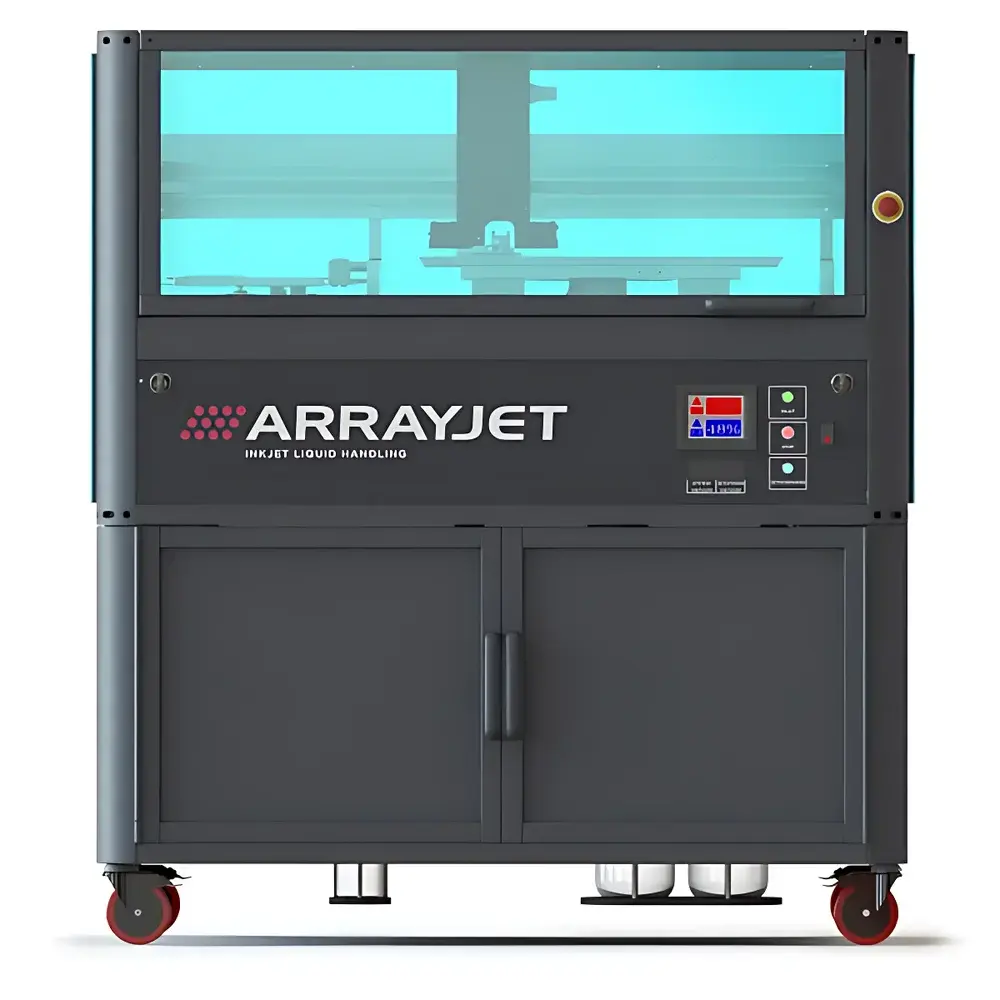
Arrayjet Mercury 100S High-Throughput Non-Contact Inkjet Microarray Spotting System
| Brand | Arrayjet |
|---|---|
| Origin | United Kingdom |
| Model | Mercury 100S |
| Spotting Type | Non-contact inkjet |
| Spot Volume Range | 40 pL to 10 nL |
| Certification | ISO 13485:2016 (Manufacturing Site, Edinburgh, UK) |
Overview
The Arrayjet Mercury 100S is a precision-engineered, non-contact piezoelectric inkjet-based microarray spotting system designed for high-fidelity deposition of biological and functional materials onto solid substrates. Operating on the principle of controlled droplet ejection via acoustic inkjet technology—distinct from thermal or continuous-jet methods—the Mercury 100S delivers picoliter-scale liquid handling with exceptional positional accuracy (< ±5 µm), minimal cross-contamination risk, and negligible sample shear stress. Unlike contact pin-based spotters, this platform eliminates physical substrate contact, preserving surface integrity and enabling deposition on delicate or coated slides (e.g., NHS-activated, epoxy, nitrocellulose, or hydrophobic polymer surfaces). Its core architecture supports both single-spot and massively parallel deposition workflows, making it suitable for applications ranging from diagnostic antibody microarrays and nucleic acid expression profiling to printed organic electronics and biosensor fabrication.
Key Features
- Non-contact acoustic inkjet dispensing ensures zero carryover and no tip clogging—even with viscous, particulate-laden, or low-surface-tension biofluids (e.g., serum, lysates, glycerol-stabilized antibodies)
- Adjustable spot volume from 40 pL to 10 nL per droplet, calibrated and verified using gravimetric and fluorescent tracer methodologies
- High-throughput capability: up to 10,000 unique features per slide at speeds exceeding 1,200 spots/second with sub-millisecond droplet timing resolution
- Modular head configuration supporting up to 16 independently addressable printheads, each with 128 nozzles, enabling true multiplexed reagent deposition
- Integrated environmental control: temperature- and humidity-regulated print chamber (18–25 °C, 30–50% RH) to stabilize droplet flight dynamics and prevent evaporation-induced concentration gradients
- Robust mechanical design compliant with ISO 13485:2016 quality management standards for medical device manufacturing—validated at Arrayjet’s Edinburgh facility
Sample Compatibility & Compliance
The Mercury 100S accommodates a broad spectrum of sample types without modification: aqueous buffers, protein solutions (IgG, enzymes, cytokines), DNA/RNA oligos, synthetic peptides, viral vectors, extracellular vesicles, and conductive inks (e.g., PEDOT:PSS, silver nanoparticle dispersions). Substrate compatibility includes standard glass slides (25 × 75 mm), silicon wafers, flexible PET films, and custom-patterned sensor chips. All hardware and firmware comply with IEC 61000-6-2 (EMC immunity) and IEC 61000-6-4 (EMC emission) standards. For regulated environments, the system supports audit-trail-enabled operation under GLP and GMP frameworks; optional 21 CFR Part 11-compliant software modules provide electronic signature, user role management, and immutable data logging.
Software & Data Management
Controlled via Arrayjet’s proprietary JetSuite™ software (Windows 10/11 x64), the Mercury 100S offers intuitive graphical layout design, real-time nozzle health monitoring, and automated calibration routines—including dynamic drop velocity measurement and satellite droplet suppression tuning. Experimental metadata (e.g., lot numbers, dilution factors, ambient conditions) is embedded directly into output files (UTF-8 CSV, XML, or MIAME-compliant MAGE-TAB). Raw deposition logs are timestamped and stored in SQLite databases with SHA-256 hash integrity verification. Export options include TIFF-based spot maps, JSON-encoded feature coordinates, and direct integration with downstream analysis platforms (e.g., GeneSpring GX, R/Bioconductor limma).
Applications
- High-density diagnostic microarrays for serological profiling and autoantibody screening
- Functional genomics: CRISPR guide RNA libraries, siRNA validation arrays, and spatial transcriptomics probe printing
- Point-of-care biosensor development: immobilization of capture agents on electrochemical or optical transducers
- Microelectronics prototyping: additive printing of dielectric layers, interconnects, and passivation films on flexible substrates
- Cell-based assay platforms: precise patterning of extracellular matrix proteins to guide stem cell differentiation
- Biobanking support: archival-grade printing of reference standards for inter-laboratory assay harmonization
FAQ
What is the minimum recommended viscosity for reliable jetting?
Viscosities up to 20 mPa·s are supported at 25 °C; higher values require pre-heating or diluent optimization—consult Arrayjet’s Fluid Compatibility Guide.
Can the Mercury 100S deposit live cells?
Yes—validated protocols exist for mammalian and bacterial cells using low-acoustic-energy waveforms and buffered glycerol carriers; viability retention exceeds 92% post-deposition (per ISO 20944-2 cytotoxicity assessment).
Is remote maintenance and diagnostics available?
All Mercury 100S units include secure TLS-encrypted remote access (opt-in); Arrayjet Field Application Scientists perform predictive nozzle diagnostics and firmware updates via encrypted SSH tunnels.
How is calibration traceability maintained?
Each system ships with NIST-traceable calibration certificates for stage positioning (laser interferometer-verified) and volumetric delivery (gravimetrically validated using Class S1 microbalances per ISO/IEC 17025).




