
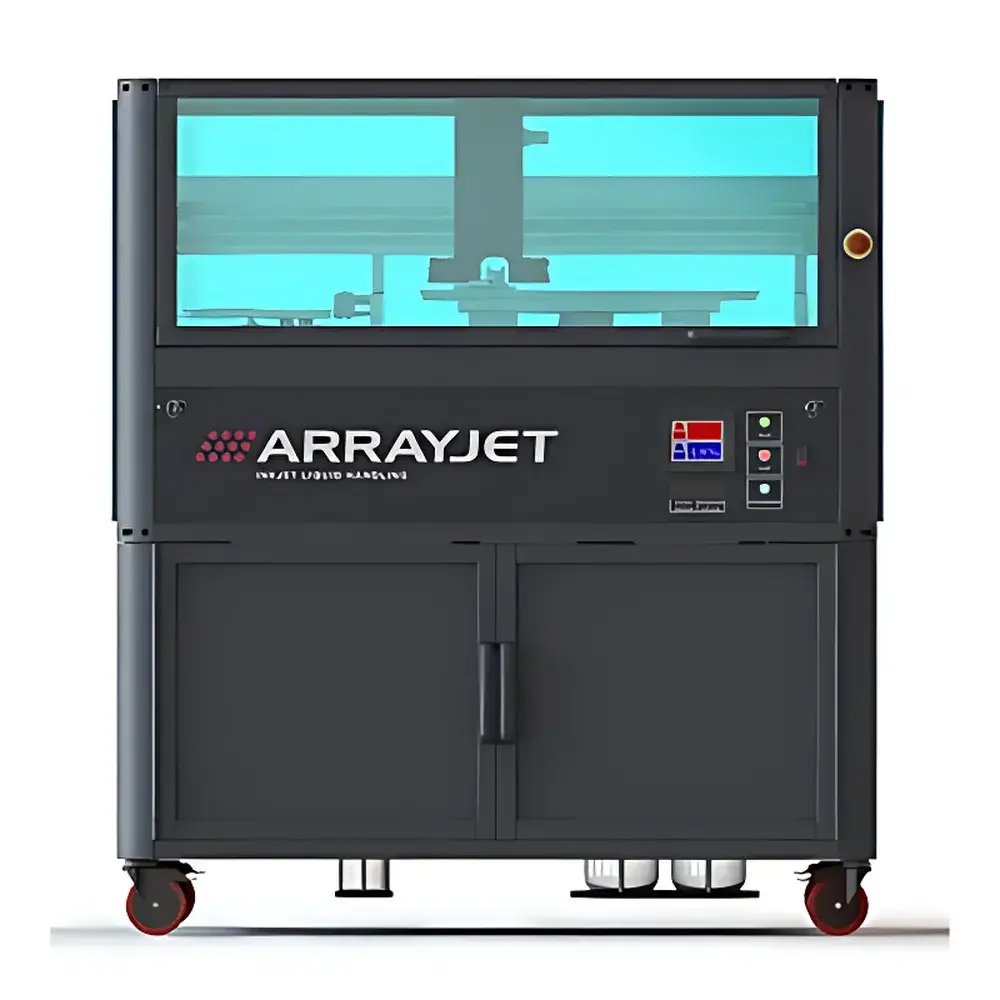
ArrayJet Mercury 25 Non-Contact Microarray Spotting System
| Brand | ArrayJet |
|---|---|
| Origin | United Kingdom |
| Model | Mercury 25 |
| Spotting Method | Non-contact piezoelectric inkjet |
| Number of Parallel Nozzles | 128 |
| Spotting Speed | 711 spots per second |
| Substrate Capacity | 1 × SBS-standard microplate or 25 × standard microscope slides (76 × 26 mm) |
| Spot-to-Spot Reproducibility | CV < 5% |
| Environmental Control | Integrated humidity and temperature regulation with evaporation suppression |
Overview
The ArrayJet Mercury 25 is a high-precision, non-contact microarray spotting system engineered for reproducible deposition of biomolecules—including DNA, RNA, proteins, antibodies, glycans, and small molecules—onto diverse solid supports. It employs industrial-grade piezoelectric inkjet technology, where voltage-driven actuators generate precise acoustic pressure waves to eject sub-nanoliter droplets without physical contact between nozzle and substrate. This eliminates cross-contamination, surface damage, and carryover—critical for low-volume, high-value biological reagents. Unlike pin-based or contact printing methods, the Mercury 25’s flight-mode jetting ensures consistent droplet volume (typically 0.5–2.5 nL per spot), minimal sample waste, and compatibility with viscous or particulate-containing solutions. Designed for both academic core facilities and regulated biopharmaceutical environments, the system operates within a controlled chamber featuring real-time humidity monitoring (±2% RH) and ambient temperature stabilization (±0.5 °C), mitigating solvent evaporation and maintaining solute concentration integrity across extended print runs.
Key Features
- 128 parallel, individually addressable piezoelectric nozzles enabling true parallel spotting—significantly reducing array fabrication time without compromising positional fidelity.
- Spotting speed of up to 711 discrete spots per second across a single slide, scalable to full 25-slide batches via automated carousel handling.
- Sub-nanoliter dispensing accuracy supported by closed-loop calibration routines and dynamic drop visualization using integrated high-speed imaging.
- Integrated environmental control module maintains stable chamber conditions during operation, minimizing spot morphology variation caused by rapid solvent evaporation.
- Industrial-grade printhead architecture rated for >10⁹ actuation cycles, validated under ISO 9001 manufacturing protocols and compatible with aqueous buffers, DMSO-containing compounds, and glycerol-stabilized protein formulations.
- Modular mechanical design compliant with ISO 13849-1 safety standards, including emergency stop circuitry, interlocked access doors, and CE/UKCA marking.
Sample Compatibility & Compliance
The Mercury 25 accommodates a broad spectrum of sample types—including oligonucleotides, recombinant proteins, monoclonal antibodies, synthetic peptides, carbohydrates, and small-molecule libraries—without requiring pre-filtration or dilution beyond standard assay preparation. It accepts substrates ranging from functionalized glass slides (amine-, epoxy-, aldehyde-, or NHS-activated), nitrocellulose and PVDF membranes, polymer-coated microtiter plates (96-/384-well SBS format), and silicon- or gold-based biosensor surfaces. All fluidic pathways are constructed from chemically inert materials (e.g., PEEK, fused silica, and stainless steel 316L), ensuring compatibility with aggressive solvents and low-pH buffers. The system meets key regulatory prerequisites for GxP environments: audit trail functionality (with user authentication and timestamped event logging), electronic signature support aligned with FDA 21 CFR Part 11, and full traceability of calibration records and maintenance logs per ISO/IEC 17025 requirements.
Software & Data Management
Operation is fully managed through Command Centre™—a Windows-based application built on .NET Framework with deterministic real-time scheduling. The software provides drag-and-drop layout design, multi-layer mask alignment tools, and interactive preview rendering showing exact spot placement, overlap zones, and grid offsets at 1 µm resolution. All print jobs are saved as XML-based protocol files containing complete metadata: nozzle mapping, voltage profiles, dwell times, environmental setpoints, and QC checkpoints. Raw log data—including piezo firing statistics, chamber sensor readings, and error codes—is exported in CSV/TSV format for integration into LIMS or ELN platforms (e.g., LabArchives, Benchling). Optional API modules enable RESTful integration with enterprise workflow engines and robotic liquid handlers.
Applications
- High-throughput fabrication of nucleic acid microarrays for genotyping, expression profiling, and epigenetic analysis.
- Reverse-phase protein arrays (RPPA) using lysates from cell lines or clinical tissue specimens.
- Antibody and aptamer screening platforms for diagnostic biomarker validation.
- Microbial detection arrays targeting pathogen-specific genomic signatures or antimicrobial resistance markers.
- Compound library immobilization onto functionalized surfaces for label-free binding kinetics assays (e.g., SPRi, interferometry).
- Deposition of reagents onto microfluidic chips and semiconductor-integrated biosensors for point-of-care device development.
FAQ
What minimum sample volume is required per nozzle reservoir to sustain continuous operation?
Typical reservoir capacity is 80 µL per nozzle; with average consumption of 0.8 nL per spot, one fill supports >100,000 spots.
Can the Mercury 25 deposit multiple different reagents in a single pass?
Yes—via multi-reservoir configuration with independent fluid paths and synchronized nozzle addressing.
Is post-spotting UV crosslinking or baking required for covalent immobilization?
No—covalent coupling occurs spontaneously on activated surfaces; optional post-processing steps are defined by substrate chemistry, not instrument limitations.
How frequently must the printhead undergo preventive maintenance?
Recommended nozzle flush and calibration every 200 operational hours, with full head inspection every 1,000 hours per manufacturer service schedule.
Does ArrayJet provide application-specific method development support?
Yes—dedicated technical specialists offer remote and on-site optimization services, including viscosity adaptation, surface energy mapping, and spot morphology analysis using confocal fluorescence imaging.




