
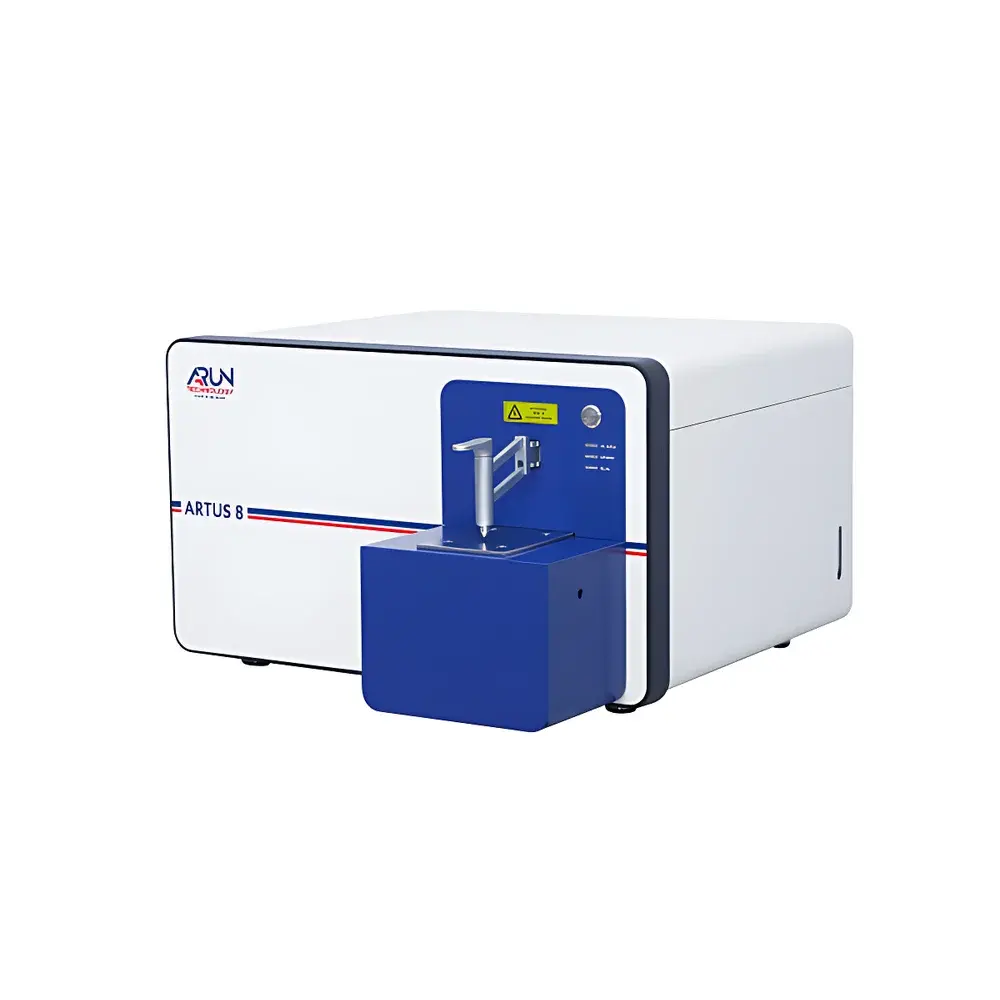
ARUN TECHNOLOGY ARTUS 8 B Benchtop Spark Optical Emission Spectrometer (OES)
| Brand | ARUN TECHNOLOGY LTD. |
|---|---|
| Origin | United Kingdom |
| Instrument Type | Benchtop |
| Excitation Source | Spark |
| Detector | Charge-Coupled Device (CCD) |
| Spectral Range | Configurable (130–700 nm) |
| Optical Design | Paschen-Runge Mount with Long Focal Length |
| Temperature Control Stability | ±0.1 °C |
| Software Platform | iAPS Intelligent Alloy Identification System, OMVR Calibration Engine, ASR Spark Filtering Algorithm |
| Compliance | Designed for ISO/IEC 17025-compliant laboratories |
Overview
The ARUN TECHNOLOGY ARTUS 8 B is a benchtop spark optical emission spectrometer engineered for high-precision elemental analysis of metallic alloys in production, quality control, and research environments. It operates on the principle of spark-induced plasma emission spectroscopy: a controlled high-voltage spark ablates a micro-volume of the conductive sample surface, generating excited atoms and ions whose characteristic UV–visible emission lines (130–700 nm) are dispersed and quantified via a dual-chamber Paschen-Runge optical system. Unlike sequential or PMT-based OES instruments, the ARTUS 8 B employs two fully independent CCD detectors — one optimized for deep UV (130–190 nm) and another for visible/NIR (190–700 nm) — enabling simultaneous detection of critical light elements (C, N, P, S, B, As) alongside major and trace alloying constituents (e.g., Cr, Ni, Mo, Cu, Al, Ti, V) without mechanical wavelength scanning. Its argon-purged, pressure-stabilized optical chamber eliminates vacuum-related mechanical drift, while its active thermal regulation (±0.1 °C) ensures long-term spectral stability across ambient fluctuations.
Key Features
- Dual optical chambers with dedicated CCD arrays: UV chamber (130–190 nm) and VIS/NIR chamber (190–700 nm), each with optimized grating and detector geometry for maximum quantum efficiency and linearity.
- Paschen-Runge mounting with extended focal length: Increases usable spectral line density and improves resolution (<0.01 nm at 200 nm), directly enhancing detection limits and inter-element interference correction.
- High-energy digital spark source: Fully programmable pulse synthesis allows independent control of pre-spark conditioning, integration time, and discharge energy per element group — essential for optimizing signal-to-noise ratios across diverse matrices (Fe, Al, Cu, Ni, Ti, Mg, Zn).
- ASR (Aberrant Spark Removal) algorithm: Real-time rejection of non-representative sparks caused by surface oxides, inclusions, or microstructural heterogeneity, improving measurement reproducibility (RSD < 1.2% for certified reference materials).
- OMVR (Optimized Multivariate Regression): A physics-informed calibration engine that models matrix effects, inter-element correlations, and background shifts — reducing reliance on large CRM libraries and enabling robust quantification across untrained alloys.
- Integrated thermal and mechanical stabilization: Active chamber temperature control (±0.1 °C), pneumatic optical chamber pressure compensation, and real-time spectral centroid correction mitigate thermal drift and mechanical hysteresis.
Sample Compatibility & Compliance
The ARTUS 8 B accommodates solid metallic samples up to 32 kg via its gravity-assisted, open-design spark stand with rapid-access electrode exchange and tool-free cleaning ports. It supports flat, cylindrical, and irregular geometries (minimum diameter ≥ 10 mm; minimum thickness ≥ 2 mm). Sample preparation requires only standard grinding (SiC paper, 120–400 grit) or milling — no acid etching or vacuum deposition needed. The instrument meets ISO 11577 (metallic materials — spark emission spectrometry), ASTM E415 (standard test method for analysis of carbon and low-alloy steel), and EN 10052 (terminology related to heat treatment of steels). Its firmware and software architecture support full audit trail logging, electronic signatures, and secure user role management — fulfilling requirements for GLP, GMP, and ISO/IEC 17025 accreditation when deployed with optional Mini-LIMS (SQL-based) and 21 CFR Part 11 compliance modules.
Software & Data Management
The ARTUS 8 B runs on a Windows-based, fully graphical interface requiring ≤2 hours for operator proficiency. Core modules include: iAPS (intelligent Alloy Pattern Search), which matches unknown spectra against a configurable library of >1,200 international standards (ASTM, DIN, JIS, GB, UNS); automatic grade classification with confidence scoring; pass/fail decision logic based on user-defined tolerance bands; and dynamic recalibration triggers. Data export supports CSV, XML, and PDF report generation with embedded spectral plots and uncertainty estimates. With Mini-LIMS integration, all analyses are timestamped, user-attributed, and stored in ACID-compliant relational databases — enabling traceability from raw spectrum to final certificate of conformance. Remote diagnostics, firmware updates, and collaborative method sharing are enabled via encrypted HTTPS web services.
Applications
The ARTUS 8 B serves as a primary analytical tool across metallurgical supply chains: incoming material inspection in foundries and rolling mills; melt shop process control for carbon equivalency and residual element monitoring; QC release testing for aerospace-grade aluminum (e.g., 2xxx, 7xxx series), stainless steels (304, 316, duplex), superalloys (Inconel 718, Hastelloy C-276), and titanium grades (Ti-6Al-4V); R&D alloy development where ppm-level trace element quantification (e.g., Sn in Cu, Ca in Al) impacts mechanical performance; and failure analysis labs requiring rapid compositional mapping of fracture surfaces or weld zones. Its ability to quantify light elements without vacuum pumps makes it especially suitable for high-throughput lab environments lacking dedicated vacuum infrastructure.
FAQ
Does the ARTUS 8 B require vacuum pumping for UV analysis?
No — its sealed, argon-flushed optical chamber maintains stable UV transmission without vacuum systems, reducing maintenance and eliminating vacuum-induced mechanical stress on optics.
Can the instrument analyze non-ferrous alloys such as aluminum or copper without changing hardware?
Yes — method flexibility is achieved entirely through software configuration; new base materials and elements are added via calibration files and excitation parameter sets, not optical modifications.
How does the OMVR calibration differ from conventional univariate or polynomial regression?
OMVR incorporates physical constraints (e.g., ionization potentials, line intensity ratios, matrix absorption coefficients) into the regression model, significantly improving accuracy for off-calibration compositions and minimizing CRM dependency.
Is remote support and method transfer possible between multiple ARTUS 8 B units?
Yes — via secure cloud-enabled synchronization, methods, calibrations, and spectral libraries can be version-controlled and deployed across geographically distributed instruments with cryptographic integrity verification.
What safety certifications does the spark source meet?
The high-voltage spark generator complies with IEC 61010-1 (Safety Requirements for Electrical Equipment for Measurement, Control, and Laboratory Use) and includes redundant hardware interlocks, emergency stop circuitry, and spark chamber overpressure venting.




