
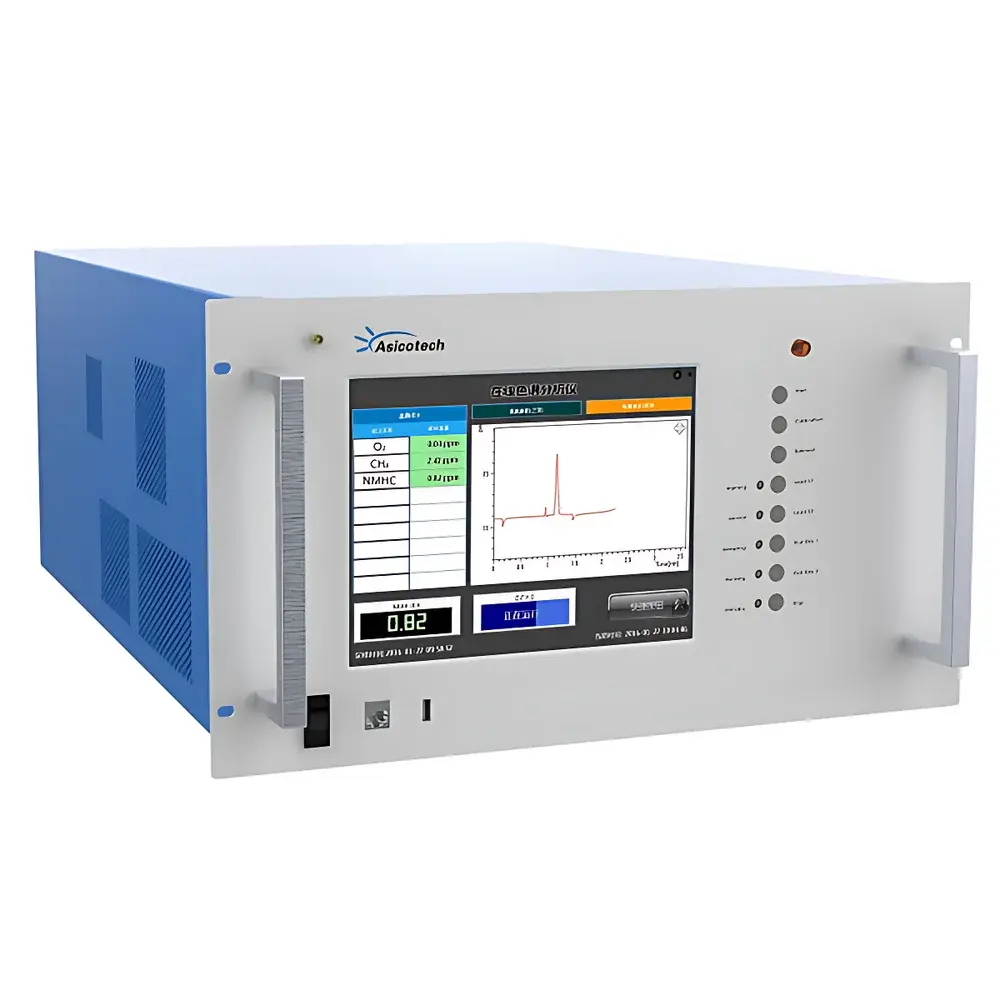
Asicotech P5100-A6 Online Methane and Non-Methane Hydrocarbons (NMHC) Analyzer
| Brand | Asicotech |
|---|---|
| Origin | Shanghai, China |
| Manufacturer Type | Original Equipment Manufacturer (OEM) |
| Country of Origin | China |
| Model | P5100-A6 |
| Instrument Type | Online Continuous Emission Monitoring System (CEMS) |
| Detection Limit | <10 ppb for NMHC |
| Compliance | HJ 1019–2019 “Technical Specification for Continuous Automatic Monitoring of Non-Methane Hydrocarbons in Ambient Air (Trial)” |
Overview
The Asicotech P5100-A6 Online Methane and Non-Methane Hydrocarbons (NMHC) Analyzer is a fully integrated, continuous ambient air and stack emission monitoring system engineered for high-sensitivity, regulatory-compliant hydrocarbon speciation. It employs a proprietary dual-path gas chromatographic architecture coupled with on-line pre-concentration via thermoelectrically cooled adsorption and rapid resistive heating desorption—enabling quantitative separation and detection of methane (CH₄) and the residual C₂–C₁₂ non-methane hydrocarbon fraction in a single analytical cycle. Unlike conventional flame ionization detector (FID)-only total hydrocarbon analyzers, the P5100-A6 implements a dedicated methane quantification loop using a fixed-volume sampling valve and methanizer-free FID detection, while simultaneously routing the bulk sample stream through a cryo-enriched trap to capture NMHC at sub-ambient temperatures (–30 °C). This design eliminates methane breakthrough interference and ensures trace-level NMHC measurement fidelity in complex matrices such as refinery off-gas, semiconductor process purge streams, and urban ambient air.
Key Features
- Integrated D2200-T5 online dynamic dilution module with programmable dilution ratios from 50× to 2000×, maintaining linearity (R² > 0.999) across the full range for calibration traceability and matrix-matched standard delivery.
- Automated sample acquisition using a vacuum-assisted diaphragm pump and mass flow controller (MFC), with real-time atmospheric pressure compensation and auto-balancing between sample line and ambient reference pressure.
- Cryo-trap enrichment based on solid-state Peltier cooling (–30 °C to ambient), enabling quantitative capture of volatile organic compounds (VOCs) down to C₂ hydrocarbons without liquid nitrogen or mechanical refrigeration.
- Direct-resistive thermal desorption (DRTD) with sub-second ramp-to-temperature capability (up to 300 °C), minimizing band broadening and ensuring sharp, reproducible chromatographic peaks.
- Dual-channel GC-FID configuration: one dedicated methane channel using a 1 mL fixed-loop injection and optimized column set (e.g., Porapak Q + HayeSep D); second channel for NMHC separation on a fused-silica capillary column (e.g., DB-1 or equivalent) with backflush capability.
- Fully automated calibration sequence supporting multi-point bracketing, zero/span verification, and leak integrity checks per EPA Method 25A and ISO 13845 requirements.
Sample Compatibility & Compliance
The P5100-A6 is validated for continuous analysis of gaseous samples with moisture content ≤ 500 ppmv and particulate loading < 1 mg/m³. It meets the performance criteria defined in China’s HJ 1019–2019 Technical Specification for Continuous Automatic Monitoring of Non-Methane Hydrocarbons in Ambient Air (Trial), including detection limit (<10 ppb NMHC), repeatability (RSD ≤ 3% at 50 ppb), linearity (≥ 0.995 over 10–1000 ppb), and interferences rejection (e.g., CO, CO₂, H₂O, SO₂ ≤ ±5% bias). The system architecture supports GLP/GMP-aligned audit trails, with timestamped event logging, method version control, and user-access-level permissions compliant with FDA 21 CFR Part 11 principles. Optional I/O modules enable integration into existing SCADA/DCS platforms via Modbus TCP or OPC UA protocols.
Software & Data Management
The embedded Linux-based control software provides real-time chromatogram visualization, automatic peak integration using adaptive baseline algorithms, and NMHC calculation per national definition: NMHC = Total Hydrocarbons – CH₄. Raw data (including FID voltage traces, valve timing logs, temperature profiles, and calibration records) are stored locally in SQLite format with optional encrypted cloud backup. Reporting modules generate daily summary reports conforming to HJ 75–2017 and HJ 76–2017 CEMS data validation templates, including uptime statistics, QA/QC flagging, and drift correction logs. Remote diagnostics and firmware updates are supported via secure TLS-encrypted SSH tunneling, with role-based access control for operators, engineers, and auditors.
Applications
- Continuous emissions monitoring (CEM) of methane and NMHC from petrochemical and coal-to-olefins (MTO/MTA/GTO) plant stacks, complying with China’s “Three-Year Action Plan for VOCs Control”.
- Ultra-high-purity gas certification in semiconductor fabrication facilities—monitoring residual hydrocarbons in hydrogen (H₂), nitrogen (N₂), and carbon dioxide (CO₂) supply lines to meet SEMI F57 purity Class 1 specifications.
- Ambient air quality networks requiring real-time NMHC speciation for ozone precursor modeling and source apportionment studies.
- Landfill and biogas upgrading facilities where simultaneous CH₄ recovery efficiency assessment and NMHC fugitive emission tracking are required.
- Research laboratories conducting kinetic studies of atmospheric oxidation pathways involving alkanes, alkenes, and aromatic compounds.
FAQ
What regulatory standards does the P5100-A6 comply with?
It fulfills HJ 1019–2019 for ambient air NMHC monitoring and supports alignment with EPA Method 25A, ISO 13845, and EN 13526 for industrial stack applications.
Can the system operate unattended for extended periods?
Yes—designed for 30-day unattended operation with onboard consumables (traps, calibration gases) and automated self-diagnostics; scheduled maintenance intervals are ≥ 90 days.
Is methane removal prior to NMHC analysis achieved chemically or physically?
Physically, via selective adsorption/desorption kinetics in the dual-trap system—no catalytic methanizers or chemical scrubbers are used, eliminating reagent consumption and cross-reactivity risks.
How is data integrity ensured during power interruption or network outage?
All critical process data—including chromatograms, valve actuation timestamps, and environmental sensor readings—are buffered in non-volatile memory and automatically synchronized upon recovery.
Does the system support remote method modification and validation?
Yes—authorized users can upload revised methods, initiate calibration sequences, and review QC results remotely via HTTPS-secured web interface with two-factor authentication.
Related Products







