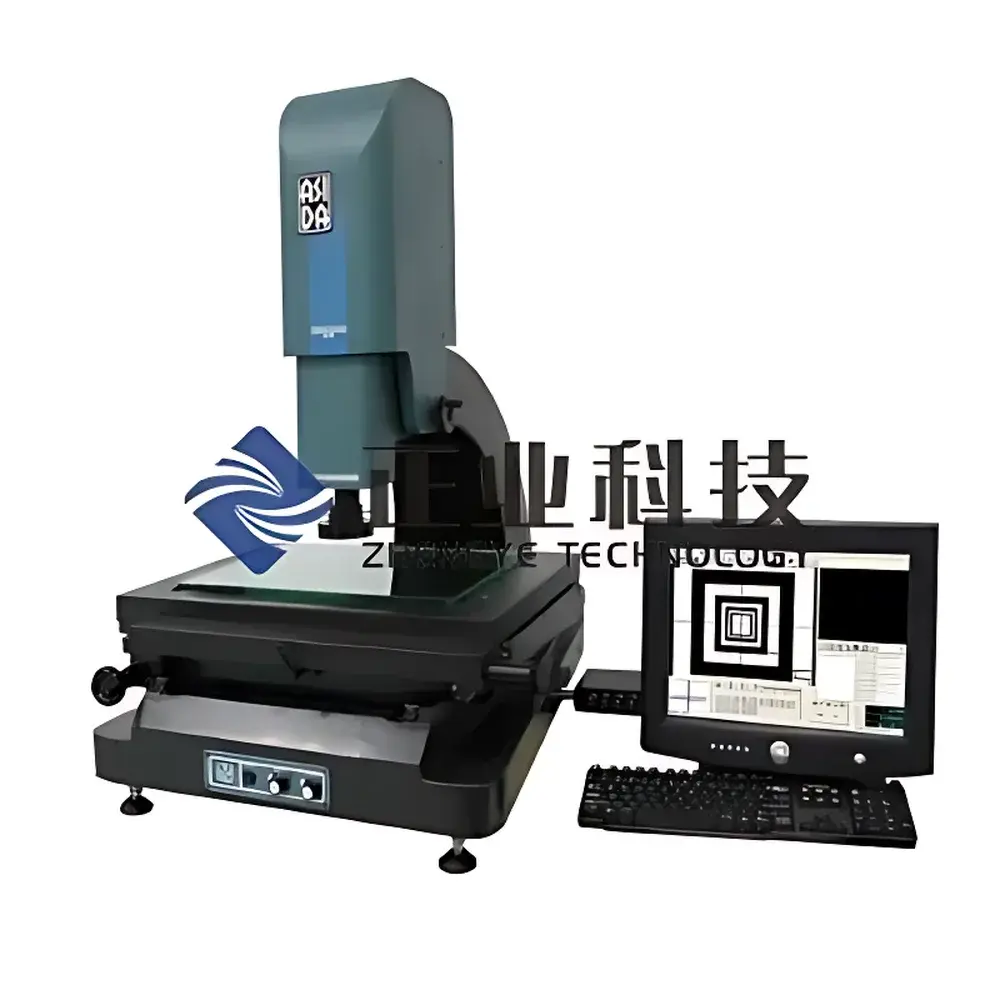
ASIDA VMA Series Fully Automated Vision Measuring System
| Brand | ASIDA |
|---|---|
| Model | VMA Series |
| Type | Fully Automated Vision Measuring Machine |
| Origin | Guangdong, China |
| Construction | Granite Base & Column |
| Motion System | Panasonic Servo Motors (X/Y/Z) |
| Optical System | 0.7×–4.5× Zoom Objective with 25×–225× Total Magnification |
| Illumination | Ring-type LED Cold Light Source |
| Linear Accuracy | (3 + L/200) µm |
| Repeatability | ≤ ±0.003 mm |
| Encoder Resolution | 1 µm |
| Measurement Range (X×Y×Z) | 200×100×150 mm to 500×400×300 mm |
| Software | ASIDA VMA3.00.01 (Multilingual: EN/CN/TC) |
| Output Formats | DXF, Excel, Word |
| Compliance | Designed for ISO 1101, ISO 10360-2, and GD&T metrology workflows |
Overview
The ASIDA VMA Series Fully Automated Vision Measuring System is an industrial-grade coordinate vision metrology platform engineered for high-reproducibility two-dimensional geometric inspection of precision mechanical components, stamped parts, PCBs, connectors, and micro-fabricated assemblies. Operating on the principle of digital image-based coordinate metrology, the system captures high-resolution grayscale images via a telecentric optical path, locates edge features using sub-pixel centroid algorithms, and computes dimensional attributes—including point coordinates, distances, angles, radii, parallelism, perpendicularity, concentricity, and profile deviations—relative to user-defined datums or CAD models. With optional tactile probe integration, the platform extends into 3D measurement capability for height, step, and form analysis, supporting comprehensive GD&T evaluation per ASME Y14.5 and ISO 1101 standards. Its granite monolithic base and column provide thermal stability and vibration damping essential for sub-micron-level repeatability in ambient lab or QC floor environments.
Key Features
- Monolithic natural granite structure (base and column) ensuring long-term geometric stability and minimal thermal drift under variable environmental conditions.
- Panasonic AC servo motor-driven motion system with preloaded linear guides and frictionless transmission on X/Y axes, enabling smooth, backlash-free positioning and sustained accuracy over extended operational cycles.
- High-resolution optical path featuring a 0.7×–4.5× manual zoom objective coupled with a progressive-scan industrial CMOS sensor, delivering 25×–225× total magnification with consistent depth-of-field and minimal distortion across the field of view.
- Uniform ring-type LED cold illumination system providing shadow-free, adjustable coaxial and oblique lighting modes—critical for reliable edge detection on reflective, matte, or textured surfaces without thermal deformation of workpieces.
- 1 µm resolution glass scale encoders on all three axes, calibrated traceably to national metrological standards, supporting real-time position feedback and closed-loop motion control.
- Robust mechanical design accommodating payloads up to 30 kg on reinforced glass stages, with Z-axis travel up to 300 mm for tall or multi-layered components.
Sample Compatibility & Compliance
The VMA Series accommodates flat, planar, and moderately contoured parts within its specified XYZ travel envelope, including metal stampings, ceramic substrates, plastic injection-molded housings, semiconductor leadframes, and precision-machined fixtures. Sample mounting utilizes standard kinematic or vacuum chucks; optional custom fixtures support batch inspection of high-volume production parts. The system complies with core requirements of ISO 10360-2 (CMM verification), ISO 14253-1 (decision rules for conformity assessment), and supports audit-ready documentation for GLP/GMP-regulated environments. While not FDA 21 CFR Part 11 certified out-of-the-box, the VMA3.00.01 software architecture permits configuration of electronic signatures, audit trails, and user access controls to meet internal validation protocols.
Software & Data Management
ASIDA VMA3.00.01 is a Windows-based metrology application supporting English, Simplified Chinese, and Traditional Chinese interfaces. It provides automated feature recognition (lines, circles, arcs, polygons), alignment routines (best-fit, iterative, datum-based), and GD&T evaluation (position, profile, runout, flatness). Measurement programs are scriptable and reusable; results export natively to DXF (for CAD comparison), Excel (statistical process control), and Word (inspection reports). The software stores full measurement history—including raw images, coordinate data, operator ID, timestamp, and calibration logs—enabling full traceability. System requirements include Windows XP Professional or later, Intel Pentium 4 2.4 GHz CPU, 512 MB RAM, 64 MB discrete GPU, and 80 GB HDD; UPS-backed power (1 kVA minimum) is recommended for uninterrupted operation.
Applications
Typical use cases span quality assurance labs, contract manufacturing facilities, and R&D centers engaged in precision engineering. Key applications include: verification of PCB pad geometry and solder mask registration; dimensional validation of automotive gaskets and brake caliper components; contour analysis of medical device housings; tolerance checking of watch movement plates; and first-article inspection of aerospace fasteners. The system serves as a cost-effective alternative to coordinate measuring machines (CMMs) for 2D-dominant geometries while offering faster throughput, lower operator dependency, and reduced maintenance overhead compared to traditional toolmakers’ microscopes.
FAQ
Does the VMA Series support automatic edge detection on low-contrast or reflective surfaces?
Yes—through adaptive thresholding, gradient-based edge enhancement, and multi-angle LED illumination sequencing, the system achieves robust feature extraction even on polished metals and anodized aluminum.
Can measurement programs be exported and shared across multiple VMA units?
Yes—VMA3.00.01 saves programs as encrypted .vmp files compatible across identical model variants; version-controlled deployment is supported via network share or USB.
Is calibration certification included with delivery?
A factory calibration report (traceable to CNAS-accredited standards) is provided; annual recalibration is recommended and can be performed on-site or at authorized service centers.
What probe options are available for 3D extension?
ASIDA offers a modular M3 tactile probe kit with 3 mm ruby stylus, compatible with VMA’s Z-axis motorized turret; probe data integrates directly into the same measurement report.
How is software licensing managed?
Each unit ships with a perpetual node-locked license tied to the host PC’s MAC address; floating licenses and volume agreements are available upon request.