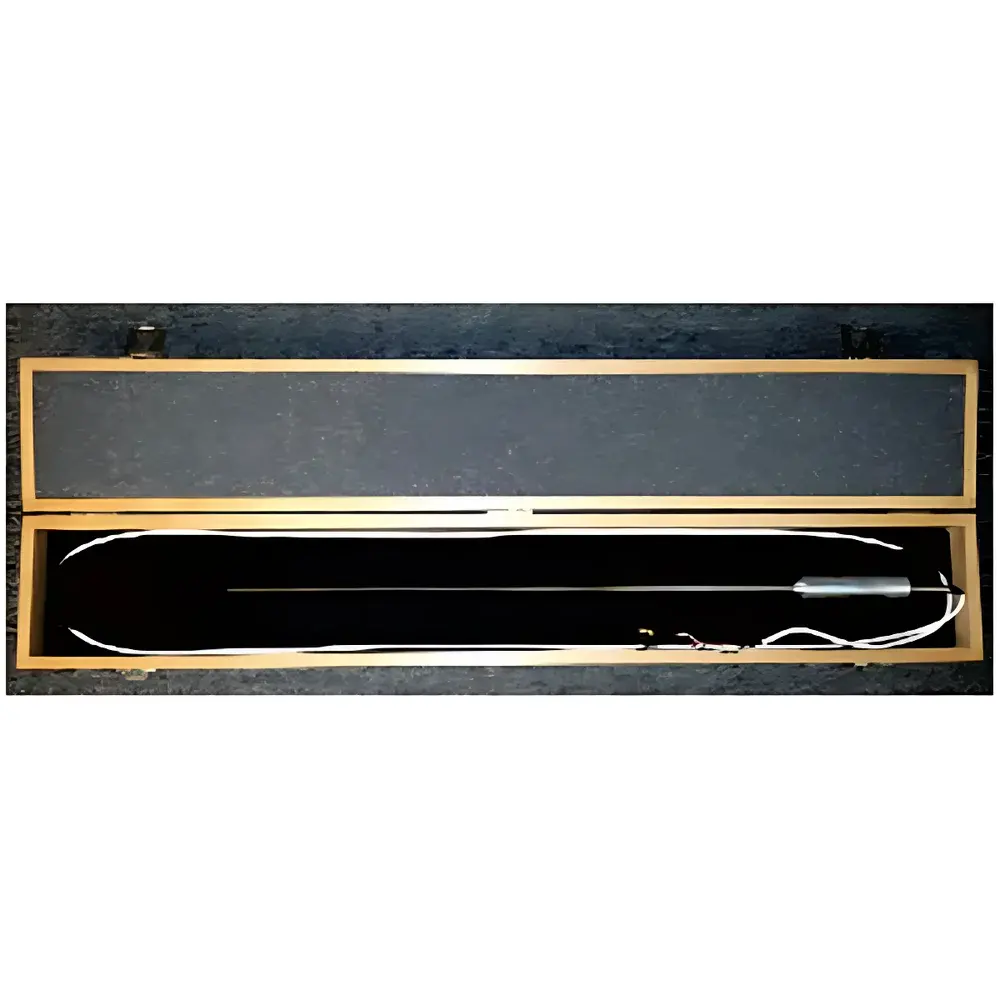
ASP YKI1100 High-Temperature Metal-Sheathed Platinum Resistance Thermometer (PRT)
| Brand | ASP / Advanced Sensing Products |
|---|---|
| Origin | USA |
| Manufacturer Type | Authorized Distributor |
| Product Category | Imported Instrument |
| Model | YKI1100 |
| Instrument Class | Temperature Verification and Calibration System |
| Temperature Range | −200 °C to 1100 °C |
| Nominal Resistance | 10 Ω or 100 Ω (customizable at 0.01 °C reference) |
| Temperature Coefficient of Resistance (TCR) | 0.003850 Ω/Ω/°C |
| Stability | ΔR₀ < 0.1 °C after 100 h continuous exposure at 1100 °C |
| Repeatability | ΔR₀ < 0.020 °C over 10 consecutive cycles from 25 °C to 1100 °C |
| Shock & Vibration Resistance | Withstands 20 G acceleration across 10–5000 Hz frequency range |
| Standard Probe Dimensions | Ø6.35 mm × 450 mm (custom lengths/diameters available) |
Overview
The ASP YKI1100 is a high-precision, metal-sheathed platinum resistance thermometer engineered for long-term stability and metrological integrity in extreme thermal environments up to 1100 °C. It employs a rigorously aged, wire-wound Pt100 or Pt10 sensing element encapsulated within a hermetically sealed, oxidation-resistant Inconel 600 or stainless steel sheath—designed to eliminate contamination-induced drift during prolonged exposure to high-temperature oxidizing, reducing, or inert atmospheres. Unlike conventional ceramic-sheathed PRTs, the YKI1100’s robust metallic construction ensures mechanical resilience without compromising thermal response fidelity. Its calibration traceability aligns with ITS-90 via NIST-traceable reference standards, and its design adheres to the fundamental principles of IEC 60751:2022 for platinum resistance thermometers. The sensor operates on the well-defined resistive temperature relationship of pure platinum, where resistance variation is linearized per the Callendar–Van Dusen equation above 0 °C and exhibits predictable quadratic behavior below 0 °C.
Key Features
- Extended operational range from −200 °C to +1100 °C with full compliance to IEC 60751 Class A tolerances across the entire span
- Proven thermal stability: R₀ drift < 0.1 °C after 100 hours at 1100 °C—validated against water triple-point (0.01 °C) reproducibility testing
- High repeatability: < 0.020 °C R₀ deviation over 10 thermal cycles between ambient and maximum temperature
- Vibration-hardened construction rated for 20 G shock and broadband sinusoidal vibration (10–5000 Hz), suitable for furnace, kiln, and aerospace test stand integration
- Hermetic metal sheath (Inconel 600 standard) prevents gas permeation, particle ingress, and catalytic surface reactions that degrade sensor accuracy in reactive atmospheres
- Customizable resistance values (10 Ω, 100 Ω, or application-specific nominal resistance at 0.01 °C), lead configurations (2-, 3-, or 4-wire), and dimensional parameters (diameter down to Ø3.2 mm; length up to 1500 mm)
Sample Compatibility & Compliance
The YKI1100 is compatible with solid, liquid, and gaseous media in static or low-velocity flow conditions—including molten salts, molten metals (e.g., aluminum, zinc), ceramic sintering furnaces, and high-temperature vacuum chambers. Its metallic sheath eliminates the risk of thermal shock fracture associated with alumina or quartz probes. The device conforms to ASTM E1137/E1137M for industrial platinum resistance thermometers and supports GLP/GMP-compliant calibration workflows under ISO/IEC 17025 requirements. Documentation includes full uncertainty budgets per EURAMET cg-18 and NIST SP 250-97 guidelines. Optional factory calibration certificates report expanded uncertainties (k = 2) referenced to fixed points (TPW, FPZn, FPAl) and include drift trend analysis.
Software & Data Management
When integrated with ASP’s CalTrak™ Calibration Management Suite or third-party platforms such as MET/CAL®, Quantum™, or LabVIEW-based DAQ systems, the YKI1100 supports automated calibration sequences, real-time resistance-to-temperature conversion using ITS-90 coefficients, and audit-trail generation compliant with FDA 21 CFR Part 11. All calibration records retain full metadata—including environmental conditions, operator ID, equipment IDs, and measurement timestamps—with digital signature capability. Raw resistance data export is supported in CSV, XML, and .tdms formats for traceability and statistical process control (SPC) analysis.
Applications
- Primary and secondary temperature calibration laboratories performing accredited calibrations to ISO/IEC 17025
- Thermal validation of pharmaceutical autoclaves, sterilizers, and lyophilizers per USP and EU Annex 1
- Materials science research involving high-temperature phase transitions, sintering kinetics, and creep testing
- Aerospace component qualification in turbine engine test cells and thermal vacuum chambers
- Quality assurance in advanced ceramics manufacturing, nuclear fuel fabrication, and semiconductor diffusion furnace monitoring
- Reference standard deployment in national metrology institutes (NMIs) for inter-laboratory comparisons
FAQ
What is the recommended excitation current for the YKI1100 to minimize self-heating error?
For optimal accuracy at temperatures above 600 °C, a maximum excitation current of 1 mA is advised—reducing Joule heating to < 0.01 °C at 1100 °C in still air. Lower currents (0.25 mA) are recommended for sub-0.01 °C uncertainty targets.
Can the YKI1100 be used in reducing atmospheres such as H₂/N₂ mixtures?
Yes—the Inconel 600 sheath provides excellent resistance to hydrogen embrittlement and maintains integrity in atmospheres with dew points as low as −50 °C. For ultra-high-purity H₂ applications, optional Hastelloy C-276 sheathing is available.
Is the probe suitable for immersion in molten glass or slag?
While not intended for direct contact with highly corrosive slags, the YKI1100 has demonstrated >500-hour service life in borosilicate glass melts when mounted behind protective quartz viewports or in guarded thermowell assemblies.
How often should recalibration be performed for critical metrology applications?
Annual recalibration is standard; however, users operating continuously above 900 °C should perform interim verification at the water triple point every 3 months to monitor R₀ drift trends.