
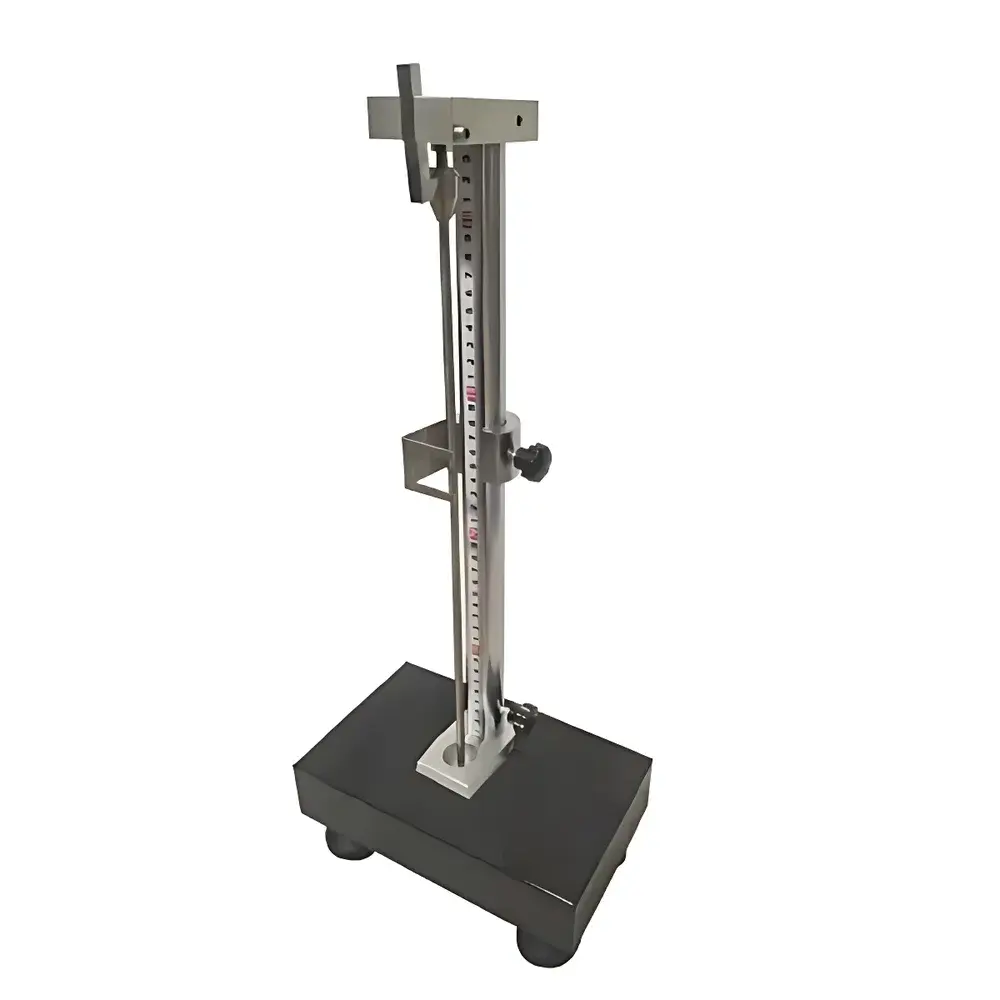
ASTM D2632 Digital Vertical Rubber Rebound Elasticity Tester NYX NC-757B
| Brand | NYX |
|---|---|
| Origin | Tianjin, China |
| Manufacturer Type | Direct Manufacturer |
| Country of Origin | China |
| Model | NC-757B |
| Ball Drop Height | 400 ± 1 mm |
| Ball Mass | 28 ± 0.5 g |
| Sensor Type | High-Precision Through-Beam Fiber Optic Sensor |
| Sampling Resolution | 500–1000 µs |
| Output | Automatic Calculation & Display of Rebound Height (mm) and Rebound Percentage (%) |
| Compliance | ASTM D2632–2014 |
Overview
The NYX NC-757B Digital Vertical Rubber Rebound Elasticity Tester is an engineered instrument designed specifically for the quantitative assessment of resilience in vulcanized rubber and thermoplastic elastomers per ASTM D2632–2014. It operates on the principle of vertical free-fall rebound measurement: a standardized steel ball is released from a precisely controlled height onto a horizontally mounted rubber test specimen; the rebound height is captured optically, and the resilience is expressed as a percentage of the original drop height. This method relies on fundamental energy conservation principles—where kinetic energy at impact is partially dissipated through viscoelastic deformation—and provides a repeatable, non-destructive index of material elasticity critical for quality control in rubber compounding, tire manufacturing, and polymer R&D laboratories.
Key Features
- Compliance-certified mechanical architecture aligned with ASTM D2632–2014 requirements, including strict tolerances on drop height (400 ± 1 mm) and impactor mass (28 ± 0.5 g).
- Through-beam fiber optic sensor system with sub-millisecond temporal resolution (500–1000 µs), enabling accurate detection of both initial impact and peak rebound position without mechanical contact or hysteresis.
- Digital processing unit that automatically discards the first three rebounds (per standard protocol), computes the arithmetic mean of the 4th, 5th, and 6th rebound heights, and outputs both absolute rebound height (mm) and resilience (%).
- Integrated LED digital display with real-time readout—no external software or PC required for basic operation—ensuring robustness in production-floor environments.
- Stainless-steel base plate and precision-machined guide column ensure orthogonal alignment and minimize lateral deviation during ball descent, contributing to measurement reproducibility across operators and shifts.
- Adjustable specimen holder accommodates standard ASTM D2632 test pieces (minimum 25 mm × 25 mm × 12.5 mm), with clear marking for minimum 14 mm edge clearance to avoid boundary effects.
Sample Compatibility & Compliance
The NC-757B is validated for use with cured rubber compounds—including natural rubber (NR), styrene-butadiene rubber (SBR), nitrile rubber (NBR), ethylene propylene diene monomer (EPDM), and thermoplastic elastomers (TPEs)—provided specimens meet dimensional and surface flatness requirements specified in ASTM D2632. It supports routine QC testing in ISO/IEC 17025-accredited laboratories and aligns with GLP documentation practices. While not inherently FDA 21 CFR Part 11 compliant (as it lacks electronic signature and audit trail functionality), raw data output can be manually recorded into LIMS or ELN systems satisfying GMP traceability requirements. The instrument does not require calibration certification beyond annual verification of drop height and ball mass per internal SOPs or third-party metrology services.
Software & Data Management
The NC-757B operates as a standalone hardware system with embedded firmware; no proprietary software installation is required. All measurements are processed and displayed locally via the front-panel LED interface. For laboratories requiring data archival or integration, the unit features a standard RS-232 serial port (optional USB-to-serial adapter available) enabling ASCII-formatted output of test results—including test ID, date/time stamp, individual rebound heights, mean rebound %, and operator ID—to external terminals or spreadsheet applications. Exported data conforms to common CSV formatting conventions, facilitating downstream statistical process control (SPC) analysis using tools such as Minitab or JMP. Firmware updates (if issued) are delivered via UART-based bootloader and require technician-level access.
Applications
- Quality assurance of raw rubber batches prior to mixing and extrusion.
- In-process monitoring of vulcanization kinetics in continuous curing lines (e.g., microwave or hot-air tunnels).
- Formulation screening during compound development—correlating resilience with curative type, filler loading (e.g., carbon black vs. silica), and plasticizer content.
- Comparative evaluation of aging effects (heat, ozone, UV) on elastic recovery performance.
- Technical support for customer complaints related to “dead” or “sticky” rubber behavior in end-use products such as automotive mounts, conveyor belts, and anti-vibration pads.
- Teaching laboratories demonstrating viscoelastic response principles in polymer physics courses.
FAQ
What standards does the NC-757B comply with?
It is fully configured and validated for ASTM D2632–2014, the standard test method for rubber property—resilience by vertical rebound.
Is calibration traceable to national standards?
Drop height and ball mass must be verified annually using NIST-traceable calipers and analytical balances; optical sensor timing is factory-calibrated and field-verifiable using oscilloscope-based pulse-width analysis.
Can the instrument test non-rubber materials?
While primarily intended for vulcanized elastomers, it may yield comparative data for rigid foams or soft gels—but results lack standardized interpretation outside ASTM D2632 scope.
How many tests can be stored internally?
The device does not store historical test records; all results are displayed and transmitted in real time only.
What maintenance is required?
Monthly inspection of guide column cleanliness, sensor lens integrity, and ball surface finish; annual verification of mechanical alignment and drop-height repeatability.




