
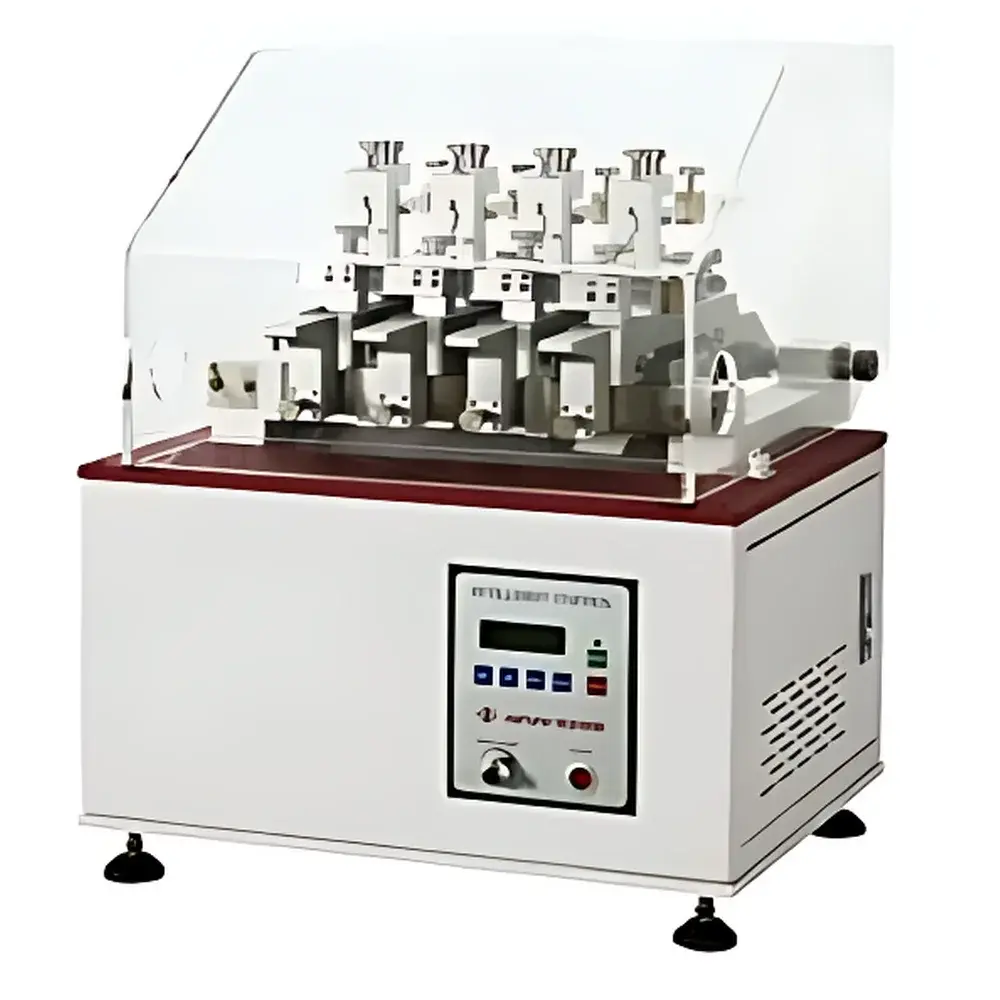
ASTM D4157 Oscillatory Abrasion Tester – HY-603B Textile Wear Resistance Testing Instrument
| Origin | Tianjin, China |
|---|---|
| Manufacturer Type | Authorized Distributor |
| Origin Category | Domestic (China) |
| Model | HY-603B |
| Pricing | Available Upon Request |
| Standard Compliance | ASTM D4157, ASTM D3597, FED-STD-191 Method 5304, SAE J948, SAE J1530, GM 2756M, Toyota TSH1301G, BS EN ISO 12402-2 |
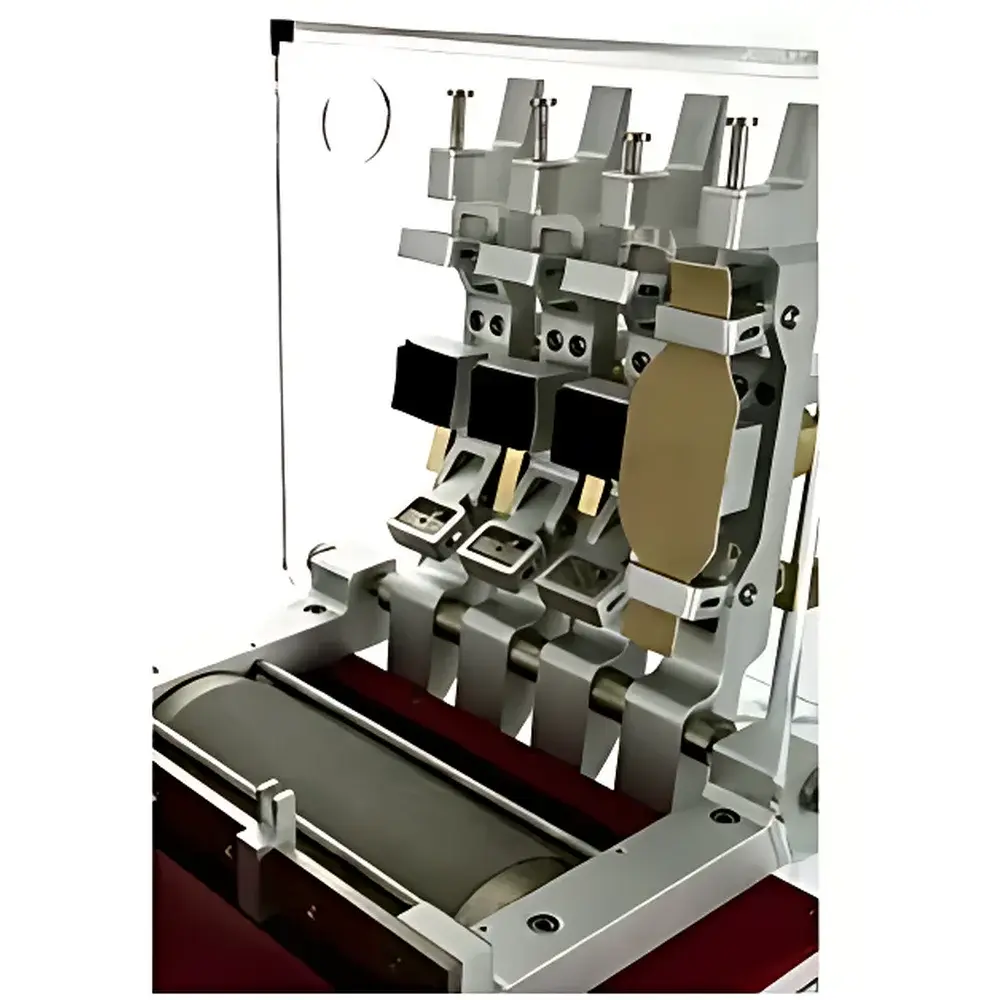
| Test Heads | 4 independent oscillating stations |
| Counter | 4-channel digital electronic counter |
| Oscillation Speed | 0–90 rpm (infinitely variable, precision-controlled) |
| Curved Abrasion Surface Radius | R100 mm |
| Curved Surface Length | 400 mm |
| Effective Oscillation Stroke | 76 mm (arc length) |
| Abrasion Head Dimensions | 50 × 50 mm with R100 mm convex curvature |
| Specimen Tension | 17.8 N (adjustable per test method) |
| Specimen Load | 13.4 N (standard vertical force) |
| Included Accessories | Stainless steel wire mesh abrasive surface, rubber backing pad, certified standard abradants (Grade 10 or Grade 8 cotton duck fabric), ISO/IEC 17025-accredited calibration certificate |
Overview
The HY-603B ASTM D4157 Oscillatory Abrasion Tester is a precision-engineered instrument designed to quantify the resistance of textile materials to repetitive curved-surface abrasion under controlled mechanical stress. Operating on the principle of reciprocating oscillation—where a conditioned fabric specimen is subjected to continuous back-and-forth motion against a standardized curved abrasive surface—the system replicates real-world wear mechanisms encountered in automotive interior trims, upholstery fabrics, seating systems, and high-performance contract textiles. Unlike linear or rotary abrasion methods, the oscillatory geometry defined in ASTM D4157 simulates localized flexing and rubbing over contoured substrates (e.g., seat bolsters, armrests, dashboard covers), making it indispensable for functional durability validation in Tier-1 supplier QA labs and OEM material approval workflows. The tester’s rigid cast-iron frame, thermally stable drive mechanism, and synchronized multi-station architecture ensure high reproducibility across inter-laboratory trials and long-term method validation studies.
Key Features
- Four independently operating test stations enable parallel evaluation of replicate specimens or comparative testing of multiple material variants—reducing total test cycle time by up to 75% versus single-head systems.
- Infinitely variable oscillation speed (0–90 rpm) with closed-loop feedback control ensures precise adherence to method-defined frequencies across all load conditions.
- Curved friction surface (R100 mm radius, 400 mm total length) and matching convex abrasion heads (50 × 50 mm, R100 mm) maintain consistent contact geometry throughout the 76 mm effective stroke—minimizing edge effects and ensuring uniform shear distribution.
- Digital 4-channel electronic counter logs cycles with ±1 count accuracy and auto-stops upon user-defined endpoint (e.g., yarn break, pilling onset, or visual failure per ASTM D3597 criteria).
- Adjustable specimen tension (standard 17.8 N, configurable) and vertical loading (13.4 N nominal) comply with both ASTM and OEM-specific protocols—including GM 2756M’s dual-load requirements for surface vs. structural wear assessment.
- Integrated mounting interface supports interchangeable abrasive media: stainless steel wire mesh (for aggressive automotive-grade validation), certified Grade 10 or Grade 8 cotton duck (per ASTM D4157 Annex A1), and custom substrate adapters for proprietary reference standards.
Sample Compatibility & Compliance
The HY-603B accommodates woven, knitted, nonwoven, and laminated textile substrates ranging from lightweight technical membranes (500 g/m²). Specimen clamping fixtures meet ISO 2062 requirements for dimensional stability during tension application. All mechanical tolerances, stroke repeatability, and force calibration are traceable to NIM (National Institute of Metrology, China) and verified per ISO/IEC 17025:2017. The system fully satisfies audit requirements for GLP-compliant textile testing laboratories and supports documented evidence generation for FDA-regulated medical textile applications (e.g., patient gowns, barrier drapes) where abrasion resistance correlates with barrier integrity per ISO 13485 Annex C.
Software & Data Management
While the base HY-603B operates via standalone hardware controls, optional PC-integrated software (HY-Link v3.2) provides automated test sequencing, real-time cycle monitoring, CSV-exportable raw data logs, and configurable pass/fail thresholds aligned with ASTM D4157 Section 8 reporting templates. Audit trails include operator ID, calibration timestamp, environmental metadata (optional RH/temp input), and digital signature capture—fully compliant with 21 CFR Part 11 for regulated environments. Data files conform to ASTM E1447 hierarchical naming conventions and integrate natively with LIMS platforms via ODBC drivers.
Applications
- Automotive interior qualification: Seat fabric, headliner, door panel trim, and airbag cover durability per SAE J1530 and Toyota TSH1301G.
- Furniture industry compliance: Upholstery fabric certification against BS EN ISO 12402-2 for leisure and commercial seating.
- Technical textile development: Abrasion resistance profiling of flame-retardant, antimicrobial, or phase-change material (PCM)-integrated fabrics.
- OEM material approval: Cross-referenced performance benchmarking between supplier lots using identical oscillation parameters and abradant batches.
- Research correlation studies: Statistical modeling of abrasion cycles-to-failure versus fiber morphology (SEM), coating adhesion (ASTM D3359), and tensile retention (ASTM D5035).
FAQ
Does the HY-603B support automated data export for laboratory information management systems (LIMS)?
Yes—when equipped with HY-Link v3.2 software, the system exports timestamped cycle counts, operator IDs, and environmental annotations in ASTM E1447-compliant CSV format and supports direct ODBC connectivity.
Can the oscillation speed be validated and recalibrated in-house?
Yes—speed verification uses an optical tachometer traceable to national standards; full recalibration services—including load cell verification and stroke amplitude measurement—are available through authorized service centers with ISO/IEC 17025 accreditation.
Is the R100 mm curved surface geometry customizable for non-standard radii?
Standard configuration is fixed at R100 mm per ASTM D4157. Custom-radius abrasion surfaces (e.g., R50 mm or R200 mm) are available as factory-engineered options under separate model suffixes (HY-603B-CR50 / HY-603B-CR200), subject to minimum order quantity and extended lead time.
How frequently must the standard abradant (cotton duck) be replaced during testing?
Per ASTM D4157 Section 6.3, Grade 10 cotton duck abradants must be discarded after 50,000 cycles or upon visible degradation (e.g., fiber shedding, surface flattening); replacement intervals are logged automatically in HY-Link software when enabled.
Does the system meet requirements for ISO/IEC 17025 accreditation of textile testing laboratories?
Yes—the HY-603B’s metrological specifications, documented uncertainty budgets, and included NIM-traceable calibration certificate satisfy Clause 6.4 (Equipment) and Clause 7.7 (Reporting of Results) of ISO/IEC 17025:2017 for textile abrasion testing scope.






