
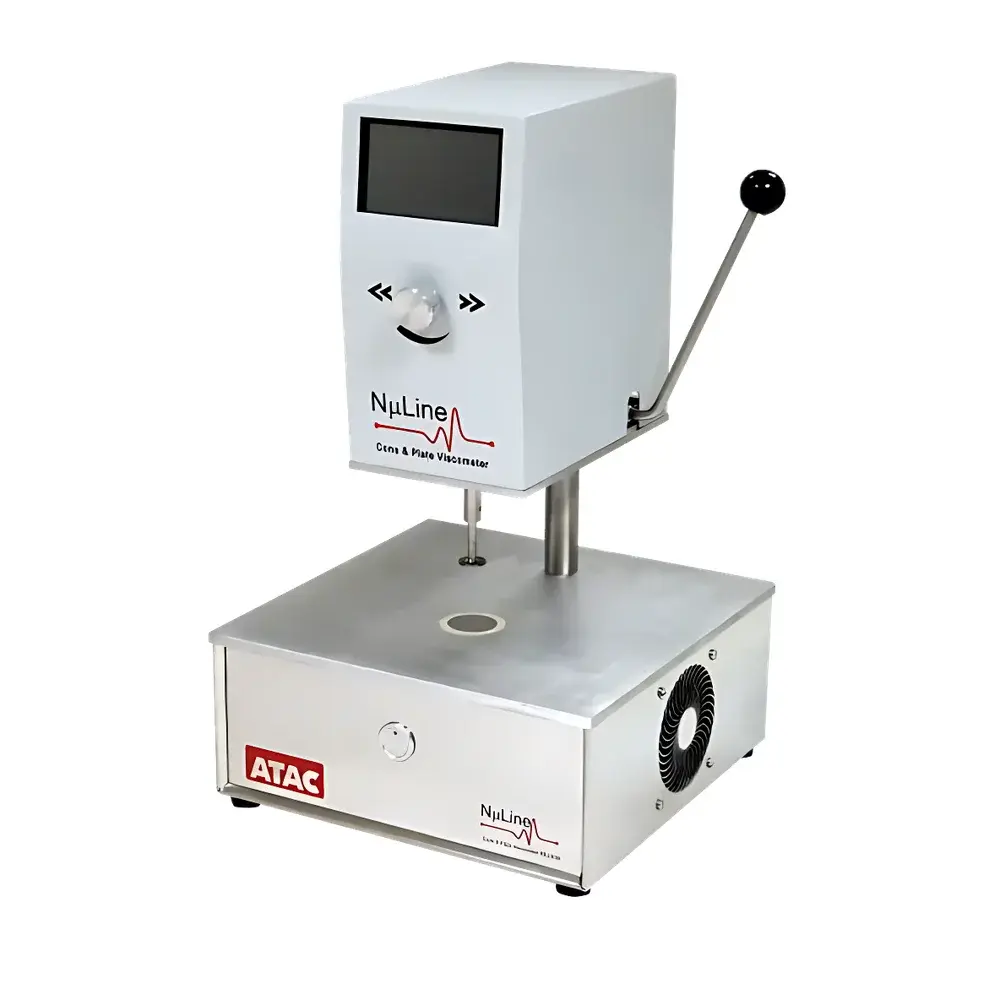
ATAC Nuline Series Cone-Plate Rotational Viscometer REL0100
| Brand | ATAC |
|---|---|
| Origin | United Kingdom |
| Model | REL0100 |
| Instrument Type | Cone-Plate Rotational Viscometer |
| Temperature Range | 10 °C to 100 °C |
| Sample Volume | 0.2 mL |
| Compliance | BS EN ISO 2884-1:2006 |
| Full-Scale Accuracy | ±2% (calibrated with standard oils) |
| Speed Range | 5–900 rpm (integer steps) |
| Low-Speed Mode | 5–90 rpm (0.1 rpm increments) |
| Temperature Control Accuracy | ±0.1 °C |
| Display | 4.3-inch color LCD |
| Data Interface | USB |
| Power Supply | 100–240 V AC, 50/60 Hz, 150 W |
| Dimensions (H×W×D) | 510 × 302 × 302 mm |
| Weight | 13.5 kg |
Overview
The ATAC Nuline Series Cone-Plate Rotational Viscometer REL0100 is a precision-engineered instrument designed for controlled-shear-rate viscosity measurement of low-to-medium viscosity Newtonian and non-Newtonian fluids under thermally regulated conditions. Based on the legacy REL viscometer platform—originally adopted as the reference instrument for BS 3900 (now superseded by BS EN ISO 2884-1:2006)—the REL0100 implements classical cone-and-plate rheometry geometry to deliver high reproducibility in shear stress and shear rate quantification. Its fixed-angle conical rotor (typically 1° or 2°, depending on configuration) rotates above a stationary temperature-controlled plate, establishing a uniform shear gap (≈50 µm at apex) ideal for characterizing structural breakdown, yield behavior, and time-dependent flow properties. The instrument operates within a calibrated temperature range of 10 °C to 100 °C, making it particularly suitable for formulation development and QC testing where thermal sensitivity must be tightly managed—such as in solvent-based coatings, pharmaceutical suspensions, and edible oil blends.
Key Features
- 4.3-inch full-color LCD interface with intuitive navigation and real-time parameter display (temperature, rpm, viscosity, shear rate)
- Multi-rotor compatibility: Supports up to six pre-stored calibration profiles for interchangeable cone geometries (e.g., CP-1, CP-2, CP-4), enabling rapid method switching without recalibration
- Two-speed control modes: High-resolution low-speed mode (5–90 rpm, 0.1 rpm increments) for precise yield stress and creep analysis; standard mode (5–900 rpm, integer steps) for routine viscosity profiling
- Integrated Peltier-based temperature control system with ±0.1 °C stability and programmable ramping, compliant with ISO 2884-1:2006 thermal conditioning requirements
- Minimal sample requirement of only 0.2 mL—critical for high-value or limited-availability materials such as active pharmaceutical ingredients (APIs) or specialty resins
- Digital auto-zero function and contamination-resistant pressure transduction ensure long-term baseline stability and reduced drift during extended runs
- USB connectivity with dedicated PC software for real-time data acquisition, graphical visualization (viscosity vs. shear rate/time), and export-compatible CSV/TXT reporting
Sample Compatibility & Compliance
The REL0100 is validated for use across diverse industrial matrices including architectural paints, UV-curable inks, polymer dispersions, food emulsions (e.g., dressings, sauces), asphalt binders, and topical pharmaceutical gels. Its cone-plate geometry minimizes edge effects and eliminates wall-slip artifacts common in coaxial cylinder systems—particularly advantageous for filled or particle-laden systems. The instrument conforms to BS EN ISO 2884-1:2006 (“Paints and varnishes — Determination of viscosity using rotary viscometers — Part 1: Cone-and-plate viscometers”), supporting audit-ready documentation for GLP and GMP environments. While not inherently 21 CFR Part 11 compliant, its software supports user-access logging, timestamped data records, and editable metadata fields—facilitating alignment with FDA-regulated workflows when deployed with validated IT infrastructure.
Software & Data Management
The included Windows-based acquisition software provides synchronized logging of viscosity (Pa·s or cP), shear rate (s⁻¹), temperature (°C or °F), and rotational speed (rpm). Users may define custom test protocols—including multi-step shear ramps, timed steady-shear holds, and temperature sweeps—with automatic graph generation and overlay capability. All raw datasets are stored locally with embedded instrument metadata (serial number, calibration ID, operator tag), and support batch export for LIMS integration. Audit trails are manually configurable via system log files; for regulated labs, optional third-party validation packages are available to meet ALCOA+ data integrity principles.
Applications
- QC release testing of resin solutions per ASTM D1084 (viscosity of latex)
- Yield stress determination in thixotropic food gels using controlled shear ramping
- Thermal stability assessment of inkjet inks between 20 °C and 80 °C
- Batch-to-batch consistency verification of pharmaceutical ointments under ISO 15197-compliant conditions
- Rheological fingerprinting of bituminous binders for pavement performance modeling
- Formulation screening of waterborne acrylic dispersions during drying kinetics studies
FAQ
What cone geometries are supported by the REL0100?
Standard configurations include 1° and 2° cones with diameters of 25 mm and 40 mm; all are pre-calibrated and stored in instrument memory.
Is external cooling required for the 10 °C lower limit?
No—the integrated Peltier module enables active cooling to 10 °C without auxiliary chillers or recirculating baths.
Can the REL0100 perform oscillatory measurements?
No—this is a steady-shear rotational viscometer; it does not support dynamic (oscillatory) rheology modes.
How is traceability maintained for calibration?
Each rotor carries a unique ID linked to NIST-traceable calibration certificates issued by ATAC UK; calibration data is encrypted and stored onboard.
Does the instrument support automated cleaning protocols?
No—manual cleaning with compatible solvents (e.g., acetone, isopropanol) is required between samples; no built-in fluidic wash station is provided.



