
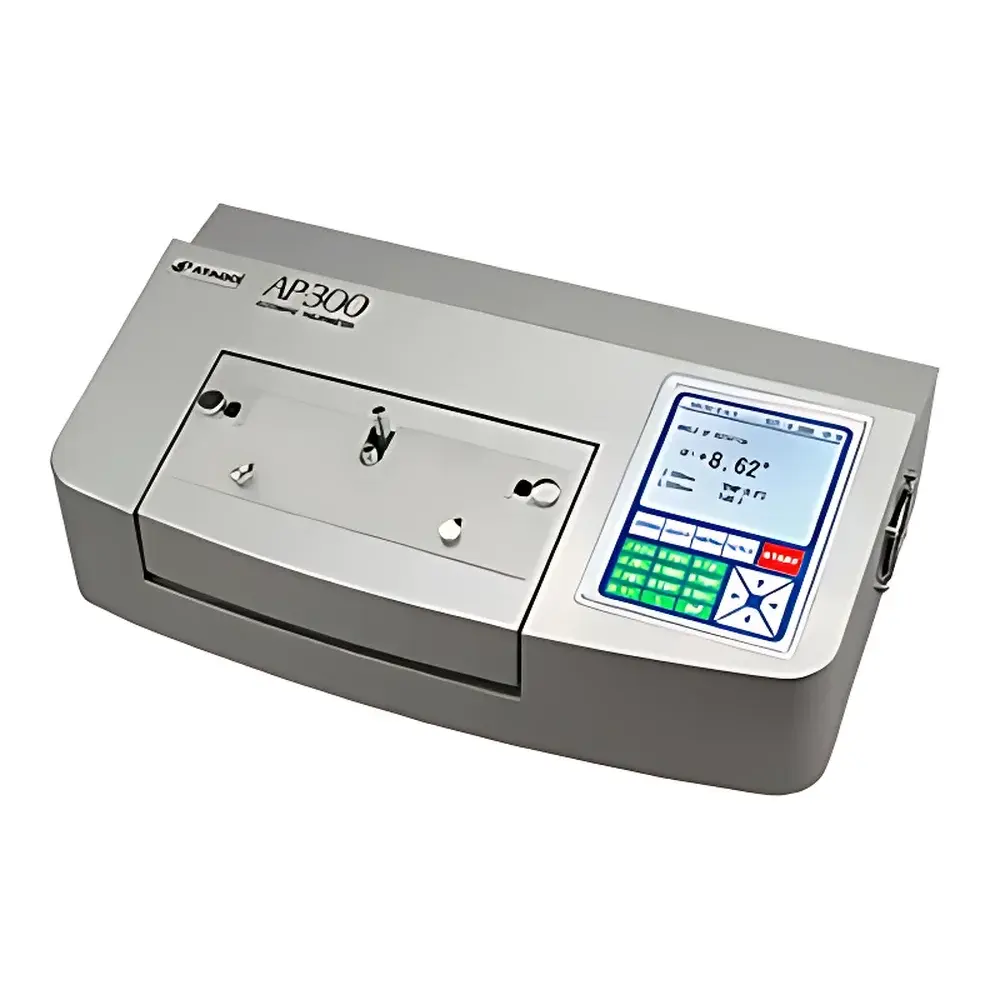
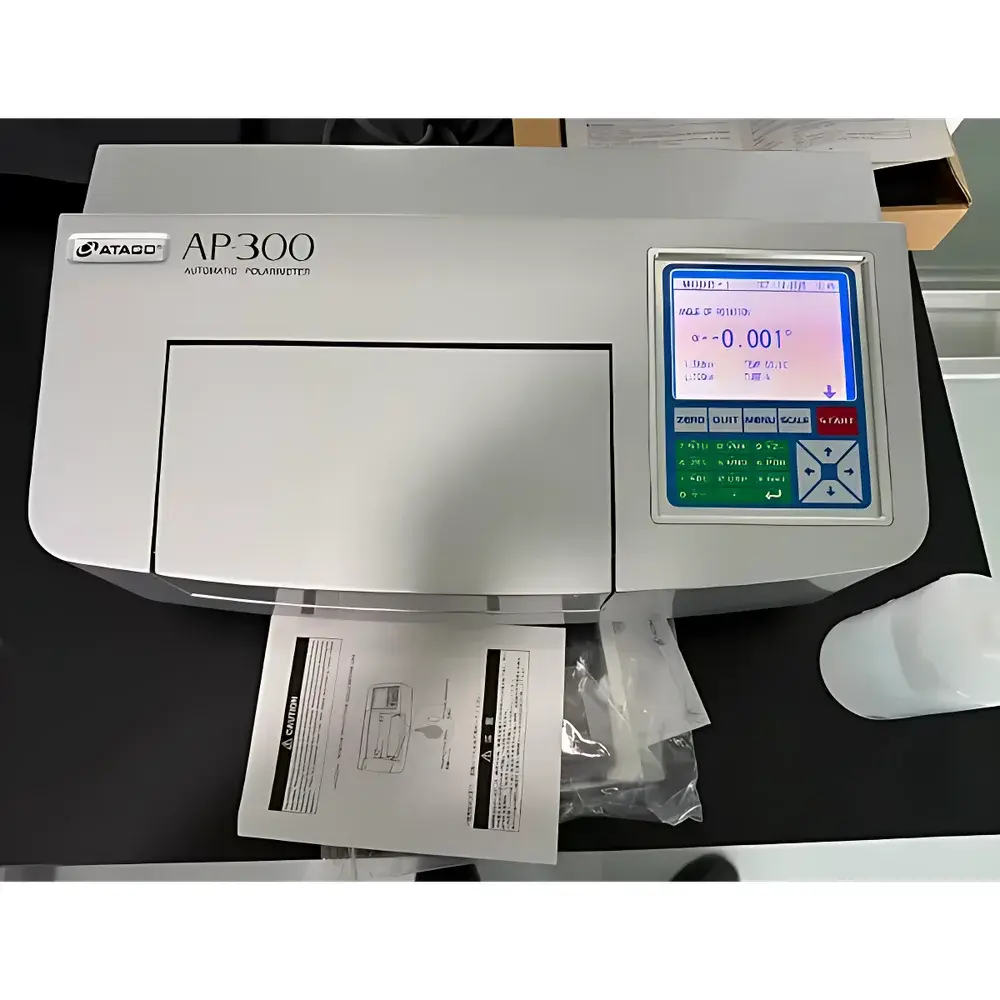
ATAGO AP-300 Temperature-Controlled Automatic Polarimeter for Pharmaceutical Applications
| Brand | ATAGO |
|---|---|
| Origin | Japan |
| Model | AP-300 |
| Product Type | Automatic Polarimeter |
| Temperature Control | Yes |
| Digital Display | Yes |
| Light Source | Halogen Lamp |
| Measurement Range | Optical Rotation (AR): −89.999 to +89.999° |
| Accuracy | ±0.01° (display value, −35.00 to +35.00°) |
| Relative Accuracy | ±0.2% (−35.01 to −89.99°, +35.01 to +89.99°) |
| Minimum Resolution | 0.001° |
| Compliance | JP XVII (Japanese Pharmacopoeia), ICUMSA, FDA 21 CFR Part 11 (audit trail, user authentication, data integrity) |
| Data Storage | 30 measurement records |
| Repeatability Function | Configurable number of repeats with automatic averaging |
| Security | Password-protected access |
Overview
The ATAGO AP-300 Temperature-Controlled Automatic Polarimeter is a precision optical instrument engineered for high-reproducibility measurement of optical rotation in chiral substances under controlled thermal conditions. Based on the fundamental principle of polarimetry—where plane-polarized light rotates upon passing through an optically active medium—the AP-300 quantifies angular deviation (in degrees) induced by molecular asymmetry in solutions such as sugars, amino acids, pharmaceutical actives (e.g., L-glutamic acid, ascorbic acid), and enantiomerically pure compounds. Designed specifically for regulated environments, the system integrates Peltier-based temperature regulation (standard operating range: 18–30 °C, compliant with ICUMSA sucrose standardization protocols) and meets the instrumental requirements outlined in the Japanese Pharmacopoeia (JP XVII) for quality control of chiral APIs and excipients. Its compact benchtop architecture, halogen lamp illumination (589.3 nm sodium D-line equivalent), and fixed-wavelength optical path ensure stable baseline performance across extended operation cycles.
Key Features
- Integrated Peltier temperature control system maintaining sample cell at user-selectable setpoints within 18–30 °C, with stability ±0.1 °C—critical for thermally sensitive assays per USP and JP general chapters on optical rotation.
- High-resolution angular detection: 0.001° resolution with dual-range accuracy specification—±0.01° absolute error within the central linear range (−35.00° to +35.00°), and ±0.2% relative error at extremes—enabling reliable quantification of low-concentration or weakly rotating analytes.
- Automated measurement sequence initiated via single START button press; no manual zeroing or calibration required prior to each analysis.
- Password-protected operational interface supporting role-based access control—aligned with FDA 21 CFR Part 11 requirements for electronic records and signatures in GMP-compliant laboratories.
- Onboard memory stores up to 30 complete measurement records including date/time stamp, temperature setting, sample ID, and all calculated parameters (optical rotation, ICUMSA sugar scale, specific rotation, concentration, purity).
- Configurable repeat measurement mode: user-defined iterations (1–9) with real-time calculation and display of mean value and standard deviation—supporting statistical process control (SPC) in QC workflows.
Sample Compatibility & Compliance
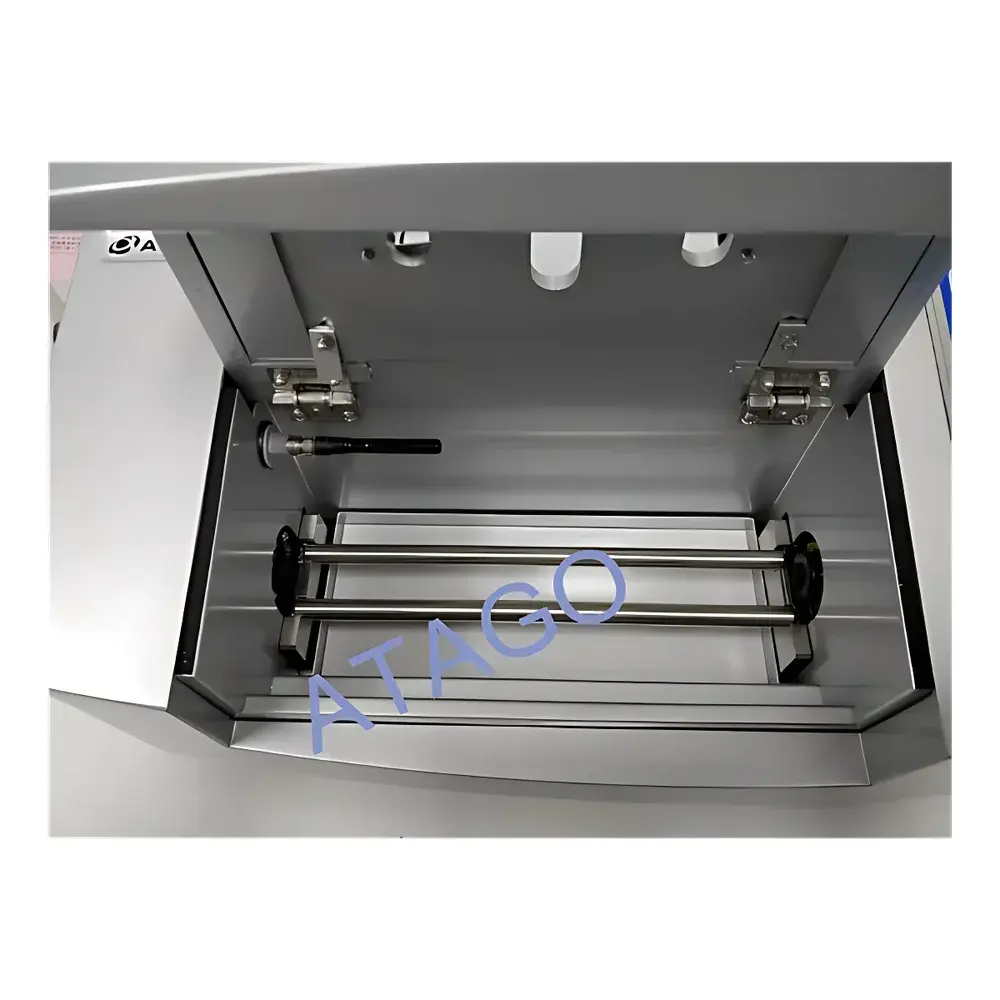
The AP-300 accepts standard 100 mm and 200 mm pathlength polarimetric cells (not included), compatible with aqueous, alcoholic, and low-viscosity organic solvent systems typical in pharmaceutical dissolution testing, raw material identification, and syrup formulation verification. It supports direct reporting in multiple standardized units: optical rotation (°), International Sugar Scale (°Z), specific rotation ([α]Dt), mass concentration (g/100 mL), and theoretical purity (%). Regulatory alignment includes full traceability to JP XVII monographs (e.g., Glucose, Sucrose, Levodopa), ICUMSA Method GS4/3-11 for refined sugar, and ASTM E1255-22 for polarimetric instrumentation validation. Instrument qualification documentation (IQ/OQ) templates are available to support GLP and GMP audit readiness.
Software & Data Management
While the AP-300 operates as a standalone instrument with embedded firmware, its RS-232 interface enables bidirectional communication with external LIMS or ELN platforms. All stored measurements include immutable metadata: operator ID (via login), timestamp, temperature log, and instrument serial number—satisfying ALCOA+ principles (Attributable, Legible, Contemporaneous, Original, Accurate). Audit trail functionality records every parameter change, measurement execution, and user login/logout event with tamper-evident timestamps. Data export is supported in CSV format for offline statistical analysis using JMP, Minitab, or Python-based QA pipelines.
Applications
- Pharmaceutical QC: Identity testing and assay of chiral drugs (e.g., ibuprofen, chloramphenicol, penicillamine); batch release testing per pharmacopoeial monographs.
- Sugar industry: Determination of sucrose content in raw juice, molasses, and refined syrups per ICUMSA standards.
- Food & flavor analytics: Quantification of dextrose equivalents in hydrolyzed starches; enantiomeric excess assessment in natural flavor isolates (e.g., limonene, carvone).
- Academic research: Teaching polarimetry fundamentals in undergraduate chemistry labs; kinetic studies of enzymatic racemization or epimerization.
- Biotechnology: Monitoring optical rotation shifts during biocatalytic asymmetric synthesis or chiral resolution processes.
FAQ
Does the AP-300 comply with FDA 21 CFR Part 11 for electronic records?
Yes—the instrument implements role-based authentication, electronic signature capture, and immutable audit trails for all critical operations.
What temperature range is supported for regulatory-compliant sugar analysis?
18–30 °C, fully aligned with ICUMSA GS4/3-11 and ISO 20483:2013 for international sugar scale reporting.
Can the AP-300 calculate specific rotation directly?
Yes—it automatically computes [α]Dt when pathlength (dm) and concentration (g/100 mL) are entered manually or recalled from stored method templates.
Is external software required to generate compliance reports?
No—PDF-ready reports with header/footer branding, measurement summary, and operator traceability can be printed directly via optional thermal printer interface.
How is calibration verified under GMP conditions?
The unit supports manual zero-point adjustment using certified quartz control plates (optional accessories), with calibration logs stored alongside routine measurements for inspection readiness.



