
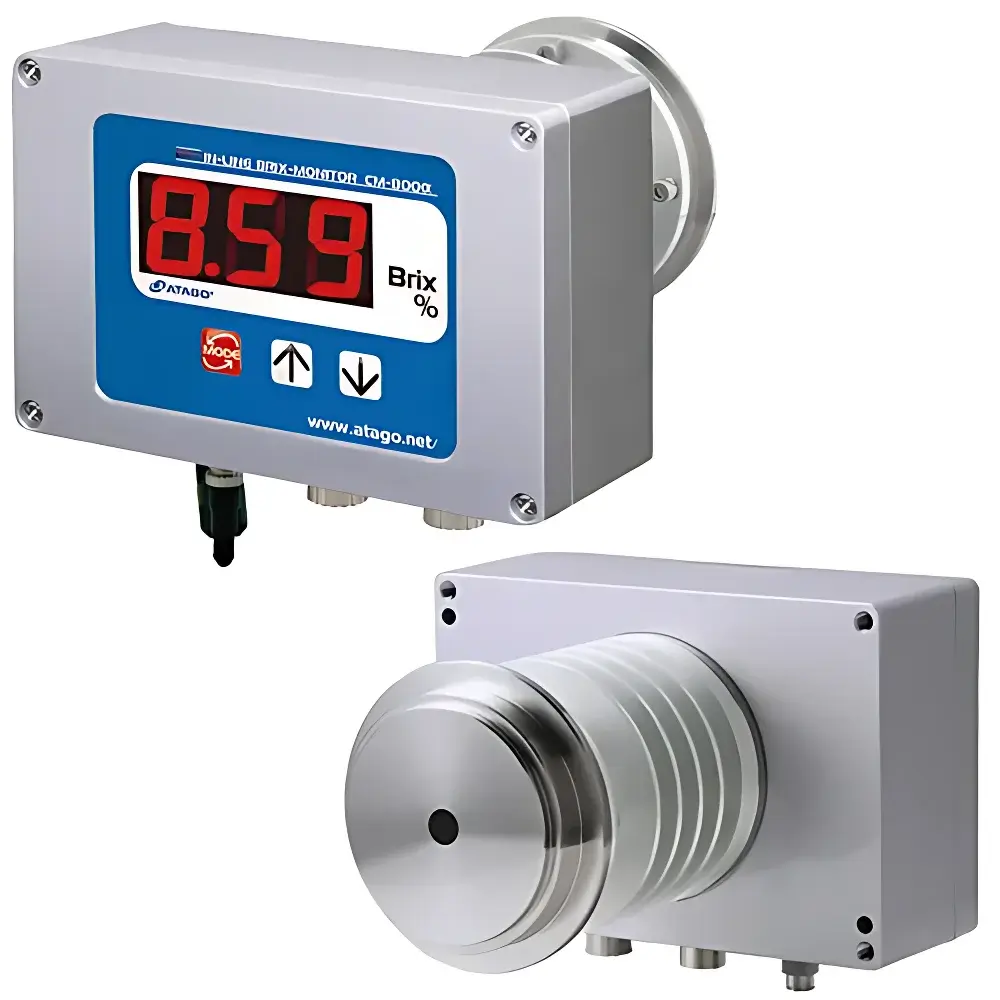
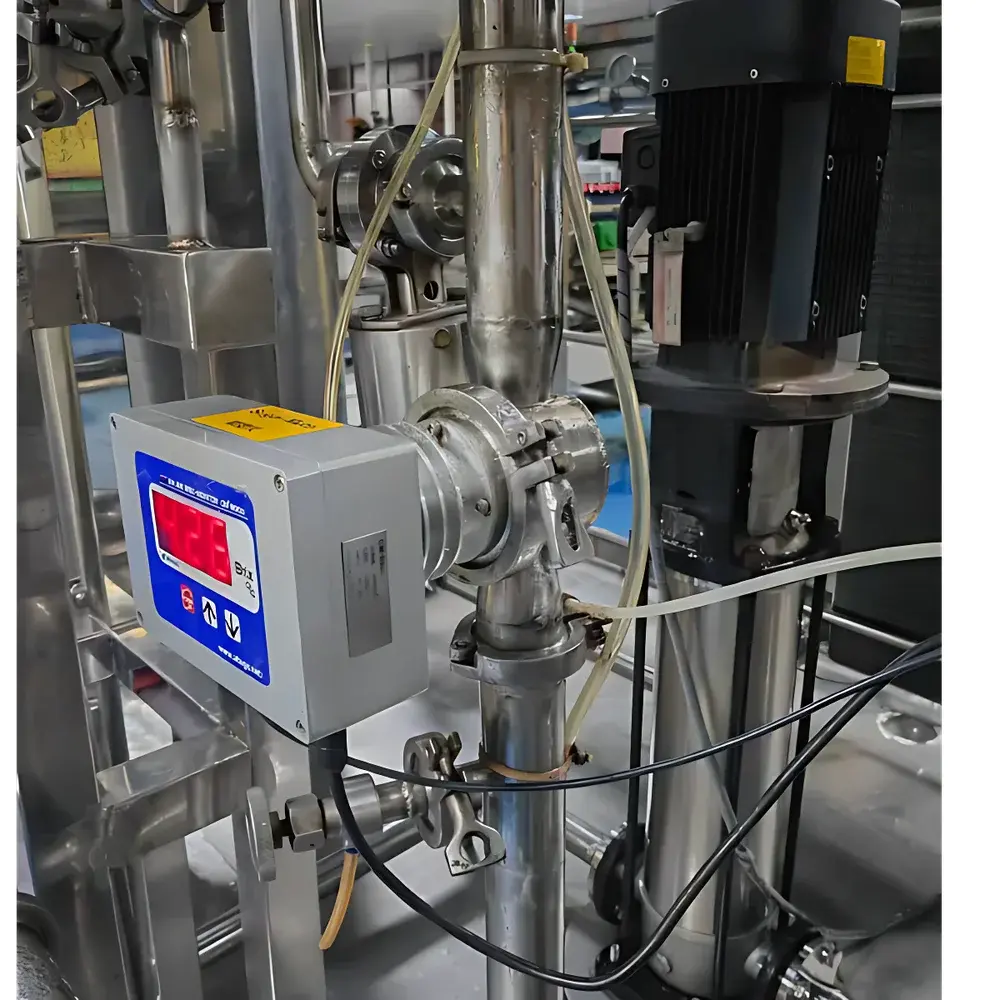
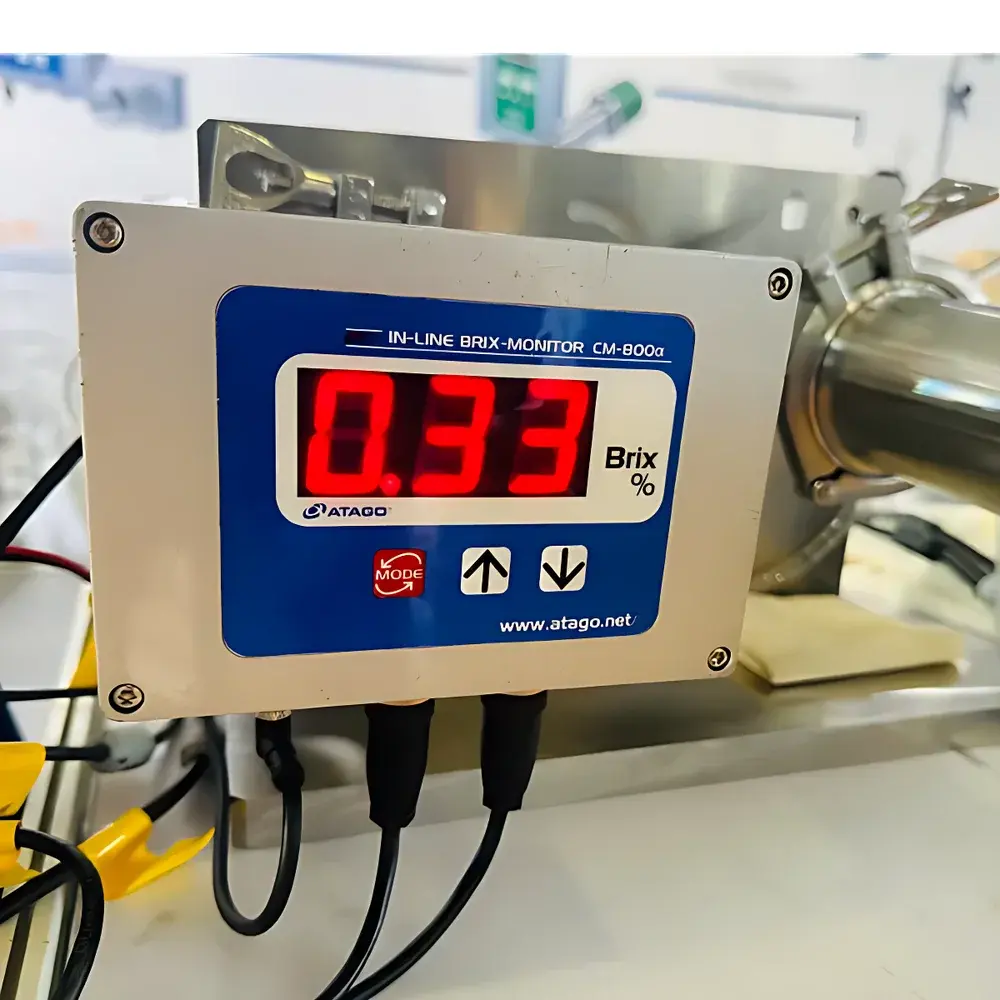
ATAGO CM-800α In-line Refractometer for Mold Release Agents
| Brand | ATAGO |
|---|---|
| Origin | Japan |
| Model | CM-800α |
| Product Type | In-line Refractometer |
| Brix Range | 0.00–80.00% (with Automatic Temperature Compensation, ATC) |
| Brix Accuracy | ±0.1% |
| Temperature Range | −15–160.0°C |
| ATC Range | 5–100°C |
| Resolution | Brix 0.01% (≤9.99%), 0.1% (>10.0%) |
| Temp | 1°C/°F |
| Output | DC 4–20 mA, RS-232C |
| Measurement Interval | ~1 sec (configurable up to 5 intervals) |
| IP Rating | IP67 |
| Light Source | LED (approx. 589 nm, sodium D-line equivalent) |
| Prism Material | Synthetic Sapphire |
| Body Material | SUS316L Stainless Steel |
| Dimensions | 160 × 167 × 110 mm |
| Weight | 2.4 kg |
| Power Supply | DC 24 V (AC 100 V optional with AD-32 adapter) |
Overview
The ATAGO CM-800α In-line Refractometer is an industrial-grade process analytical instrument engineered for continuous, real-time monitoring of mold release agent concentration in manufacturing fluid lines. It operates on the principle of critical-angle refractometry: a collimated LED light source (spectrally centered near 589 nm, approximating the sodium D-line) impinges on the interface between the process fluid and a synthetic sapphire prism; the resulting refraction angle is detected by a high-stability photodiode array and converted into refractive index (nD), which is then linearly correlated to Brix concentration via factory-calibrated polynomial algorithms incorporating automatic temperature compensation (ATC). Designed for permanent installation in pressurized or gravity-fed pipelines, the CM-800α delivers second-level measurement cycles with ±0.1% Brix accuracy across a broad 0.00–80.00% range—enabling precise control of release agent dilution ratios, mixing homogeneity, and post-cleaning rinse efficacy without process interruption.
Key Features
- Real-time in-line measurement with ~1-second default sampling interval—configurable to five user-defined intervals for synchronization with PLC scan cycles or batch logic.
- Automatic Temperature Compensation (ATC) over 5–100°C, ensuring stable Brix output despite thermal drift in casting, injection, or composite layup environments.
- IP67-rated stainless steel (SUS316L) housing and synthetic sapphire prism—resistant to corrosion, abrasion, and high-pressure CIP/SIP cleaning protocols.
- Dual analog (DC 4–20 mA) and digital (RS-232C) outputs: 4–20 mA supports direct integration into DCS/SCADA systems for closed-loop dosing control; RS-232C transmits raw refractive index (nD) or Brix values, configurable via onboard menu.
- High-resolution display with adaptive decimal precision: 0.01% resolution below 10.0% Brix, 0.1% above—optimized for both low-concentration dilutions and highly concentrated stock solutions.
- No moving parts or consumables; maintenance-free optical path design ensures long-term metrological stability under continuous operation.
Sample Compatibility & Compliance
The CM-800α is validated for aqueous and water-miscible mold release formulations—including silicone-, fatty acid-, and polymer-based emulsions—commonly used in plastic injection molding, die-casting, rubber vulcanization, and fiber-reinforced composite (FRP/CFRP) demolding processes. Its sapphire prism and 316L wetted surfaces comply with FDA-compliant material standards for indirect food contact applications where applicable. While not intrinsically rated for hazardous areas, its DC24V power architecture and sealed electronics meet IEC 61000-6-2/6-4 immunity and emission requirements for industrial electromagnetic environments. The device supports traceable calibration using NIST-traceable sucrose reference standards and conforms to ISO 2150:2019 (Refractometers — General Requirements) for optical metrology performance verification.
Software & Data Management
The CM-800α operates autonomously without external software dependency. All configuration—including output scaling, temperature unit selection (°C/°F), RS-232 data format (nD or Brix), and measurement interval—is performed via intuitive front-panel navigation. For enterprise-level integration, the 4–20 mA signal may be logged into historians (e.g., OSIsoft PI, Ignition) or fed into predictive maintenance models tracking concentration variance trends over time. When paired with ATAGO’s optional PC interface cable and free ATAGO Data Logger software (Windows-compatible), users can export timestamped CSV files containing Brix, temperature, and nD for GLP-aligned audit trails—supporting basic 21 CFR Part 11 compliance through user-accessible log export and manual signature documentation.
Applications
- Continuous monitoring of mold release agent dilution during automated blending in centralized dosing stations.
- Feedback control of spray nozzle actuation in high-speed injection molding lines to maintain optimal film thickness and minimize residue buildup.
- In-process verification of cleaning solution concentration during post-mold alkaline or solvent-based wash cycles.
- Batch-to-batch consistency validation for multi-component release formulations in aerospace composites manufacturing.
- Process deviation detection: rapid identification of coolant carryover, emulsion breakdown, or formulation drift due to evaporation or contamination.
FAQ
Does the CM-800α require periodic recalibration?
Calibration is recommended before initial installation and after any physical impact or prism cleaning; routine verification every 3–6 months using certified sucrose standards is advised for GMP-aligned operations.
Can it measure non-aqueous release agents?
The CM-800α is optimized for water-based and water-miscible formulations; hydrocarbon-based solvents (e.g., mineral oil, xylene) require custom nD–concentration correlation and are not supported out-of-the-box.
Is the device suitable for high-pressure pipelines?
Yes—it is rated for continuous operation at up to 1.0 MPa (10 bar) at 25°C; pressure rating decreases linearly to 0.6 MPa at 100°C per ATAGO’s mechanical specification sheet.
How is temperature measured?
A platinum RTD (PT1000) sensor embedded adjacent to the prism surface provides direct fluid temperature measurement, enabling real-time ATC correction independent of ambient conditions.
What mounting configurations are supported?
Standard flange-mount (JIS 10K/16K, ANSI 150#) and sanitary tri-clamp (ISO 2852) adapters are available; inline insertion depth is fixed at 60 mm for optimal flow profile interaction.





