
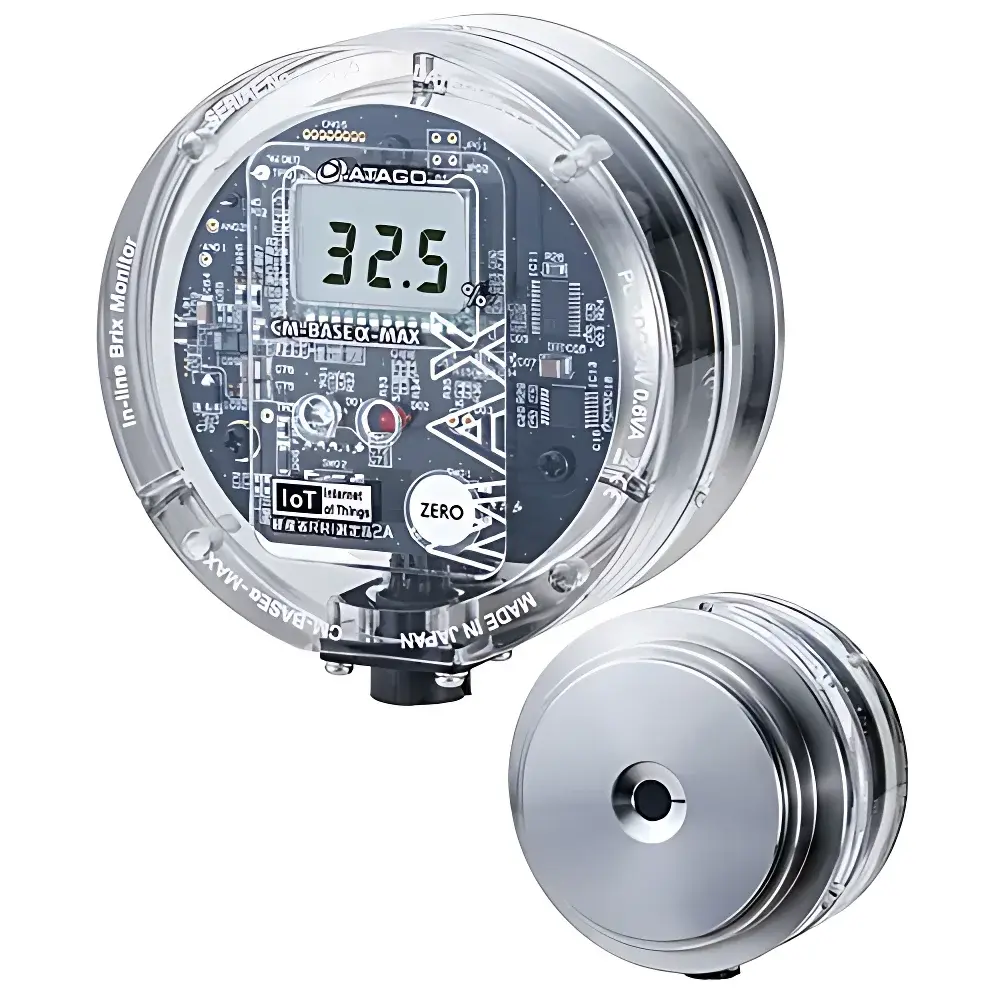
ATAGO CM-BASEα-MAX In-Line Refractometer
| Brand | ATAGO |
|---|---|
| Origin | Japan |
| Model | CM-BASEα-MAX |
| Type | In-line Refractometer |
| Measurement Range | Brix 0.0–93.0% |
| Accuracy | ±0.2% Brix |
| Resolution | 0.1% Brix |
| Temperature Compensation | Automatic (ATC), 10–95°C |
| Output Signals | RS-232C and DC 4–20 mA |
| Enclosure Rating | IP67 |
| Power Supply | DC 24 V |
| Dimensions | 90 × 90 × 58 mm |
| Weight | 830 g (main unit only) |
| Display | Digital LCD |
Overview
The ATAGO CM-BASEα-MAX is a compact, high-precision in-line refractometer engineered for continuous, real-time monitoring of soluble solids concentration—expressed as Brix—in liquid process streams. Based on the principle of critical-angle refractometry, the instrument measures the refractive index of flowing liquids and converts it to Brix values using built-in calibration curves traceable to NIST-standard sucrose solutions. Unlike benchtop or handheld units, the CM-BASEα-MAX integrates directly into stainless-steel sanitary piping systems via tri-clamp or flanged fittings, enabling non-invasive, flow-through measurement without sample diversion or downtime. Its optical sensing head employs sapphire prism technology and temperature-compensated photodiode detection, ensuring stable performance across dynamic industrial environments. Designed specifically for unattended operation in food, beverage, pharmaceutical, and chemical manufacturing lines, the CM-BASEα-MAX delivers repeatable Brix data under varying flow rates (recommended minimum: 0.3 m/s) and pressure conditions (up to 10 bar), supporting process validation and quality assurance protocols aligned with ISO 21527, AOAC 932.12, and USP .
Key Features
- High-accuracy Brix measurement with ±0.2% tolerance and 0.1% resolution, validated per ATAGO’s internal metrology protocol and compliant with JIS Z 8013 standards for refractometric instrumentation
- Automatic Temperature Compensation (ATC) across a broad operational range of 10–95°C, eliminating manual correction and minimizing thermal drift during steam-in-place (SIP) or CIP cycles
- IP67-rated aluminum housing with sapphire prism window, resistant to corrosion, high-pressure washdown, and ambient humidity typical in wet-process zones
- Integrated dual-output interface: analog DC 4–20 mA (HART-compatible) for PLC/DCS integration and digital RS-232C for direct PC connection or SCADA logging
- Single-cable architecture combining power and signal transmission—reducing installation complexity and electromagnetic interference in electrically noisy plant environments
- Compact footprint (90 × 90 × 58 mm) and low mass (830 g) facilitate retrofitting into space-constrained pipelines without structural reinforcement
Sample Compatibility & Compliance
The CM-BASEα-MAX is optimized for homogeneous, optically transparent or mildly turbid aqueous solutions including fruit juices, syrups, dairy concentrates, brines, glycol solutions, and cleaning agents. It is not suitable for opaque suspensions, highly viscous fluids (>500 cP), or media containing particulates >50 µm that may adhere to the prism surface. All wetted parts conform to FDA 21 CFR §177.2600 for food-contact polymers and 3-A Sanitary Standards #106-01. The device supports GLP/GMP data integrity requirements through configurable output logging intervals and timestamped serial data frames. While it does not include onboard audit trail or electronic signature functionality, its analog/digital outputs are compatible with third-party MES/QMS platforms compliant with FDA 21 CFR Part 11 when deployed with validated system architecture.
Software & Data Management
The CM-BASEα-MAX operates as a standalone sensor node with no embedded firmware-based software. Configuration and diagnostics are performed via ASCII command protocol over RS-232C using ATAGO-supplied terminal utilities or user-developed scripts (e.g., Python PySerial). Data streams support fixed-interval polling (1–10 Hz default) and event-triggered transmission. Raw Brix and temperature values are output in ASCII format with CRC error-checking. For enterprise-level deployment, the 4–20 mA output can be interfaced with Siemens Desigo, Rockwell FactoryTalk, or Emerson DeltaV systems for trend visualization, alarm generation (e.g., Brix deviation >±0.5%), and SPC charting. Calibration verification logs—performed using certified sucrose reference standards (e.g., ATAGO SR-100 series)—can be archived externally to satisfy ISO 9001 clause 7.1.5.2.
Applications
- Continuous Brix control in juice concentration (evaporator feed/effluent), jam cooking, and syrup blending lines
- In-line monitoring of sugar content in soft drink concentrate dilution systems prior to carbonation
- Real-time validation of cleaning solution strength (e.g., caustic soda % w/w approximated via refractive index correlation)
- Process consistency verification during fermentation broth harvesting in biopharmaceutical upstream operations
- Concentration tracking in dairy ultrafiltration retentate streams and whey protein standardization
FAQ
Does the CM-BASEα-MAX require periodic recalibration?
Yes—ATAGO recommends quarterly verification using traceable sucrose standards; full recalibration is advised after prism cleaning, mechanical shock, or exposure to temperatures beyond 95°C.
Can it measure non-sucrose solutions such as sodium chloride or ethanol?
It reports refractive index-derived Brix equivalents only; for non-sugar solutes, users must establish custom correlation curves using laboratory-grade reference methods (e.g., gravimetric analysis or HPLC).
Is explosion-proof certification available?
No—the standard unit lacks ATEX or IECEx certification; for hazardous area use, it must be installed in an intrinsically safe barrier-protected zone or paired with an approved remote-mounted optical interface.
What is the minimum required flow velocity for reliable measurement?
A sustained laminar-to-turbulent transition flow of ≥0.3 m/s is necessary to ensure uniform prism wetting and eliminate boundary layer effects.
How is prism fouling mitigated in high-solids applications?
ATAGO offers optional automated CIP-compatible purge fittings and recommends scheduled ultrasonic cleaning with deionized water or 1% citric acid solution—validated per equipment manufacturer guidelines.





