
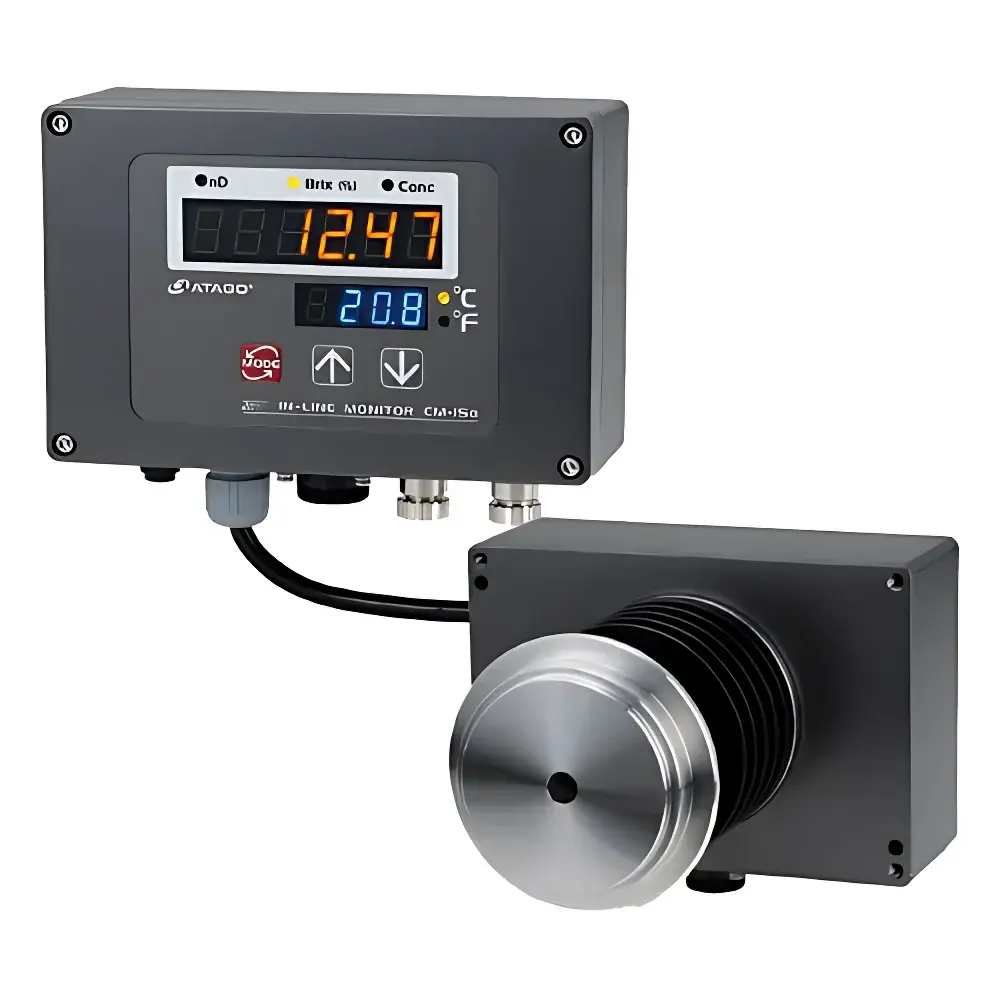
ATAGO CM-ISα Intrinsically Safe Online Refractometer
| Brand | ATAGO |
|---|---|
| Origin | Japan |
| Model | CM-ISα (Cat. No. 3700) |
| Measurement Principle | Critical Angle Refractometry |
| Measured Parameters | Refractive Index (nD), Brix (%), Concentration (% w/w or % w/v), Temperature |
| Refractive Index Range | 1.32000–1.49100 |
| Brix Range | 0.0–80.0% |
| Temperature Range | −15 to +160°C (5 to 320°F) |
| Refractive Index Resolution | 0.00001 |
| Brix Resolution | 0.01% or 0.1% (configurable) |
| Temperature Resolution | 0.1°C / 0.1°F |
| Refractive Index Accuracy | ±0.0002 |
| Brix Accuracy | ±0.1% |
| Temperature Accuracy | ±1°C / ±1°F |
| Automatic Temperature Compensation Range | 5–100°C |
| Output Signals | DC 4–20 mA (2-wire) or RS-232C |
| Power Supply | DC 24 V |
| Intrinsic Safety Certification | Ex ia IIB T3 Ga TA (IEC 60079-0, -11) |
| Enclosure Rating | IP67 |
| Process Connection | G1/2" or 3/4" NPT (optional flange mount) |
| Wetted Materials | Sapphire prism, 316L stainless steel body, EPDM or Viton® gasket options |
| Operating Pressure | ≤1.0 MPa (10 bar) |
| Response Time (T90) | < 5 s (typical, dependent on flow rate and thermal stability) |
Overview
The ATAGO CM-ISα is an intrinsically safe, industrial-grade online refractometer engineered for continuous, real-time concentration monitoring of aqueous and organic liquid process streams in hazardous environments. Based on the critical-angle principle of total internal reflection, the CM-ISα measures refractive index (nD) with high optical stability and long-term repeatability—enabling precise derivation of Brix, mass-based concentration (% w/w), volume-based concentration (% w/v), and temperature without interference from sample color, turbidity, suspended solids, or air bubbles. Its sapphire prism sensor provides exceptional chemical resistance and mechanical durability, while the fully sealed, IP67-rated housing ensures reliable operation under washdown, high-humidity, or corrosive ambient conditions. Designed specifically for Zone 1 and Zone 2 classified areas per IEC 60079 standards, the CM-ISα meets Ex ia IIB T3 Ga TA certification—guaranteeing safe operation even during fault conditions in explosive atmospheres containing hydrogen-rich gases (e.g., H₂, acetylene, ethylene) or solvent vapors (e.g., ethanol, IPA, DMF, NMP). The instrument operates independently of flow velocity or pressure fluctuations when installed with proper bypass or inline flow cells, making it suitable for both turbulent and laminar flow regimes.
Key Features
- Intrinsically safe design certified to Ex ia IIB T3 Ga TA (IEC 60079-0, -11), enabling deployment in Class I, Division 1 / Zone 1 hazardous locations without explosion-proof enclosures
- Sapphire prism optical interface with proven resistance to abrasion, acid/alkali corrosion, and thermal shock across −15 to +160°C operating range
- High-resolution measurement: 0.00001 refractive index units, 0.01% Brix (configurable to 0.1% for high-noise environments), and 0.1°C temperature resolution
- Factory-calibrated traceability to NIST-traceable refractometer standards; optional user calibration verification using certified sucrose or NaCl reference solutions
- Dual analog/digital output: isolated 4–20 mA current loop (HART-compatible upon request) and RS-232C serial interface for integration into DCS, PLC, or SCADA systems
- Automatic temperature compensation (ATC) across 5–100°C, with embedded Pt1000 RTD sensor ensuring accurate thermal correction per ISO 21748 and ASTM E1222 guidelines
- Robust mechanical construction: 316L stainless steel wetted parts, configurable gasket materials (EPDM standard; Viton® available for aggressive solvents), and G1/2″ or 3/4″ NPT process connections
Sample Compatibility & Compliance
The CM-ISα is validated for continuous measurement of a broad spectrum of process liquids—including strong acids (HCl, H₃PO₄), caustics (NaOH), polar aprotic solvents (DMF, DMSO, NMP), alcohols (ethanol, isopropanol), hydrogen peroxide (H₂O₂), fermentation broths, cell culture media, and wastewater effluents. It complies with key international regulatory frameworks relevant to process analytical technology (PAT): FDA Guidance for Industry on PAT (2004), ICH Q5, Q7, and Q8; EU GMP Annex 11; and ISO/IEC 17025 requirements for measurement uncertainty evaluation. For pharmaceutical applications, the device supports audit trail generation (when paired with compatible host software), electronic signature capability, and 21 CFR Part 11 compliance via system-level configuration. All firmware and calibration records are timestamped and stored onboard for GLP/GMP traceability.
Software & Data Management
While the CM-ISα operates as a standalone transmitter, its RS-232C interface enables bidirectional communication with ATAGO’s proprietary PC-based configuration and data logging software (CM-Link v3.x). This software supports remote parameter setup (e.g., Brix/concentration conversion tables, alarm thresholds, damping filters), real-time graphing, CSV export, and batch report generation aligned with ALCOA+ principles (Attributable, Legible, Contemporaneous, Original, Accurate, Complete, Consistent, Enduring, Available). When integrated into a validated control system, the 4–20 mA output may be assigned to discrete concentration alarms (e.g., low/high limits), trend analysis triggers, or feed-forward control loops—supporting closed-loop process optimization per ISA-88 and ISA-95 standards.
Applications
- Biopharmaceutical manufacturing: Real-time monitoring of fermentation broth density, harvest titer estimation, buffer preparation consistency, and diafiltration endpoint detection
- Chemical synthesis: In-line concentration control of reaction mixtures, crystallization endpoints, solvent recovery streams, and quench solution dosing
- Semiconductor wet processing: Precise H₂O₂, SC1 (NH₄OH:H₂O₂:H₂O), SC2 (HCl:H₂O₂:H₂O), and piranha (H₂SO₄:H₂O₂) bath concentration tracking for etch/clean uniformity
- Environmental engineering: Continuous acid/base neutralization control in industrial wastewater treatment, glycol recovery in HVAC systems, and brine concentration in zero-liquid-discharge (ZLD) plants
- Petroleum refining: Interface detection between oil/water phases in separators, desalter wash water salinity monitoring, and amine solvent regeneration control
FAQ
What certifications does the CM-ISα hold for hazardous area installation?
The CM-ISα carries Ex ia IIB T3 Ga TA certification per IEC 60079-0 and IEC 60079-11, qualifying it for use in Zone 1 gas groups IIB (including ethylene and acetone) with maximum surface temperature ≤100°C (T3) and equipment protection level Ga (high level of protection).
Can the CM-ISα measure non-aqueous solvents like DMF or NMP?
Yes—the sapphire prism and 316L construction provide compatibility with common polar aprotic solvents; however, concentration calibration curves must be developed empirically using reference gravimetric or titrimetric methods for each specific solute-solvent system.
Is temperature compensation mandatory for accurate concentration readings?
Yes—refractive index is inherently temperature-dependent. The built-in Pt1000 sensor enables automatic compensation across 5–100°C; operation outside this range requires external temperature input or manual correction per published temperature coefficients.
How frequently should the prism be cleaned or recalibrated?
In clean, stable processes, annual verification against certified standards suffices; in fouling-prone applications (e.g., fermentation, wastewater), weekly visual inspection and monthly cleaning with deionized water or appropriate solvent is recommended. Recalibration intervals follow risk-based assessment per ISO/IEC 17025 Clause 7.7.
Does the CM-ISα support Modbus RTU or Profibus DP protocols?
No—the native digital interface is RS-232C only; Modbus or Profibus integration requires an external protocol converter configured as a transparent bridge between the CM-ISα and the fieldbus network.




