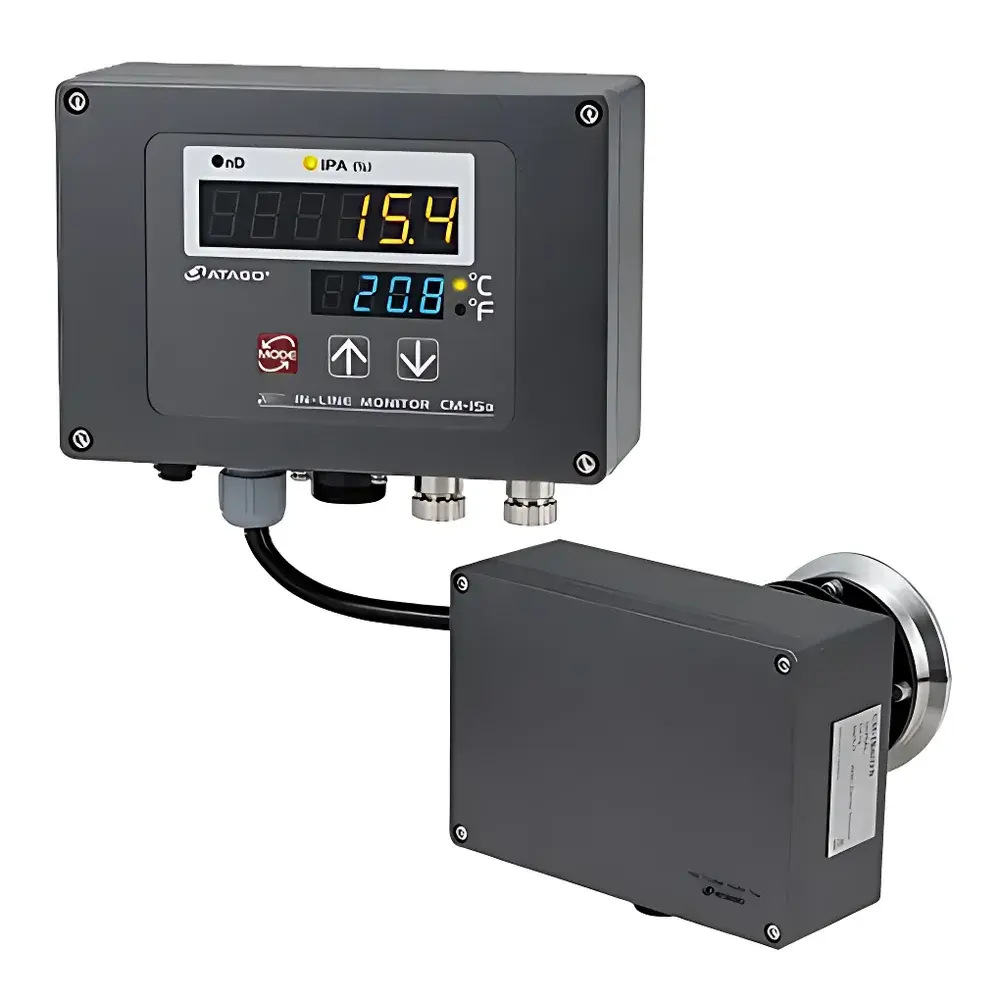
ATAGO CM-Isα-IPA Intrinsically Safe In-Line Refractometer for Isopropyl Alcohol (IPA) Concentration Monitoring
| Brand | ATAGO |
|---|---|
| Origin | Japan |
| Model | CM-Isα-IPA |
| Explosion Protection Rating | Ex ia IIB T3 Ga TA |
| Measurement Principle | Digital Refractometry |
| Application | Continuous In-Line IPA Aqueous Solution Concentration Monitoring |
| Compliance | ATEX/IECEx Certified for Zone 0/1 Hazardous Areas |
| Housing Material | 316L Stainless Steel |
| Process Connection | G1/2" or NPT 1/2" (customizable) |
| Operating Temperature Range | 0–80 °C (process fluid) |
| Pressure Rating | ≤1.0 MPa |
| Output Signal | 4–20 mA (HART optional), RS-485 (Modbus RTU), Ethernet/IP (optional) |
| Accuracy | ±0.1 wt% IPA (calibrated range: 0–100 wt%) |
| Repeatability | ±0.02 wt% IPA |
| Response Time (T90) | <3 seconds |
| IP Rating | IP67 |
Overview
The ATAGO CM-Isα-IPA is an intrinsically safe, in-line digital refractometer engineered specifically for continuous, real-time concentration monitoring of isopropyl alcohol (IPA) aqueous solutions in industrial process environments. Based on the fundamental optical principle of critical angle refractometry, the instrument measures the refractive index of the process stream and converts it—via factory-calibrated polynomial algorithms—into precise weight percent (wt%) IPA concentration values. Unlike offline titration or laboratory-based HPLC analysis, the CM-Isα-IPA delivers stable, drift-free measurements without sample extraction, reagent consumption, or operator intervention. Its solid-state optical design eliminates moving parts and optical alignment sensitivity, ensuring long-term stability under thermal cycling and mechanical vibration common in chemical manufacturing, semiconductor wet benches, and pharmaceutical cleaning-in-place (CIP) systems.
Key Features
- Intrinsically safe certification to Ex ia IIB T3 Ga TA per IEC 60079-0, -11 and EN 60079-0, -11 — approved for continuous operation in Zone 0 (gas group IIB, T3 temperature class) and Zone 1 hazardous locations.
- Optical sensing head with sapphire prism (Mohs hardness 9) in direct contact with process fluid, resistant to abrasion, corrosion, and IPA solvent attack.
- Integrated temperature compensation using dual Pt100 RTD sensors—one embedded in the prism base, one in the flow path—for accurate correction across 0–80 °C operating range.
- Modular electronics housing separable from the wetted sensor body, enabling maintenance without process shutdown or fluid isolation.
- Configurable analog output (4–20 mA with HART 7.5 protocol) and digital interfaces including RS-485 (Modbus RTU) and optional EtherNet/IP for integration into DCS, SCADA, or MES platforms.
- Self-diagnostics with continuous monitoring of LED intensity, photodiode response, prism fouling detection, and internal thermal drift alerts.
Sample Compatibility & Compliance
The CM-Isα-IPA is validated for homogeneous, non-particulate, optically transparent IPA–water mixtures within the full 0–100 wt% concentration range. It is not intended for suspensions, emulsions, or solutions containing >5 ppm suspended solids, as these may cause prism coating or measurement scatter. The device complies with ISO 21501-4 for optical particle-free verification methodology and meets the metrological traceability requirements of ISO/IEC 17025 when used with ATAGO’s certified calibration standards (NIST-traceable sucrose and IPA reference solutions). For regulated industries, the firmware supports audit trail logging and user-access control aligned with FDA 21 CFR Part 11 principles (electronic signatures, change history, and data integrity safeguards), making it suitable for GMP-compliant pharmaceutical IPA rinse validation and semiconductor fab chemical delivery systems.
Software & Data Management
The CM-Isα-IPA operates with ATAGO’s proprietary ProcessLink™ configuration software (Windows-based, USB or Ethernet connectivity), enabling field calibration, span adjustment, linearization coefficient tuning, and alarm threshold setup. All configuration changes are timestamped and logged with user ID attribution. Process data—including concentration, temperature, signal quality index, and diagnostic status—is streamed continuously and can be archived via OPC UA servers or MQTT brokers. Optional cloud-enabled gateways support secure TLS 1.2 transmission to IIoT platforms for predictive maintenance analytics, such as trend-based prism contamination forecasting or calibration interval optimization based on historical stability metrics.
Applications
- Real-time concentration control in IPA recovery and recycling loops within electronics manufacturing (e.g., wafer drying, photoresist stripping).
- Automated endpoint detection during IPA-based CIP cycles in biopharmaceutical stainless-steel piping systems.
- Concentration verification in bulk IPA blending stations prior to packaging or distribution.
- Continuous monitoring of IPA content in disinfectant formulation lines (e.g., WHO-recommended 75% IPA solutions) to ensure compliance with pharmacopeial specifications (USP , EP 2.2.42).
- Interface detection between IPA and water phases in decantation or distillation feed streams.
FAQ
Does the CM-Isα-IPA require periodic recalibration?
Yes—recommended at intervals defined by process criticality and regulatory requirements (typically every 3–6 months); calibration uses traceable IPA standard solutions and is fully documented within ProcessLink™.
Can it measure IPA in the presence of other solvents (e.g., ethanol or acetone)?
No—the factory calibration is specific to binary IPA–water systems; multi-solvent mixtures require custom modeling and are outside the certified accuracy specification.
Is cleaning required, and how is prism fouling detected?
Sapphire prism fouling is identified via real-time photodiode signal attenuation and reflected light intensity deviation; automated cleaning cycles can be triggered via PLC interface when fouling thresholds are exceeded.
What certifications validate its use in pharmaceutical clean utilities?
It carries CE marking, ATEX Category 1G, IECEx Zone 0 approval, and supports 21 CFR Part 11-compliant data handling when deployed with enabled firmware options and controlled access protocols.