
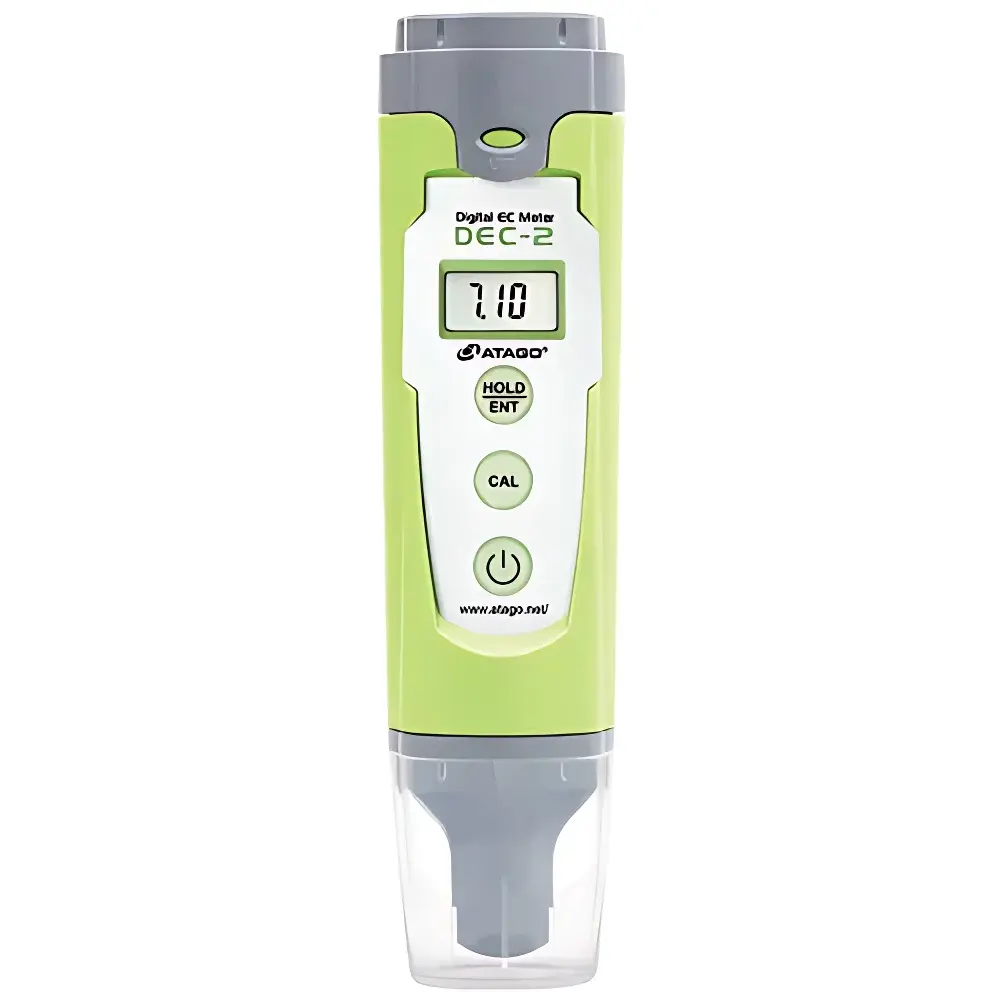
ATAGO DEC-2 Portable Digital Conductivity Meter
| Brand | ATAGO |
|---|---|
| Origin | Japan |
| Model | DEC-2 Portable Digital Conductivity Meter |
| Measurement Range | 0.0–19.9 mS/cm |
| Resolution | 0.1 mS/cm |
| Accuracy | ±0.2 mS/cm (0.0–10.0 mS/cm), ±0.4 mS/cm (10.1–19.9 mS/cm) |
| Temperature Range | 0.0–50.0 °C with Automatic Temperature Compensation (ATC) |
| IP Rating | IP67 |
| Power | 4 × LR44 button cells |
| Dimensions | 4.5 × 3.0 × 16.3 cm |
| Weight | 90 g (without accessories) |
Overview
The ATAGO DEC-2 Portable Digital Conductivity Meter is a compact, field-deployable electrochemical instrument engineered for rapid, reliable measurement of electrical conductivity in aqueous and ionically conductive solutions. Based on the principle of two-electrode AC conductivity measurement, the DEC-2 applies a low-frequency alternating current across its integrated stainless-steel sensor electrodes to minimize polarization effects and electrode fouling—ensuring stable readings even in mildly contaminated or viscous samples. Its built-in automatic temperature compensation (ATC) algorithm conforms to the standard linear temperature coefficient of 2.0 %/°C (adjustable per user-defined solution type), referenced to 25 °C, enabling traceable and reproducible results across ambient conditions from 0.0 to 50.0 °C. Designed for operational robustness rather than laboratory benchtop use, the DEC-2 delivers calibrated performance without requiring recalibration between routine measurements—making it particularly suitable for quality control checkpoints, process monitoring, and environmental screening where portability and repeatability are critical.
Key Features
- IP67-rated enclosure ensures full dust ingress protection and immersion resistance up to 1 meter for 30 minutes—enabling direct rinsing under tap water or submersion during field sampling without risk of damage.
- Integrated dual-stainless-steel electrode probe with fixed cell constant (K = 1.0 cm⁻¹), optimized for general-purpose applications including food brines, alkaline cleaning solutions, and agricultural leachates.
- Real-time ATC functionality with thermistor-based temperature sensing; no manual input required—the device auto-compensates and displays conductivity values normalized to 25 °C.
- Factory-calibrated using a certified 0.71 g/100 g NaCl reference solution (equivalent to ~1.00 mS/cm at 25 °C), traceable to JIS Z 8000 and ISO/IEC 17025-accredited standards.
- Low-power architecture powered by four LR44 alkaline button cells, providing >5,000 measurement cycles per battery set; auto-power-off after 10 minutes of inactivity.
- Ergonomic handheld form factor (4.5 × 3.0 × 16.3 cm, 90 g) with tactile rubberized grip and large backlit LCD for legibility under variable lighting conditions.
Sample Compatibility & Compliance
The DEC-2 is validated for use with homogeneous, non-aerated, low-viscosity aqueous electrolytes—including sodium chloride solutions, caustic soda (NaOH) cleaners, brewing wort, hydroponic nutrient reservoirs, soil extract solutions (e.g., saturated paste extracts), and metalworking fluid sumps. It is not intended for highly oxidizing media (e.g., concentrated HNO₃), organic solvents, or suspensions containing particulates >50 µm. While not certified for hazardous area operation (ATEX/IECEx), its IP67 rating supports compliance with IEC 60529 for ingress protection and aligns with GLP documentation requirements when used within defined SOPs. The instrument meets electromagnetic compatibility (EMC) requirements per EN 61326-1:2013 for laboratory and industrial environments.
Software & Data Management
The DEC-2 operates as a standalone, firmware-embedded instrument with no onboard data logging or PC connectivity. All measurements are displayed in real time and retained only until the next reading or power cycle. For audit-trail integrity in regulated environments (e.g., food safety HACCP plans or ISO 22000-compliant facilities), users are advised to record readings manually into bound logbooks or integrate the DEC-2 into digital QA workflows via external mobile capture (e.g., barcode-scanned timestamped entries). Though lacking FDA 21 CFR Part 11-compliant electronic signatures or audit trails, its calibration stability and documented factory traceability support validation under ISO/IEC 17025 Clause 6.4 and ASTM D1125–22 Annex A1 for conductivity instrumentation.
Applications
- Food & Beverage: Monitoring salt concentration in pickling brines, soy sauce fermentation tanks, and dairy whey processing streams.
- Brewing & Distilling: Quick verification of mash conductivity pre-boil and post-fermentation residual sugar estimation via ionic strength correlation.
- Agriculture & Environmental: Field assessment of soil salinity (ECₑ) using 1:5 soil:water extracts; rapid screening of irrigation water quality.
- Industrial Cleaning: Verification of alkaline cleaner concentration in CIP circuits to ensure efficacy while avoiding over-dosing and corrosion risk.
- Metalworking: Routine checks of soluble oil emulsion concentration in CNC coolant sumps to maintain lubricity and prevent microbial growth.
FAQ
What is the cell constant of the DEC-2 sensor?
The DEC-2 employs a fixed-cell-constant electrode with K = 1.0 cm⁻¹, optimized for mid-range conductivity measurements (0.1–20 mS/cm) in routine industrial and environmental applications.
Can the DEC-2 measure total dissolved solids (TDS)?
No—it reports conductivity only. TDS estimation requires application-specific conversion factors (e.g., 0.64 for NaCl solutions); the DEC-2 does not perform internal TDS calculation or display.
Is calibration required before each use?
Factory calibration is stable under normal handling. ATAGO recommends verification with a standard solution (e.g., 1.41 mS/cm KCl at 25 °C) before critical measurements or after mechanical shock, but routine recalibration is not necessary for daily QC use.
Does the DEC-2 comply with ISO or ASTM conductivity standards?
While not a certified reference instrument, its measurement methodology and accuracy specification conform to the performance criteria outlined in ASTM D1125–22 and ISO 7888:2015 for portable conductivity meters used in field and process applications.
How often should batteries be replaced?
Under typical usage (≤50 measurements/day), four LR44 cells last approximately 12–18 months; low-battery indication appears as a flashing “BATT” icon on the LCD.




