
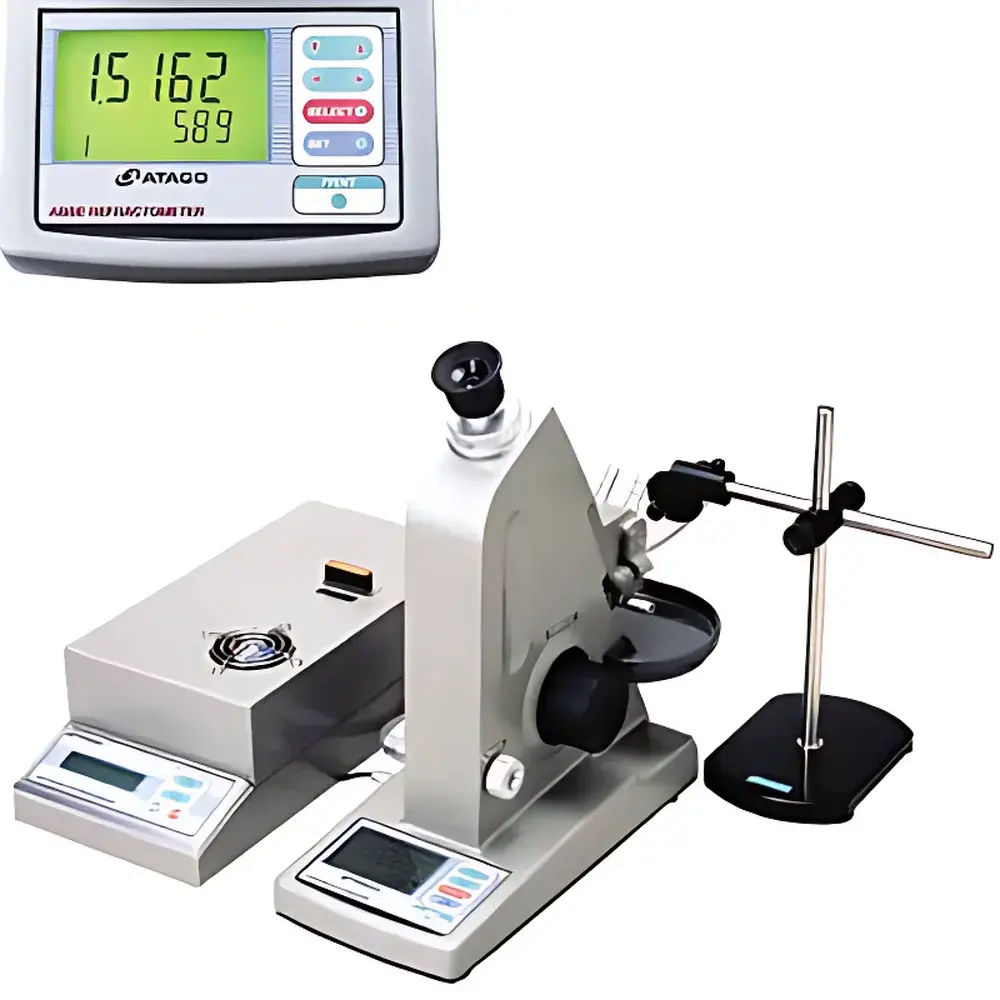
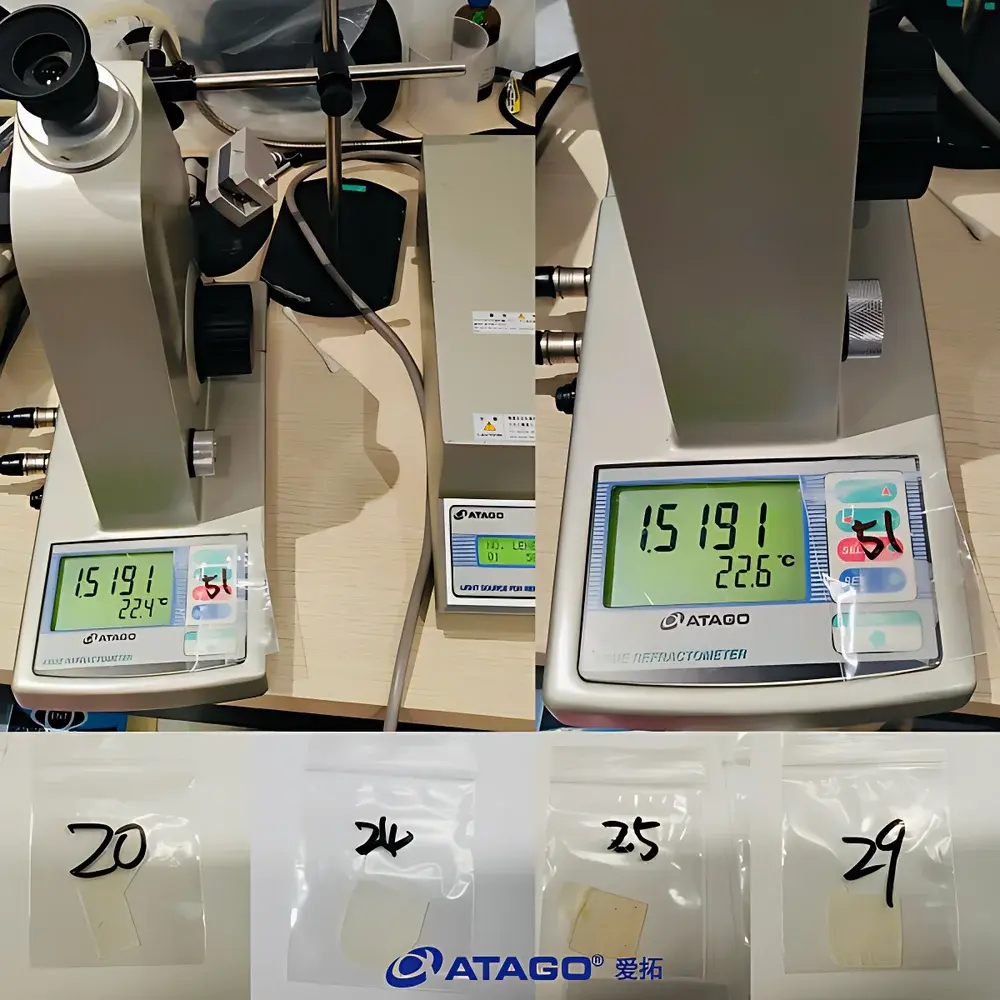
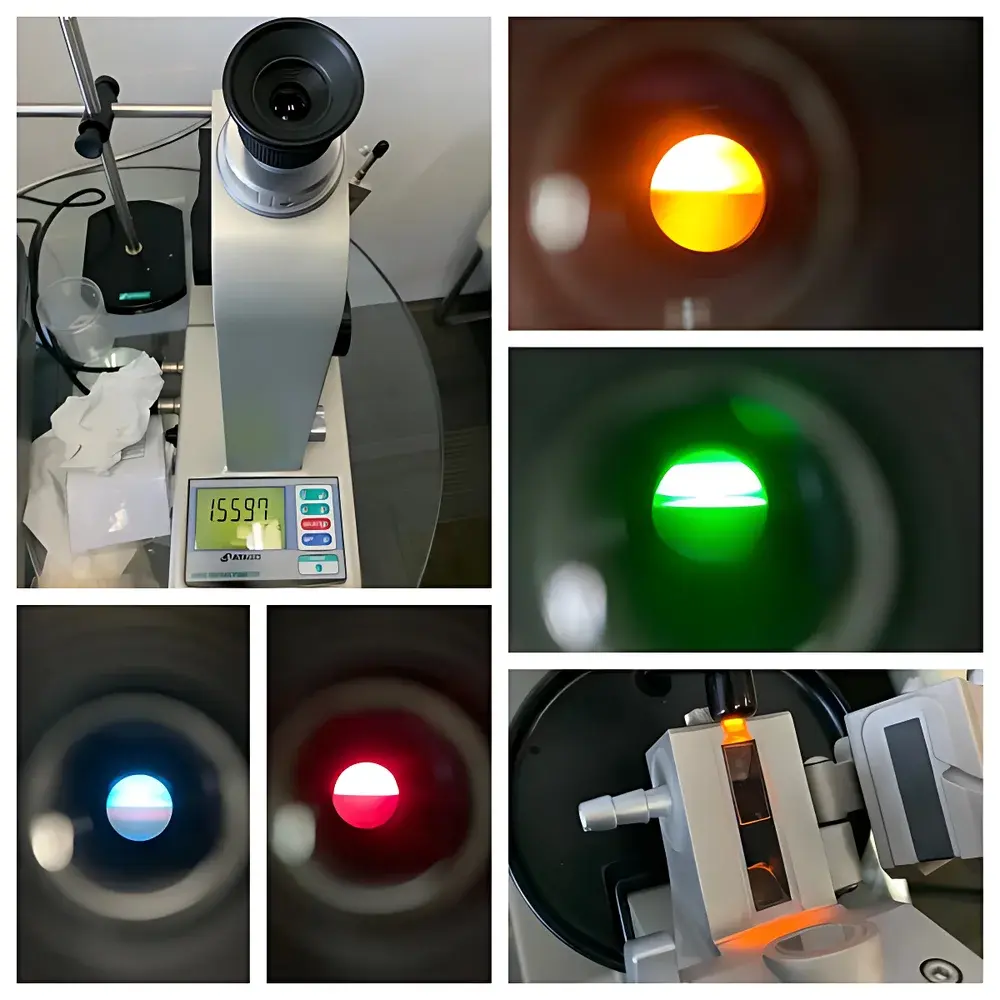
ATAGO DR-M2/M4 Multi-Wavelength Abbe Refractometer
| Brand | ATAGO |
|---|---|
| Origin | Japan |
| Model | DR-M2/M4 Multi-Wavelength Abbe Refractometer |
| Type | Benchtop Refractometer |
| Temperature Control | Yes |
| Digital Display | Yes |
| Refractive Index Range | 1.3278–1.7379 (DR-M2 at 450 nm) |
| Refractive Index Resolution | 0.0001 |
| Refractive Index Accuracy | ±0.0002 (with 500–650 nm test plates) |
| Wavelength Range | 450–1100 nm (interference filter-equipped) |
| Measurement Temperature Range | 5–50 °C |
| Light Source | Halogen lamp |
| Power Supply | AC 100–240 V, 50/60 Hz |
| Dimensions (main unit) | 13 × 29 × 31 cm |
| Weight (main unit) | 6.0 kg |
Overview
The ATAGO DR-M2 and DR-M4 Multi-Wavelength Abbe Refractometers are precision benchtop instruments engineered for high-accuracy, wavelength-dependent refractive index (nD) and Abbe number (vD) measurement across the visible to near-infrared spectrum. Based on classical Abbe refractometry—utilizing total internal reflection at a prism-sample interface—the system employs interchangeable interference filters to isolate discrete wavelengths from 450 nm to 1100 nm. This enables spectral dispersion analysis critical for optical material characterization, including lens-grade glasses, optical polymers, semiconductor thin films, and advanced photonic coatings. Unlike single-wavelength refractometers, the DR-M2/M4 series delivers full spectral n(λ) curves, supporting compliance with ISO 7884-6 (optical glass), ASTM E131 (terminology in molecular spectroscopy), and JIS K 0051 (refractive index testing methods). The integrated Peltier-assisted temperature control (5–50 °C) ensures thermal stability within ±0.1 °C, minimizing thermo-optic drift during sequential multi-wavelength acquisition.
Key Features
- Multi-wavelength capability: Precise refractive index and Abbe number determination at user-selectable wavelengths—450 nm, 589 nm (sodium D-line), 680 nm, and up to 1100 nm—using certified interference filters.
- Dual-model configuration: DR-M2 optimized for standard optical materials (e.g., BK7, SF10, fused silica); DR-M4 extends range to high-refractive-index materials (e.g., lanthanum crown, dense flint, chalcogenide glasses).
- High-resolution digital readout: 0.0001 resolution for nD, 0.1 for vD, with ±0.0002 accuracy validated per ISO 10477 using NIST-traceable calibration standards (500–650 nm test plates).
- Thermostatically controlled sample stage: Built-in Peltier element maintains sample temperature within ±0.1 °C over the full 5–50 °C operating range—essential for temperature-sensitive polymers and liquid crystals.
- Ergonomic optical design: Ergonomically angled viewing eyepiece; optional NIR viewing eyepiece (ATAGO Cat. No. 1415) required for wavelengths ≥681 nm to ensure safe and accurate visual alignment.
- Benchtop robustness: All-metal housing, vibration-damped base, and halogen broadband illumination ensure long-term mechanical and photometric stability under laboratory or QC floor conditions.
Sample Compatibility & Compliance
The DR-M2/M4 accommodates solid samples (polished wafers, prisms, lenses) and liquids (optical oils, monomers, sol-gel precursors) with refractive indices spanning 1.3278–1.9220. Sample contact is limited to the sapphire prism surface (hardness 9 Mohs), resistant to scratching by most optical materials. Instruments comply with IEC 61010-1 (safety requirements for electrical equipment) and meet electromagnetic compatibility (EMC) requirements per EN 61326-1. Data integrity aligns with GLP/GMP principles: all measurements include timestamped metadata (wavelength, temperature, operator ID if integrated with LIMS), and optional printer output provides auditable hardcopy records traceable to calibration certificates.
Software & Data Management
While the DR-M2/M4 operates as a standalone instrument with direct digital display, optional RS-232 or USB interface enables integration with custom or third-party data acquisition software. Exported datasets include wavelength (nm), n(λ), v(λ), temperature (°C), and measurement timestamp—formatted as CSV for import into MATLAB, OriginLab, or Python-based optical modeling environments (e.g., PyOptica, scikit-learn regression for Cauchy/Lorentz dispersion fitting). For regulated environments, the system supports 21 CFR Part 11-compliant audit trails when paired with validated laboratory information management systems (LIMS) that enforce electronic signature, role-based access, and immutable record retention.
Applications
- Optical material R&D: Dispersion curve generation (n vs. λ) for designing achromatic doublets, anti-reflective coatings, and gradient-index lenses.
- Semiconductor & photovoltaics: Characterization of spin-on glass (SOG), photoresist refractive indices pre-/post-bake, and thin-film stack modeling.
- Biomedical optics: Refractive index mapping of hydrogels, contact lens materials, and tissue-mimicking phantoms across therapeutic laser wavelengths (e.g., 808 nm, 1064 nm).
- Quality assurance in optics manufacturing: Incoming inspection of optical blanks against MIL-PRF-174B or ISO 10110-2 specifications.
- Academic research: Teaching fundamental optics (Cauchy’s equation, Sellmeier coefficients) and validating computational electromagnetics simulations (FDTD, RCWA).
FAQ
What is the difference between the DR-M2 and DR-M4 models?
The DR-M2 is calibrated for lower-to-mid refractive index materials (1.3278–1.7379 at 450 nm), while the DR-M4 extends the upper limit to 1.9220 at 450 nm—enabling characterization of high-index optical glasses, heavy flints, and infrared-transmitting chalcogenides.
Is temperature control mandatory for accurate measurement?
Yes. Refractive index exhibits strong thermo-optic dependence (dn/dT ≈ 1×10⁻⁴ /°C for most glasses). The integrated Peltier system stabilizes prism and sample temperature to ±0.1 °C, meeting ISO 7884-6 repeatability requirements.
Can the instrument measure beyond 1100 nm?
No. The optical path and detector sensitivity are specified up to 1100 nm. For mid-IR applications (e.g., 3–5 µm), FTIR-based ellipsometry or dedicated IR refractometers are recommended.
How is calibration performed and how often is it required?
Calibration uses NIST-traceable reference standards (e.g., SF10 glass blocks, water at 20 °C) and should be verified daily in production environments or before each measurement series in R&D; full recalibration is recommended annually or after mechanical shock.
Does the system support automated wavelength scanning?
No. Wavelength selection is manual via filter wheel insertion; however, sequential measurements at discrete wavelengths can be scripted externally via serial command protocol for semi-automated workflows.





