
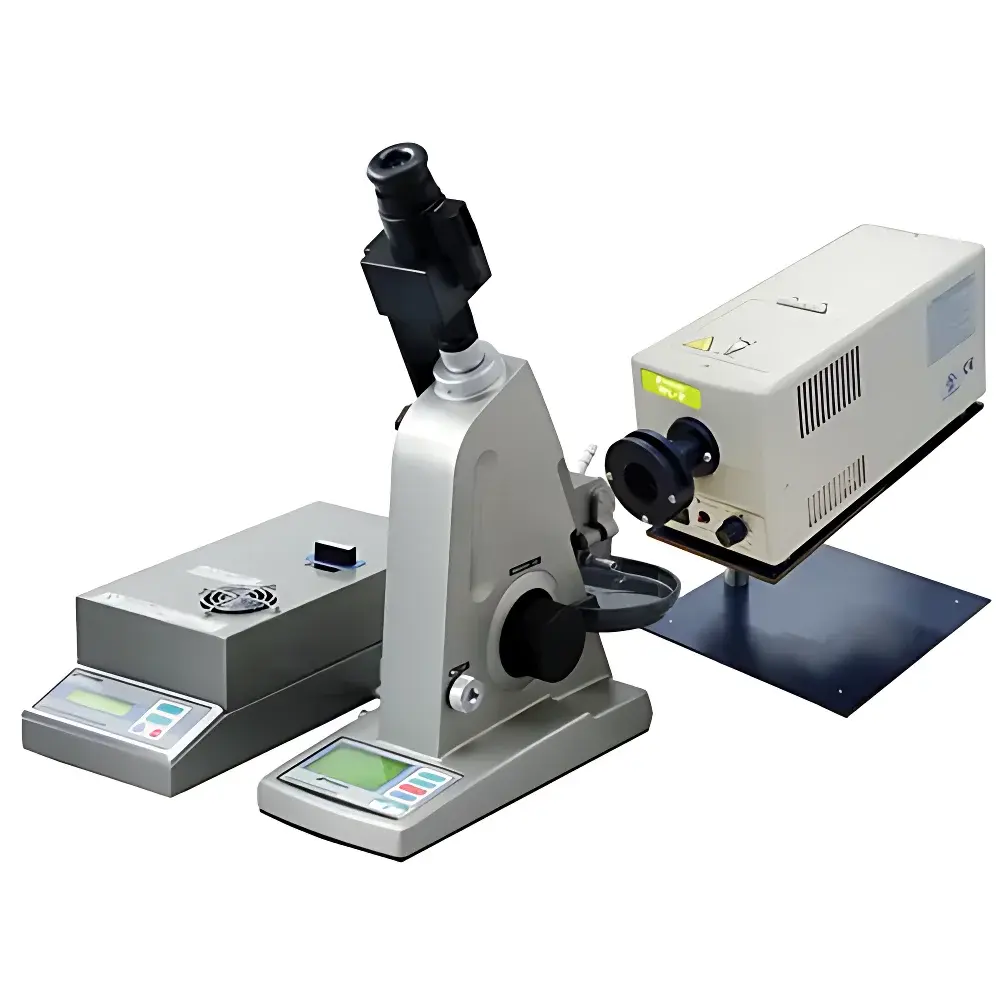
ATAGO DR-M4 (1550) Multi-Wavelength Abbe Refractometer
| Brand | ATAGO |
|---|---|
| Origin | Japan |
| Model | DR-M4 (1550) |
| Type | Benchtop Abbe Refractometer |
| Display | Digital |
| Temperature Control | None |
| Refractive Index Range | 1.5219–1.9220 |
| Measurement Accuracy | ±0.0002 |
| Wavelength Capability | 1550 nm (NIR), compatible with optional NIR viewing eyepiece (681–1100 nm conversion) |
Overview
The ATAGO DR-M4 (1550) Multi-Wavelength Abbe Refractometer is a precision optical instrument engineered for high-accuracy refractive index measurement of optically dense, highly dispersive, or infrared-transparent materials—particularly those opaque or non-transmissive in the visible spectrum. Unlike conventional Abbe refractometers limited to sodium D-line (589.3 nm) illumination, the DR-M4 (1550) integrates a stabilized 1550 nm near-infrared (NIR) light source, enabling direct measurement through substrates such as borosilicate glass, fused silica, polymer films (e.g., PET, PC, PMMA), and encapsulated liquid crystal cells without sample extraction or surface polishing. Its optical architecture adheres to the classical Abbe principle—utilizing total internal reflection at the prism-sample interface—but extends functionality via wavelength-selective collimated beam delivery and high-resolution angular detection of the critical angle. This design supports fundamental material characterization in advanced optoelectronics, where dispersion modeling, birefringence calibration, and thin-film stack verification require spectral flexibility beyond visible wavelengths.
Key Features
- Fixed-wavelength 1550 nm NIR light source with thermally stabilized diode laser output, ensuring long-term spectral stability and minimal drift (<0.05 nm/°C)
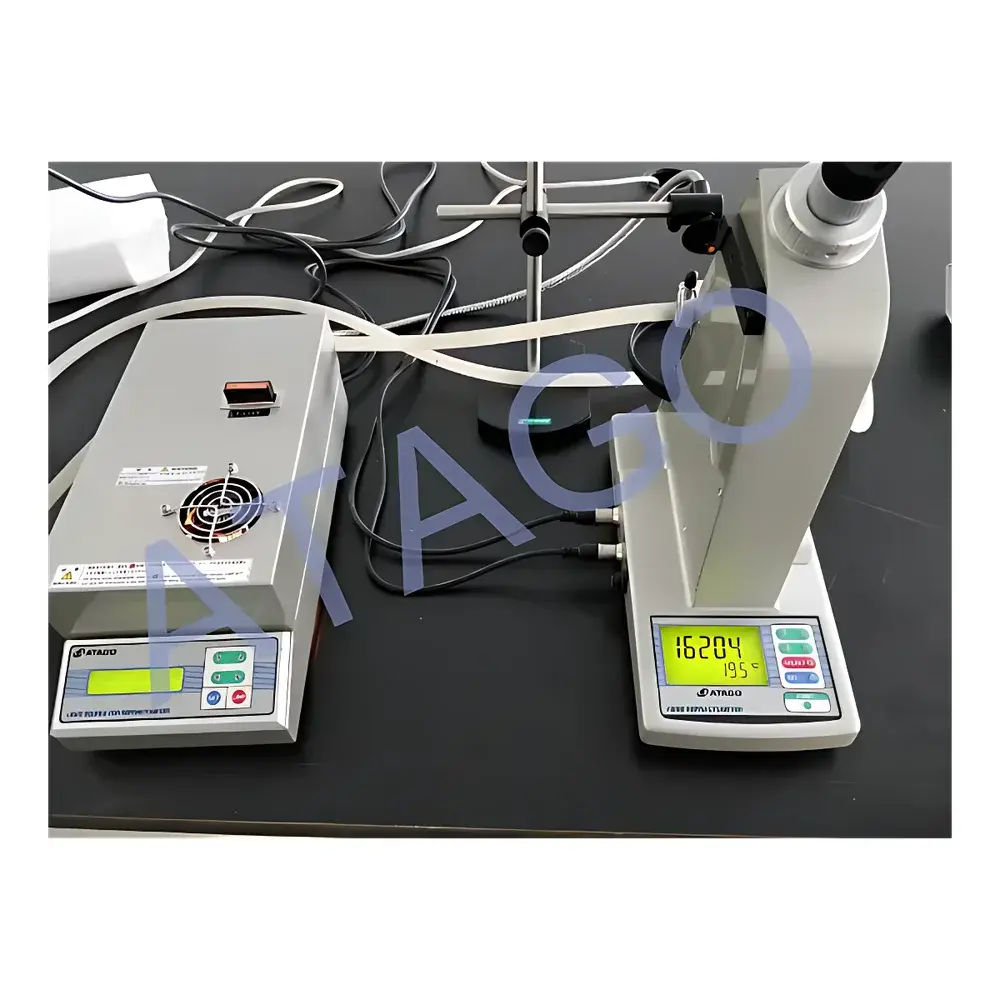
- Digital readout with 0.0001 resolution and ±0.0002 absolute accuracy across the full range (nD = 1.5219–1.9220), traceable to NIST-traceable reference standards
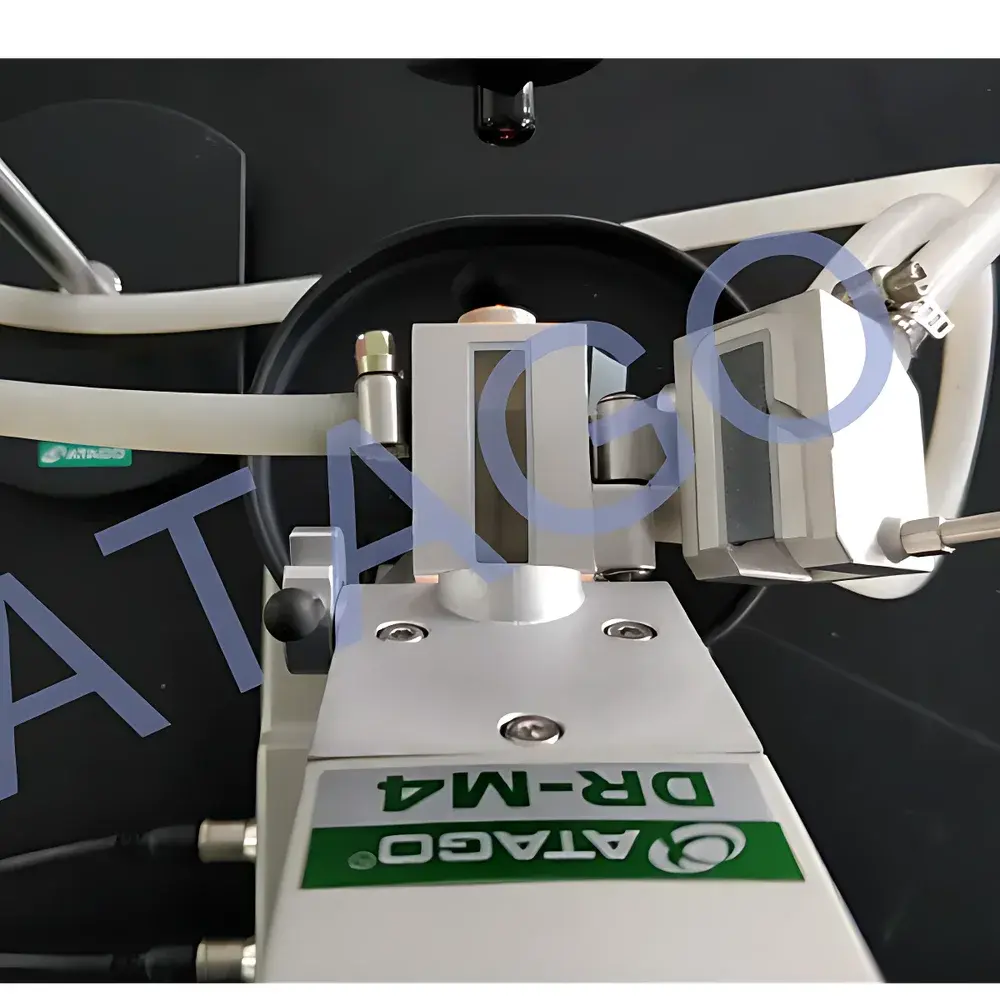
- Integrated Abbe-type double-prism system with sapphire contact surface for enhanced durability and chemical resistance
- No external temperature control unit required; optimized for ambient laboratory operation (15–30 °C), with real-time thermal compensation algorithm embedded in firmware
- Modular optical path design accommodating optional NIR viewing eyepiece (model V-EYEP-1550) for manual alignment verification under 681–1100 nm converted visible green light (520 nm peak emission)
- Compact benchtop footprint (240 × 180 × 220 mm) with ESD-safe anodized aluminum housing and CE-compliant electromagnetic shielding
Sample Compatibility & Compliance
The DR-M4 (1550) is validated for use with solid, semi-solid, and viscous liquid samples exhibiting low visible transmission but measurable NIR transmittance—including liquid crystal mixtures (ne/no anisotropy mapping), optical adhesives, photoresists, silicones, and multilayer dielectric coatings. It complies with ISO 17025 requirements for refractometric testing when operated within defined environmental conditions and calibrated using certified reference oils (e.g., Cargille Series A, n = 1.5000–1.9000). While not designed for regulated GMP environments requiring 21 CFR Part 11 audit trails, its measurement records support GLP documentation when paired with ATAGO’s optional RS-232 data logging interface and timestamped CSV export.
Software & Data Management
The instrument operates autonomously without host PC dependency. All measurements are stored internally (up to 1000 readings) with timestamp, operator ID field (user-defined), and wavelength flag (1550 nm). Optional connectivity includes RS-232 serial output for integration into LIMS or custom QA databases; ASCII-formatted output includes nD, date/time, and instrument serial number. Firmware supports user-configurable pass/fail thresholds and statistical summary (mean, SD, min/max) per batch. No proprietary software installation is required—raw data is directly importable into Excel, MATLAB, or JMP for dispersion curve fitting (Sellmeier equation modeling) or QC SPC charting.
Applications
- Characterization of liquid crystal director alignment and birefringence in TFT-LCD and OLED display R&D
- Refractive index profiling of optical waveguides, fiber preforms, and photonic crystal substrates
- In-process verification of anti-reflective coating uniformity on semiconductor wafers and solar cells
- Quality control of high-index optical adhesives (e.g., NOA61, UV-curable epoxies) used in micro-optics assembly
- Material screening for IR lens design (Ge, ZnSe, Chalcogenide glasses) where visible-light refractometry fails
- Academic research in soft matter physics, particularly polymer-dispersed liquid crystal (PDLC) phase behavior analysis
FAQ
What is the primary advantage of using 1550 nm instead of visible wavelengths?
1550 nm light penetrates many optically opaque materials—such as tinted glass, carbon-filled polymers, and liquid crystal cells with polarizer stacks—that block visible light, enabling non-destructive, in-situ measurement without disassembly.
Can the DR-M4 (1550) measure birefringent samples?
Yes—when combined with a rotatable sample stage and polarization filter accessory (sold separately), it supports ordinary (no) and extraordinary (ne) index determination for uniaxial crystals and aligned LC phases.
Is calibration required before each measurement?
No—factory calibration remains stable for ≥12 months under normal lab conditions; however, daily verification using a certified reference standard (e.g., n = 1.7500 oil) is recommended for critical applications.
Does the instrument meet ISO or ASTM standards for refractometry?
It conforms to the optical geometry and uncertainty budget requirements of ISO 21147:2021 (Abbe refractometers) and supports method validation per ASTM D1218 for hydrocarbon refractive index, though specific NIR wavelength protocols are user-defined.
Why is the NIR viewing eyepiece image rendered in green?
The phosphor-coated eyepiece converts incident NIR photons into visible light peaking at 520 nm (green), leveraging human photopic vision’s highest luminous efficacy (683 lm/W) for optimal low-light contrast perception during manual alignment.




